

Department of Physics. After graduation in 1906, he continued his studies at
Nagaoka’s laboratory. In the following year he married Hashimoto Itsuko (橋元逸
子). They had three children together. In 1908, he was appointed lecturer of physics
at the Military Academy of the Army. In those days, his interest was directed at
Einstein’s relativity, and his first work, in 1909, was on optics in a moving medium
(Ishiwara 1909).
Einstein’s relativity was based on two presuppositions: (a) the relativity of motion
and (b) the constant velocity of light. Ishiwara began to work on relativity based on
the first presupposition. He studied optical phenomena, such as the Doppler effect,
the dispersion and absorption of light, and radiation density in optical spectra from
the viewpoint of relativity. However, he could not accept presupposition (b), since
he thought that the velocity of light might change in a moving medium (Fig. 5.2).
In 1911, he moved to Sendai as an associate professor of physics at Tohoku
Imperial University. Half a year later, he was sent to Europe by the government for
3 years. He studied theoretical physics under, successively, Arnold Sommerfeld at
Munich, Max Planck at Berlin, and Albert Einstein at Zürich.
In Sendai, he was promoted to professor after returning from Europe. He began to
work on quantum theory. He proposed the generalized quantum condition at the
same time as A. Sommerfeld and W. Wilson, along with some theoretical models of
hydrogen and helium nuclei (Ishiwara 1915, 1916).
With his works on relativity and quantum physics, he was recognized by the
Japan Academy in 1919.
Ishiwara was known as a waka poet for his waka anthologies from his student
days. In 1917–1919, he fell in love with Hara Asao (原 阿佐緒), a painter as well as
a fellow waka poet. Due to this love affair he was suspended from the university.
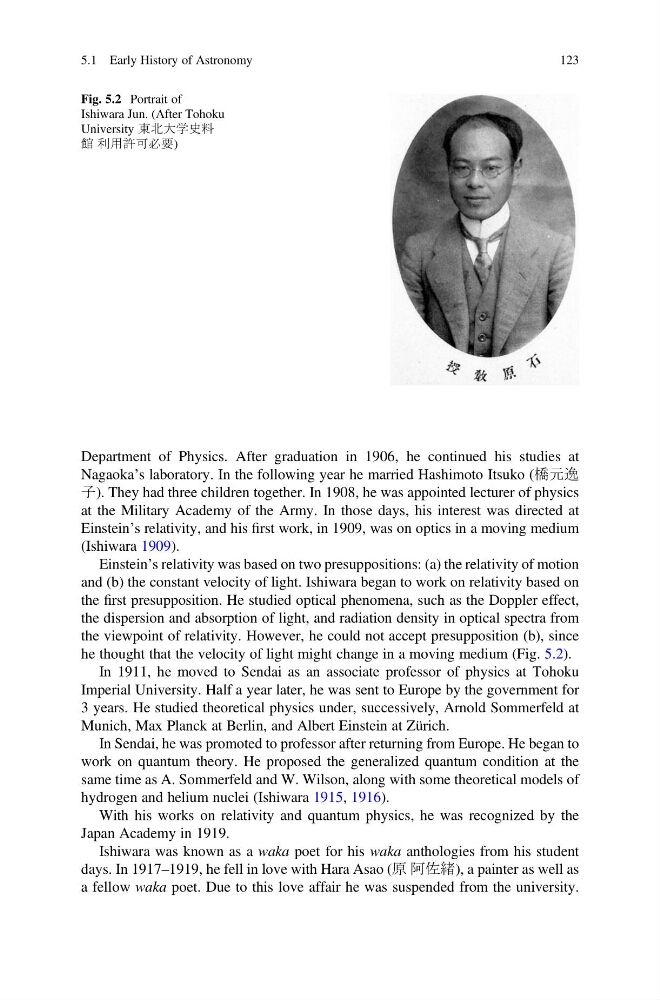
Fig. 5.2 Portrait of
Ishiwara Jun. (After Tohoku
University 東北大学史料
館 利用許可必要)
5.1 Early History of Astronomy
123
Nagaoka’s laboratory. In the following year he married Hashimoto Itsuko (橋元逸
子). They had three children together. In 1908, he was appointed lecturer of physics
at the Military Academy of the Army. In those days, his interest was directed at
Einstein’s relativity, and his first work, in 1909, was on optics in a moving medium
(Ishiwara 1909).
Einstein’s relativity was based on two presuppositions: (a) the relativity of motion
and (b) the constant velocity of light. Ishiwara began to work on relativity based on
the first presupposition. He studied optical phenomena, such as the Doppler effect,
the dispersion and absorption of light, and radiation density in optical spectra from
the viewpoint of relativity. However, he could not accept presupposition (b), since
he thought that the velocity of light might change in a moving medium (Fig. 5.2).
In 1911, he moved to Sendai as an associate professor of physics at Tohoku
Imperial University. Half a year later, he was sent to Europe by the government for
3 years. He studied theoretical physics under, successively, Arnold Sommerfeld at
Munich, Max Planck at Berlin, and Albert Einstein at Zürich.
In Sendai, he was promoted to professor after returning from Europe. He began to
work on quantum theory. He proposed the generalized quantum condition at the
same time as A. Sommerfeld and W. Wilson, along with some theoretical models of
hydrogen and helium nuclei (Ishiwara 1915, 1916).
With his works on relativity and quantum physics, he was recognized by the
Japan Academy in 1919.
Ishiwara was known as a waka poet for his waka anthologies from his student
days. In 1917–1919, he fell in love with Hara Asao (原 阿佐緒), a painter as well as
a fellow waka poet. Due to this love affair he was suspended from the university.
Fig. 5.2 Portrait of
Ishiwara Jun. (After Tohoku
University 東北大学史料
館 利用許可必要)
5.1 Early History of Astronomy
123