

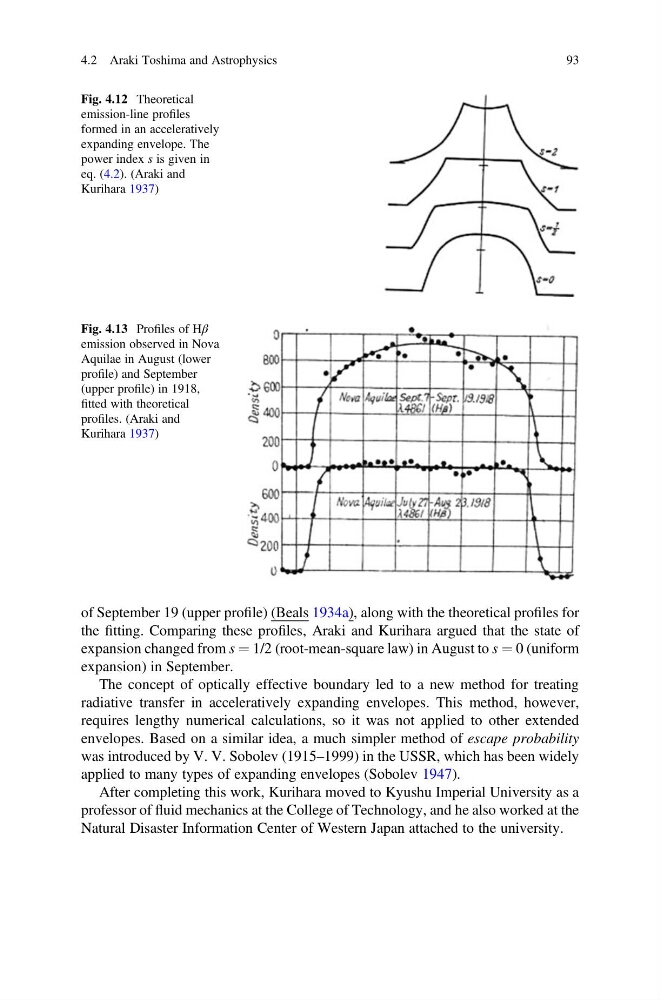
of September 19 (upper profile) (Beals 1934a), along with the theoretical profiles for
the fitting. Comparing these profiles, Araki and Kurihara argued that the state of
expansion changed from s ¼ 1/2 (root-mean-square law) in August to s ¼ 0 (uniform
expansion) in September.
The concept of optically effective boundary led to a new method for treating
radiative transfer in acceleratively expanding envelopes. This method, however,
requires lengthy numerical calculations, so it was not applied to other extended
envelopes. Based on a similar idea, a much simpler method of escape probability
was introduced by V. V. Sobolev (1915–1999) in the USSR, which has been widely
applied to many types of expanding envelopes (Sobolev 1947).
After completing this work, Kurihara moved to Kyushu Imperial University as a
professor of fluid mechanics at the College of Technology, and he also worked at the
Natural Disaster Information Center of Western Japan attached to the university.
Fig. 4.12 Theoretical
emission-line profiles
formed in an acceleratively
expanding envelope. The
power index s is given in
eq. (4.2). (Araki and
Kurihara 1937)
Fig. 4.13 Profiles of Hβ
emission observed in Nova
Aquilae in August (lower
profile) and September
(upper profile) in 1918,
fitted with theoretical
profiles. (Araki and
Kurihara 1937)
4.2 Araki Toshima and Astrophysics
93
the fitting. Comparing these profiles, Araki and Kurihara argued that the state of
expansion changed from s ¼ 1/2 (root-mean-square law) in August to s ¼ 0 (uniform
expansion) in September.
The concept of optically effective boundary led to a new method for treating
radiative transfer in acceleratively expanding envelopes. This method, however,
requires lengthy numerical calculations, so it was not applied to other extended
envelopes. Based on a similar idea, a much simpler method of escape probability
was introduced by V. V. Sobolev (1915–1999) in the USSR, which has been widely
applied to many types of expanding envelopes (Sobolev 1947).
After completing this work, Kurihara moved to Kyushu Imperial University as a
professor of fluid mechanics at the College of Technology, and he also worked at the
Natural Disaster Information Center of Western Japan attached to the university.
Fig. 4.12 Theoretical
emission-line profiles
formed in an acceleratively
expanding envelope. The
power index s is given in
eq. (4.2). (Araki and
Kurihara 1937)
Fig. 4.13 Profiles of Hβ
emission observed in Nova
Aquilae in August (lower
profile) and September
(upper profile) in 1918,
fitted with theoretical
profiles. (Araki and
Kurihara 1937)
4.2 Araki Toshima and Astrophysics
93