

2.2 Passive Micromixers
31
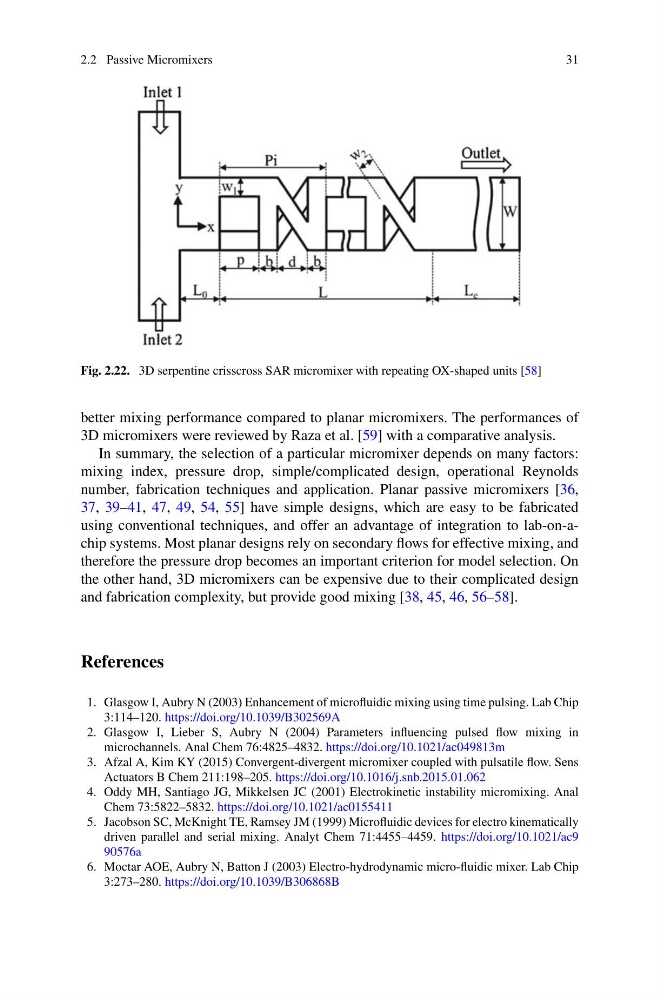
Fig. 2.22. 3D serpentine crisscross SAR micromixer with repeating OX-shaped units [58]
better mixing performance compared to planar micromixers. The performances of
3D micromixers were reviewed by Raza et al. [59] with a comparative analysis.
In summary, the selection of a particular micromixer depends on many factors:
mixing index, pressure drop, simple/complicated design, operational Reynolds
number, fabrication techniques and application. Planar passive micromixers [36,
37, 39–41, 47, 49, 54, 55] have simple designs, which are easy to be fabricated
using conventional techniques, and offer an advantage of integration to lab-on-achip systems. Most planar designs rely on secondary flows for effective mixing, and
therefore the pressure drop becomes an important criterion for model selection. On
the other hand, 3D micromixers can be expensive due to their complicated design
and fabrication complexity, but provide good mixing [38, 45, 46, 56–58].
References
1. Glasgow I, Aubry N (2003) Enhancement of microfluidic mixing using time pulsing. Lab Chip
3:114–120. https://doi.org/10.1039/B302569A
2. Glasgow I, Lieber S, Aubry N (2004) Parameters influencing pulsed flow mixing in
microchannels. Anal Chem 76:4825–4832. https://doi.org/10.1021/ac049813m
3. Afzal A, Kim KY (2015) Convergent-divergent micromixer coupled with pulsatile flow. Sens
Actuators B Chem 211:198–205. https://doi.org/10.1016/j.snb.2015.01.062
4. Oddy MH, Santiago JG, Mikkelsen JC (2001) Electrokinetic instability micromixing. Anal
Chem 73:5822–5832. https://doi.org/10.1021/ac0155411
5. Jacobson SC, McKnight TE, Ramsey JM (1999) Microfluidic devices for electro kinematically
driven parallel and serial mixing. Analyt Chem 71:4455–4459. https://doi.org/10.1021/ac9
90576a
6. Moctar AOE, Aubry N, Batton J (2003) Electro-hydrodynamic micro-fluidic mixer. Lab Chip
3:273–280. https://doi.org/10.1039/B306868B
31
Fig. 2.22. 3D serpentine crisscross SAR micromixer with repeating OX-shaped units [58]
better mixing performance compared to planar micromixers. The performances of
3D micromixers were reviewed by Raza et al. [59] with a comparative analysis.
In summary, the selection of a particular micromixer depends on many factors:
mixing index, pressure drop, simple/complicated design, operational Reynolds
number, fabrication techniques and application. Planar passive micromixers [36,
37, 39–41, 47, 49, 54, 55] have simple designs, which are easy to be fabricated
using conventional techniques, and offer an advantage of integration to lab-on-achip systems. Most planar designs rely on secondary flows for effective mixing, and
therefore the pressure drop becomes an important criterion for model selection. On
the other hand, 3D micromixers can be expensive due to their complicated design
and fabrication complexity, but provide good mixing [38, 45, 46, 56–58].
References
1. Glasgow I, Aubry N (2003) Enhancement of microfluidic mixing using time pulsing. Lab Chip
3:114–120. https://doi.org/10.1039/B302569A
2. Glasgow I, Lieber S, Aubry N (2004) Parameters influencing pulsed flow mixing in
microchannels. Anal Chem 76:4825–4832. https://doi.org/10.1021/ac049813m
3. Afzal A, Kim KY (2015) Convergent-divergent micromixer coupled with pulsatile flow. Sens
Actuators B Chem 211:198–205. https://doi.org/10.1016/j.snb.2015.01.062
4. Oddy MH, Santiago JG, Mikkelsen JC (2001) Electrokinetic instability micromixing. Anal
Chem 73:5822–5832. https://doi.org/10.1021/ac0155411
5. Jacobson SC, McKnight TE, Ramsey JM (1999) Microfluidic devices for electro kinematically
driven parallel and serial mixing. Analyt Chem 71:4455–4459. https://doi.org/10.1021/ac9
90576a
6. Moctar AOE, Aubry N, Batton J (2003) Electro-hydrodynamic micro-fluidic mixer. Lab Chip
3:273–280. https://doi.org/10.1039/B306868B