

20
2 Active and Passive Micromixers
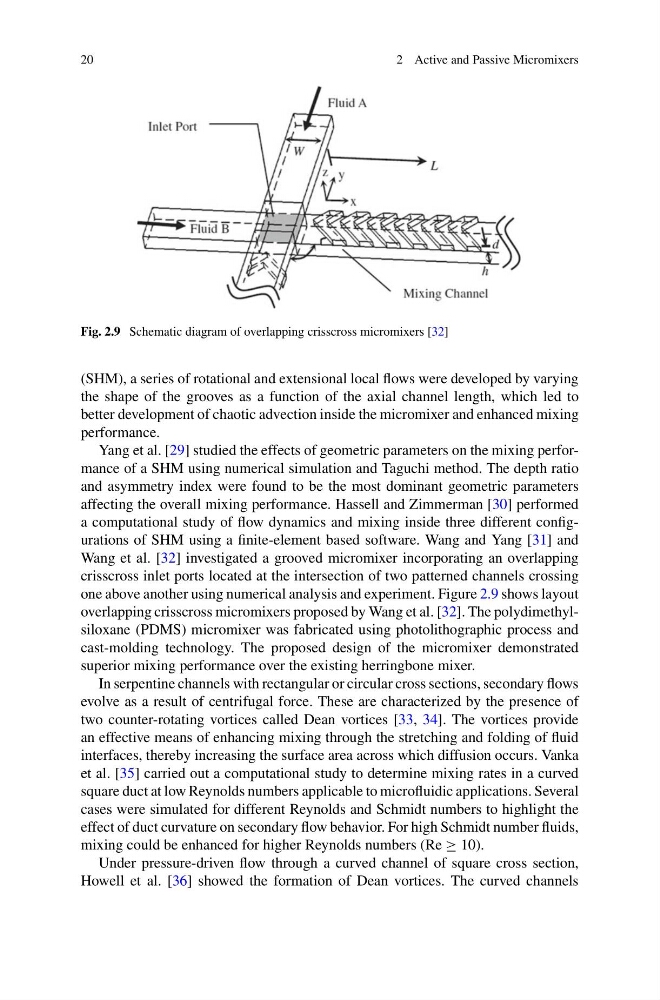
Fig. 2.9 Schematic diagram of overlapping crisscross micromixers [32]
(SHM), a series of rotational and extensional local flows were developed by varying
the shape of the grooves as a function of the axial channel length, which led to
better development of chaotic advection inside the micromixer and enhanced mixing
performance.
Yang et al. [29] studied the effects of geometric parameters on the mixing performance of a SHM using numerical simulation and Taguchi method. The depth ratio
and asymmetry index were found to be the most dominant geometric parameters
affecting the overall mixing performance. Hassell and Zimmerman [30] performed
a computational study of flow dynamics and mixing inside three different configurations of SHM using a finite-element based software. Wang and Yang [31] and
Wang et al. [32] investigated a grooved micromixer incorporating an overlapping
crisscross inlet ports located at the intersection of two patterned channels crossing
one above another using numerical analysis and experiment. Figure 2.9 shows layout
overlapping crisscross micromixers proposed by Wang et al. [32]. The polydimethylsiloxane (PDMS) micromixer was fabricated using photolithographic process and
cast-molding technology. The proposed design of the micromixer demonstrated
superior mixing performance over the existing herringbone mixer.
In serpentine channels with rectangular or circular cross sections, secondary flows
evolve as a result of centrifugal force. These are characterized by the presence of
two counter-rotating vortices called Dean vortices [33, 34]. The vortices provide
an effective means of enhancing mixing through the stretching and folding of fluid
interfaces, thereby increasing the surface area across which diffusion occurs. Vanka
et al. [35] carried out a computational study to determine mixing rates in a curved
square duct at low Reynolds numbers applicable to microfluidic applications. Several
cases were simulated for different Reynolds and Schmidt numbers to highlight the
effect of duct curvature on secondary flow behavior. For high Schmidt number fluids,
mixing could be enhanced for higher Reynolds numbers (Re ≥ 10).
Under pressure-driven flow through a curved channel of square cross section,
Howell et al. [36] showed the formation of Dean vortices. The curved channels
2 Active and Passive Micromixers
Fig. 2.9 Schematic diagram of overlapping crisscross micromixers [32]
(SHM), a series of rotational and extensional local flows were developed by varying
the shape of the grooves as a function of the axial channel length, which led to
better development of chaotic advection inside the micromixer and enhanced mixing
performance.
Yang et al. [29] studied the effects of geometric parameters on the mixing performance of a SHM using numerical simulation and Taguchi method. The depth ratio
and asymmetry index were found to be the most dominant geometric parameters
affecting the overall mixing performance. Hassell and Zimmerman [30] performed
a computational study of flow dynamics and mixing inside three different configurations of SHM using a finite-element based software. Wang and Yang [31] and
Wang et al. [32] investigated a grooved micromixer incorporating an overlapping
crisscross inlet ports located at the intersection of two patterned channels crossing
one above another using numerical analysis and experiment. Figure 2.9 shows layout
overlapping crisscross micromixers proposed by Wang et al. [32]. The polydimethylsiloxane (PDMS) micromixer was fabricated using photolithographic process and
cast-molding technology. The proposed design of the micromixer demonstrated
superior mixing performance over the existing herringbone mixer.
In serpentine channels with rectangular or circular cross sections, secondary flows
evolve as a result of centrifugal force. These are characterized by the presence of
two counter-rotating vortices called Dean vortices [33, 34]. The vortices provide
an effective means of enhancing mixing through the stretching and folding of fluid
interfaces, thereby increasing the surface area across which diffusion occurs. Vanka
et al. [35] carried out a computational study to determine mixing rates in a curved
square duct at low Reynolds numbers applicable to microfluidic applications. Several
cases were simulated for different Reynolds and Schmidt numbers to highlight the
effect of duct curvature on secondary flow behavior. For high Schmidt number fluids,
mixing could be enhanced for higher Reynolds numbers (Re ≥ 10).
Under pressure-driven flow through a curved channel of square cross section,
Howell et al. [36] showed the formation of Dean vortices. The curved channels