

14
2 Active and Passive Micromixers
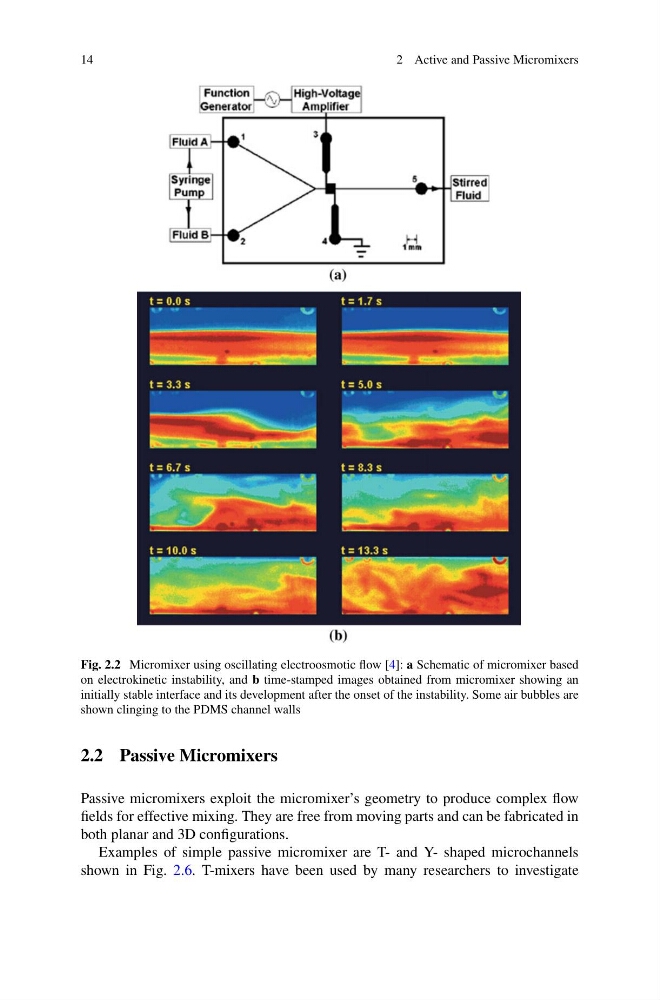
Fig. 2.2 Micromixer using oscillating electroosmotic flow [4]: a Schematic of micromixer based
on electrokinetic instability, and b time-stamped images obtained from micromixer showing an
initially stable interface and its development after the onset of the instability. Some air bubbles are
shown clinging to the PDMS channel walls
2.2 Passive Micromixers
Passive micromixers exploit the micromixer’s geometry to produce complex flow
fields for effective mixing. They are free from moving parts and can be fabricated in
both planar and 3D configurations.
Examples of simple passive micromixer are T- and Y- shaped microchannels
shown in Fig. 2.6. T-mixers have been used by many researchers to investigate
2 Active and Passive Micromixers
Fig. 2.2 Micromixer using oscillating electroosmotic flow [4]: a Schematic of micromixer based
on electrokinetic instability, and b time-stamped images obtained from micromixer showing an
initially stable interface and its development after the onset of the instability. Some air bubbles are
shown clinging to the PDMS channel walls
2.2 Passive Micromixers
Passive micromixers exploit the micromixer’s geometry to produce complex flow
fields for effective mixing. They are free from moving parts and can be fabricated in
both planar and 3D configurations.
Examples of simple passive micromixer are T- and Y- shaped microchannels
shown in Fig. 2.6. T-mixers have been used by many researchers to investigate