

1.2 Micromixer Types
3
1.2 Micromixer Types
The characteristic dimension of micromixers is in the sub-millimeter range. Typical
channel width and height of micromixers are in the range of 100–500 μm, while the
channel length can be up to few millimeters (limited by the dimension of the microfluidic platform for a particular application). Compared with large-scale mixing devices,
microfluidic systems offer advantages in terms of lower sample consumption, a
cheaper manufacturing cost, and higher throughput.
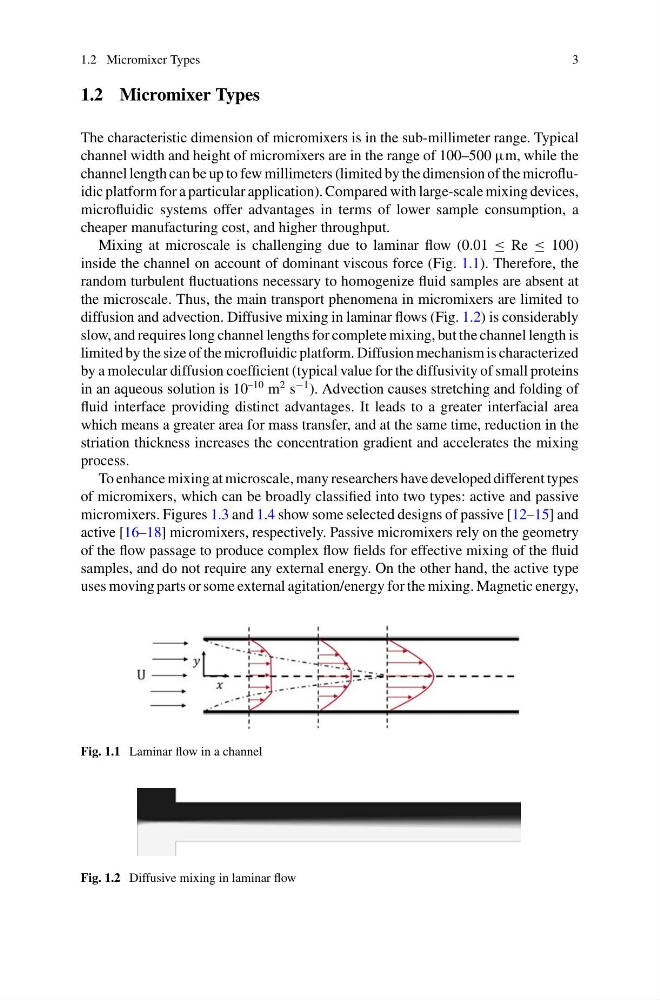
Mixing at microscale is challenging due to laminar flow (0.01 ≤ Re ≤ 100)
inside the channel on account of dominant viscous force (Fig. 1.1). Therefore, the
random turbulent fluctuations necessary to homogenize fluid samples are absent at
the microscale. Thus, the main transport phenomena in micromixers are limited to
diffusion and advection. Diffusive mixing in laminar flows (Fig. 1.2) is considerably
slow, and requires long channel lengths for complete mixing, but the channel length is
limited by the size of the microfluidic platform. Diffusion mechanism is characterized
by a molecular diffusion coefficient (typical value for the diffusivity of small proteins
in an aqueous solution is 10
–10 m
2 s
−1 ). Advection causes stretching and folding of
fluid interface providing distinct advantages. It leads to a greater interfacial area
which means a greater area for mass transfer, and at the same time, reduction in the
striation thickness increases the concentration gradient and accelerates the mixing
process.
To enhance mixing at microscale, many researchers have developed different types
of micromixers, which can be broadly classified into two types: active and passive
micromixers. Figures 1.3 and 1.4 show some selected designs of passive [12–15] and
active [16–18] micromixers, respectively. Passive micromixers rely on the geometry
of the flow passage to produce complex flow fields for effective mixing of the fluid
samples, and do not require any external energy. On the other hand, the active type
uses moving parts or some external agitation/energy for the mixing. Magnetic energy,
Fig. 1.1 Laminar flow in a channel
Fig. 1.2 Diffusive mixing in laminar flow
3
1.2 Micromixer Types
The characteristic dimension of micromixers is in the sub-millimeter range. Typical
channel width and height of micromixers are in the range of 100–500 μm, while the
channel length can be up to few millimeters (limited by the dimension of the microfluidic platform for a particular application). Compared with large-scale mixing devices,
microfluidic systems offer advantages in terms of lower sample consumption, a
cheaper manufacturing cost, and higher throughput.
Mixing at microscale is challenging due to laminar flow (0.01 ≤ Re ≤ 100)
inside the channel on account of dominant viscous force (Fig. 1.1). Therefore, the
random turbulent fluctuations necessary to homogenize fluid samples are absent at
the microscale. Thus, the main transport phenomena in micromixers are limited to
diffusion and advection. Diffusive mixing in laminar flows (Fig. 1.2) is considerably
slow, and requires long channel lengths for complete mixing, but the channel length is
limited by the size of the microfluidic platform. Diffusion mechanism is characterized
by a molecular diffusion coefficient (typical value for the diffusivity of small proteins
in an aqueous solution is 10
–10 m
2 s
−1 ). Advection causes stretching and folding of
fluid interface providing distinct advantages. It leads to a greater interfacial area
which means a greater area for mass transfer, and at the same time, reduction in the
striation thickness increases the concentration gradient and accelerates the mixing
process.
To enhance mixing at microscale, many researchers have developed different types
of micromixers, which can be broadly classified into two types: active and passive
micromixers. Figures 1.3 and 1.4 show some selected designs of passive [12–15] and
active [16–18] micromixers, respectively. Passive micromixers rely on the geometry
of the flow passage to produce complex flow fields for effective mixing of the fluid
samples, and do not require any external energy. On the other hand, the active type
uses moving parts or some external agitation/energy for the mixing. Magnetic energy,
Fig. 1.1 Laminar flow in a channel
Fig. 1.2 Diffusive mixing in laminar flow