

needs, at the bottom. The assumption is that physical and social needs require
fulfillment before more transcendent ones can be realized. Max-Neef rejects such a
hierarchical ordering and says that even if people go hungry every day, their lives
can still host relationships of dignity, creative moments of productivity and the
feeling of connection with others (Max-Neef 1992: 204–205).
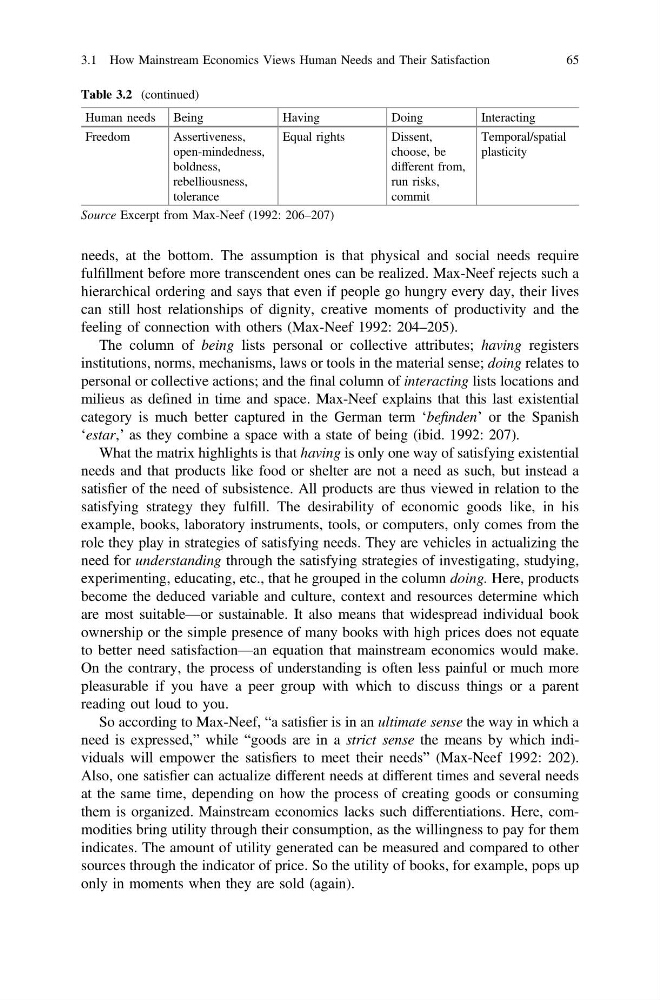
The column of being lists personal or collective attributes; having registers
institutions, norms, mechanisms, laws or tools in the material sense; doing relates to
personal or collective actions; and the final column of interacting lists locations and
milieus as defined in time and space. Max-Neef explains that this last existential
category is much better captured in the German term ‘befinden’ or the Spanish
‘estar,’ as they combine a space with a state of being (ibid. 1992: 207).
What the matrix highlights is that having is only one way of satisfying existential
needs and that products like food or shelter are not a need as such, but instead a
satisfier of the need of subsistence. All products are thus viewed in relation to the
satisfying strategy they fulfill. The desirability of economic goods like, in his
example, books, laboratory instruments, tools, or computers, only comes from the
role they play in strategies of satisfying needs. They are vehicles in actualizing the
need for understanding through the satisfying strategies of investigating, studying,
experimenting, educating, etc., that he grouped in the column doing. Here, products
become the deduced variable and culture, context and resources determine which
are most suitable—or sustainable. It also means that widespread individual book
ownership or the simple presence of many books with high prices does not equate
to better need satisfaction—an equation that mainstream economics would make.
On the contrary, the process of understanding is often less painful or much more
pleasurable if you have a peer group with which to discuss things or a parent
reading out loud to you.
So according to Max-Neef, “a satisfier is in an ultimate sense the way in which a
need is expressed,” while “goods are in a strict sense the means by which individuals will empower the satisfiers to meet their needs” (Max-Neef 1992: 202).
Also, one satisfier can actualize different needs at different times and several needs
at the same time, depending on how the process of creating goods or consuming
them is organized. Mainstream economics lacks such differentiations. Here, commodities bring utility through their consumption, as the willingness to pay for them
indicates. The amount of utility generated can be measured and compared to other
sources through the indicator of price. So the utility of books, for example, pops up
only in moments when they are sold (again).
Table 3.2 (continued)
Human needs Being
Having
Doing
Interacting
Freedom
Assertiveness,
open-mindedness,
boldness,
rebelliousness,
tolerance
Equal rights
Dissent,
choose, be
different from,
run risks,
commit
Temporal/spatial
plasticity
Source Excerpt from Max-Neef (1992: 206–207)
3.1 How Mainstream Economics Views Human Needs and Their Satisfaction
65
fulfillment before more transcendent ones can be realized. Max-Neef rejects such a
hierarchical ordering and says that even if people go hungry every day, their lives
can still host relationships of dignity, creative moments of productivity and the
feeling of connection with others (Max-Neef 1992: 204–205).
The column of being lists personal or collective attributes; having registers
institutions, norms, mechanisms, laws or tools in the material sense; doing relates to
personal or collective actions; and the final column of interacting lists locations and
milieus as defined in time and space. Max-Neef explains that this last existential
category is much better captured in the German term ‘befinden’ or the Spanish
‘estar,’ as they combine a space with a state of being (ibid. 1992: 207).
What the matrix highlights is that having is only one way of satisfying existential
needs and that products like food or shelter are not a need as such, but instead a
satisfier of the need of subsistence. All products are thus viewed in relation to the
satisfying strategy they fulfill. The desirability of economic goods like, in his
example, books, laboratory instruments, tools, or computers, only comes from the
role they play in strategies of satisfying needs. They are vehicles in actualizing the
need for understanding through the satisfying strategies of investigating, studying,
experimenting, educating, etc., that he grouped in the column doing. Here, products
become the deduced variable and culture, context and resources determine which
are most suitable—or sustainable. It also means that widespread individual book
ownership or the simple presence of many books with high prices does not equate
to better need satisfaction—an equation that mainstream economics would make.
On the contrary, the process of understanding is often less painful or much more
pleasurable if you have a peer group with which to discuss things or a parent
reading out loud to you.
So according to Max-Neef, “a satisfier is in an ultimate sense the way in which a
need is expressed,” while “goods are in a strict sense the means by which individuals will empower the satisfiers to meet their needs” (Max-Neef 1992: 202).
Also, one satisfier can actualize different needs at different times and several needs
at the same time, depending on how the process of creating goods or consuming
them is organized. Mainstream economics lacks such differentiations. Here, commodities bring utility through their consumption, as the willingness to pay for them
indicates. The amount of utility generated can be measured and compared to other
sources through the indicator of price. So the utility of books, for example, pops up
only in moments when they are sold (again).
Table 3.2 (continued)
Human needs Being
Having
Doing
Interacting
Freedom
Assertiveness,
open-mindedness,
boldness,
rebelliousness,
tolerance
Equal rights
Dissent,
choose, be
different from,
run risks,
commit
Temporal/spatial
plasticity
Source Excerpt from Max-Neef (1992: 206–207)
3.1 How Mainstream Economics Views Human Needs and Their Satisfaction
65