

the happiness of an individual over a period of time, e.g., while working.
Experienced utility is defined “as the sum of the momentary utilities over that time
period; that is, the temporal integral of momentary utility” (Kahneman/Krueger
2006: 5).
So, instead of measuring my utility and happiness solely through my shopping
expenditures, these surveys seek to capture how much pleasure or pain I experience
in every situation throughout the day. This sheds a very different light on notions of
how we can support human need satisfaction but also requires a change to some of
the basic models with which production processes are captured and analyzed.
This is the domain where ecological economics has anchored some of its most
important alternative perspectives. Some of its leading thinkers, like Robert
Costanza, Joshua Farley, Hermann Daly or Paul Ekins have juxtaposed wealth
production functions in mainstream economics with those that capture people and
planet and make them part of the economy. The following are my own synopses of
slightly diverse versions in several publications (Ekins 1992: 147–155; Costanza
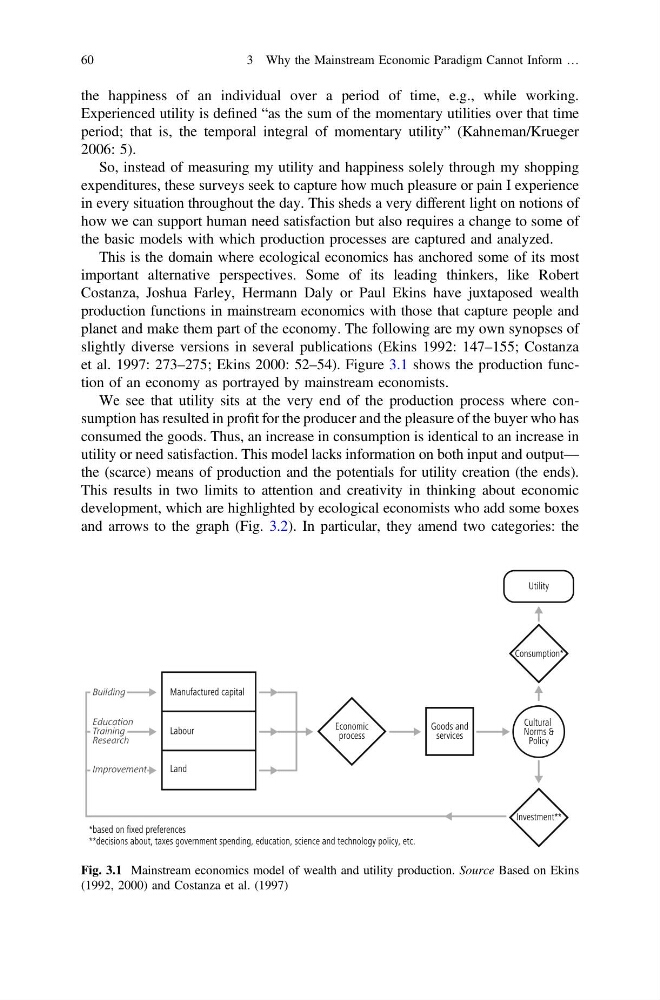
et al. 1997: 273–275; Ekins 2000: 52–54). Figure 3.1 shows the production function of an economy as portrayed by mainstream economists.
We see that utility sits at the very end of the production process where consumption has resulted in profit for the producer and the pleasure of the buyer who has
consumed the goods. Thus, an increase in consumption is identical to an increase in
utility or need satisfaction. This model lacks information on both input and output—
the (scarce) means of production and the potentials for utility creation (the ends).
This results in two limits to attention and creativity in thinking about economic
development, which are highlighted by ecological economists who add some boxes
and arrows to the graph (Fig. 3.2). In particular, they amend two categories: the
Fig. 3.1 Mainstream economics model of wealth and utility production. Source Based on Ekins
(1992, 2000) and Costanza et al. (1997)
60
3 Why the Mainstream Economic Paradigm Cannot Inform …
Experienced utility is defined “as the sum of the momentary utilities over that time
period; that is, the temporal integral of momentary utility” (Kahneman/Krueger
2006: 5).
So, instead of measuring my utility and happiness solely through my shopping
expenditures, these surveys seek to capture how much pleasure or pain I experience
in every situation throughout the day. This sheds a very different light on notions of
how we can support human need satisfaction but also requires a change to some of
the basic models with which production processes are captured and analyzed.
This is the domain where ecological economics has anchored some of its most
important alternative perspectives. Some of its leading thinkers, like Robert
Costanza, Joshua Farley, Hermann Daly or Paul Ekins have juxtaposed wealth
production functions in mainstream economics with those that capture people and
planet and make them part of the economy. The following are my own synopses of
slightly diverse versions in several publications (Ekins 1992: 147–155; Costanza
et al. 1997: 273–275; Ekins 2000: 52–54). Figure 3.1 shows the production function of an economy as portrayed by mainstream economists.
We see that utility sits at the very end of the production process where consumption has resulted in profit for the producer and the pleasure of the buyer who has
consumed the goods. Thus, an increase in consumption is identical to an increase in
utility or need satisfaction. This model lacks information on both input and output—
the (scarce) means of production and the potentials for utility creation (the ends).
This results in two limits to attention and creativity in thinking about economic
development, which are highlighted by ecological economists who add some boxes
and arrows to the graph (Fig. 3.2). In particular, they amend two categories: the
Fig. 3.1 Mainstream economics model of wealth and utility production. Source Based on Ekins
(1992, 2000) and Costanza et al. (1997)
60
3 Why the Mainstream Economic Paradigm Cannot Inform …