

prioritize two key points. These were “the concept of ‘needs,’ in particular the
essential needs of the world’s poor,” to whom, it argued, “overriding priority should
be given” and “the idea of limitations imposed by the state of technology and social
organization on the environment’s ability to meet present and future needs”
(WCED 1987: 41).
To reach these goals the Brundtland Commission urged that: “Human laws must
be reformulated to keep human activities in harmony with the unchanging and
universal laws of nature” (WCED 1987: 271). We will see that mainstream economic theory does not provide much understanding as to how to do this but rather
offers concepts that keep us blind to these key points. The urge to ‘integrate’
environmental, social and economic concerns led to the expansion of the economic
mind-set into the governance of ever more areas of life. This effect has been called
the ‘economization’ of societies and its ongoing trending reifies unsustainable path
dependencies instead of helping to unlock them. So it is at least as important to limit
the realm of issues to which economics are applied as it is to update the entire
discipline.
So to what questions do economists claim to provide answers? Perhaps the most
widely used and accepted definition was coined by Lionel Robbins, the famous
London School of Economics professor who wrote in 1932 that “Economics is the
science which studies human behaviour as a relationship between ends and scarce
means which have alternative uses” (Robbins 1932: 15). Such alternative uses are
also called ‘competing ends’ and Robbins argues that the only situations that fall
under economic consideration are those in which choices between ends (going to
the opera, sleeping or baking bread) need to be taken because the means (time or
resources) are limited. Hence, economic situations are those in which some wants
need to be relinquished. This means that economics can explain choice making, but
cannot shed light on either ends or means. In fact, it was the aim of Robbins’ essay
to limit the concerns addressed by economics.
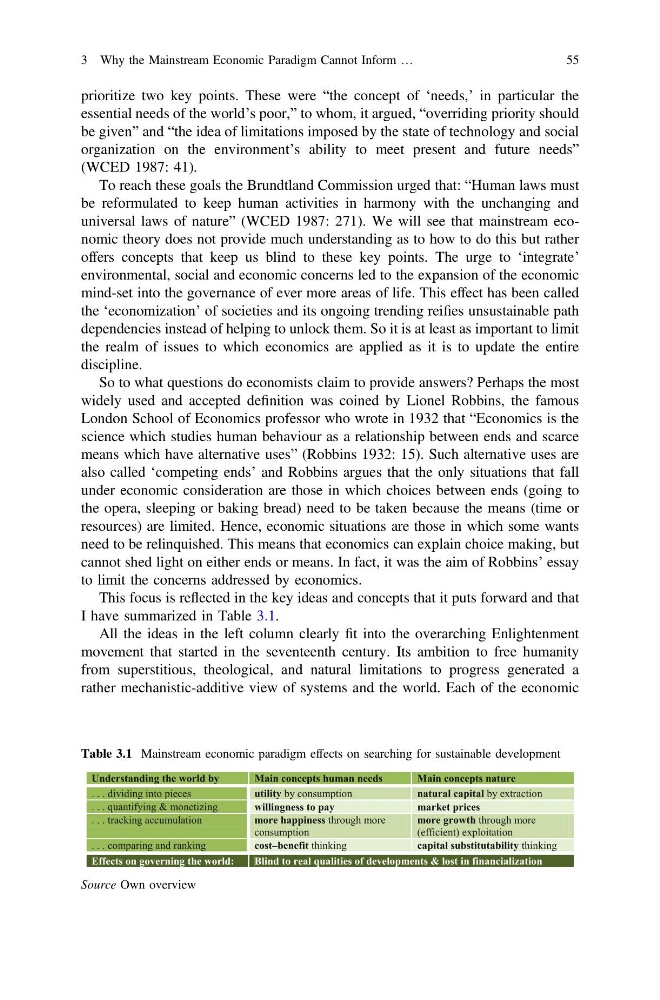
This focus is reflected in the key ideas and concepts that it puts forward and that
I have summarized in Table 3.1.
All the ideas in the left column clearly fit into the overarching Enlightenment
movement that started in the seventeenth century. Its ambition to free humanity
from superstitious, theological, and natural limitations to progress generated a
rather mechanistic-additive view of systems and the world. Each of the economic
Table 3.1 Mainstream economic paradigm effects on searching for sustainable development
Source Own overview
3 Why the Mainstream Economic Paradigm Cannot Inform …
55
essential needs of the world’s poor,” to whom, it argued, “overriding priority should
be given” and “the idea of limitations imposed by the state of technology and social
organization on the environment’s ability to meet present and future needs”
(WCED 1987: 41).
To reach these goals the Brundtland Commission urged that: “Human laws must
be reformulated to keep human activities in harmony with the unchanging and
universal laws of nature” (WCED 1987: 271). We will see that mainstream economic theory does not provide much understanding as to how to do this but rather
offers concepts that keep us blind to these key points. The urge to ‘integrate’
environmental, social and economic concerns led to the expansion of the economic
mind-set into the governance of ever more areas of life. This effect has been called
the ‘economization’ of societies and its ongoing trending reifies unsustainable path
dependencies instead of helping to unlock them. So it is at least as important to limit
the realm of issues to which economics are applied as it is to update the entire
discipline.
So to what questions do economists claim to provide answers? Perhaps the most
widely used and accepted definition was coined by Lionel Robbins, the famous
London School of Economics professor who wrote in 1932 that “Economics is the
science which studies human behaviour as a relationship between ends and scarce
means which have alternative uses” (Robbins 1932: 15). Such alternative uses are
also called ‘competing ends’ and Robbins argues that the only situations that fall
under economic consideration are those in which choices between ends (going to
the opera, sleeping or baking bread) need to be taken because the means (time or
resources) are limited. Hence, economic situations are those in which some wants
need to be relinquished. This means that economics can explain choice making, but
cannot shed light on either ends or means. In fact, it was the aim of Robbins’ essay
to limit the concerns addressed by economics.
This focus is reflected in the key ideas and concepts that it puts forward and that
I have summarized in Table 3.1.
All the ideas in the left column clearly fit into the overarching Enlightenment
movement that started in the seventeenth century. Its ambition to free humanity
from superstitious, theological, and natural limitations to progress generated a
rather mechanistic-additive view of systems and the world. Each of the economic
Table 3.1 Mainstream economic paradigm effects on searching for sustainable development
Source Own overview
3 Why the Mainstream Economic Paradigm Cannot Inform …
55