

A deconstruction of the overarching ideational frameworks or paradigms behind the
institutions, technologies and economic instruments in place provides an understanding of which path dependencies will be particularly difficult to unlock and
which pioneers and change agents are more likely to help—or block—that process.
Connecting this reflexive ontology with the MLP (Fig. 2.1) and multi-phase
concept (Fig. 2.2) of transformation research leads me to conclude this chapter with
the concept of radical incremental transformation. The MLP situates mind-sets on
the landscape level. Following the discussion of the crucial role of ideas on the
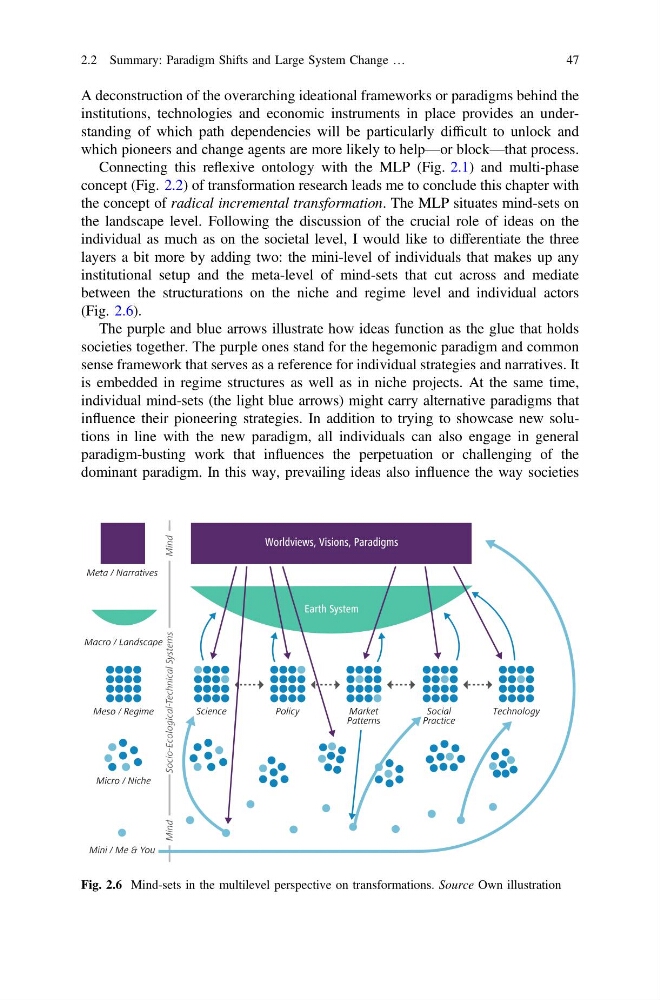
individual as much as on the societal level, I would like to differentiate the three
layers a bit more by adding two: the mini-level of individuals that makes up any
institutional setup and the meta-level of mind-sets that cut across and mediate
between the structurations on the niche and regime level and individual actors
(Fig. 2.6).
The purple and blue arrows illustrate how ideas function as the glue that holds
societies together. The purple ones stand for the hegemonic paradigm and common
sense framework that serves as a reference for individual strategies and narratives. It
is embedded in regime structures as well as in niche projects. At the same time,
individual mind-sets (the light blue arrows) might carry alternative paradigms that
influence their pioneering strategies. In addition to trying to showcase new solutions in line with the new paradigm, all individuals can also engage in general
paradigm-busting work that influences the perpetuation or challenging of the
dominant paradigm. In this way, prevailing ideas also influence the way societies
Fig. 2.6 Mind-sets in the multilevel perspective on transformations. Source Own illustration
2.2 Summary: Paradigm Shifts and Large System Change …
47
institutions, technologies and economic instruments in place provides an understanding of which path dependencies will be particularly difficult to unlock and
which pioneers and change agents are more likely to help—or block—that process.
Connecting this reflexive ontology with the MLP (Fig. 2.1) and multi-phase
concept (Fig. 2.2) of transformation research leads me to conclude this chapter with
the concept of radical incremental transformation. The MLP situates mind-sets on
the landscape level. Following the discussion of the crucial role of ideas on the
individual as much as on the societal level, I would like to differentiate the three
layers a bit more by adding two: the mini-level of individuals that makes up any
institutional setup and the meta-level of mind-sets that cut across and mediate
between the structurations on the niche and regime level and individual actors
(Fig. 2.6).
The purple and blue arrows illustrate how ideas function as the glue that holds
societies together. The purple ones stand for the hegemonic paradigm and common
sense framework that serves as a reference for individual strategies and narratives. It
is embedded in regime structures as well as in niche projects. At the same time,
individual mind-sets (the light blue arrows) might carry alternative paradigms that
influence their pioneering strategies. In addition to trying to showcase new solutions in line with the new paradigm, all individuals can also engage in general
paradigm-busting work that influences the perpetuation or challenging of the
dominant paradigm. In this way, prevailing ideas also influence the way societies
Fig. 2.6 Mind-sets in the multilevel perspective on transformations. Source Own illustration
2.2 Summary: Paradigm Shifts and Large System Change …
47