

material possessions and monetary income. This fell short of causing the upset to
the human self-image that the Brundtland Report had predicted would result from
seeing Earth from space.
This upset to the human self-image is what system-thinking scholars like
Donella Meadows call paradigm shifts. She also calls them “high leverage points”
for transforming systems. To me, paradigm or mind shifts are the bridge between
the radical and incremental aspects of transformation strategies: radically different
imaginaries of potential future developments influence the formulation of new goals
for the system that can then be implemented step by step, changing the rules,
procedures, roles and norms accordingly.
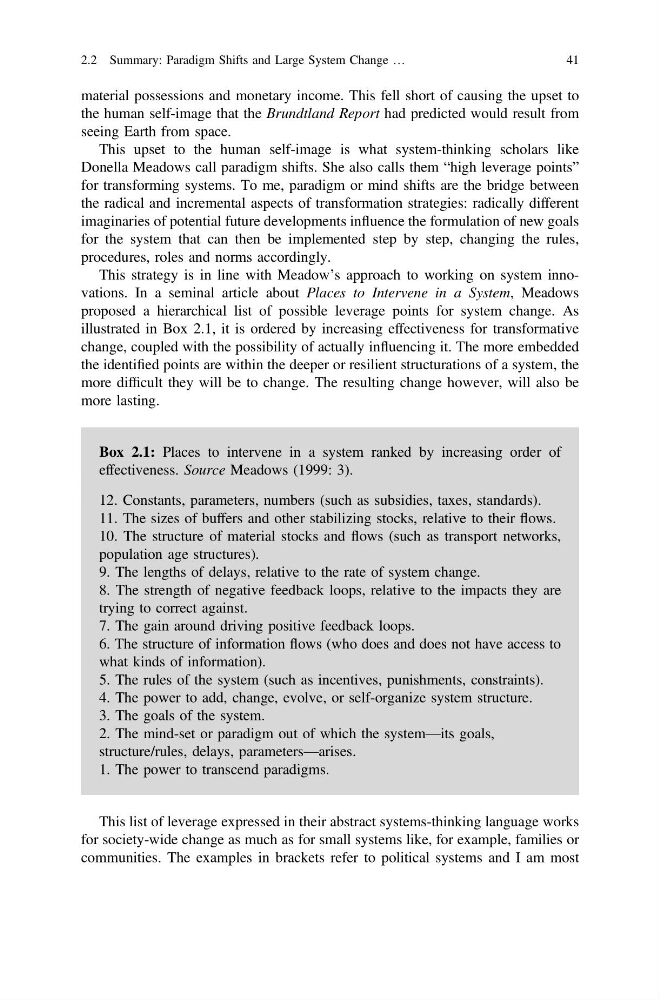
This strategy is in line with Meadow’s approach to working on system innovations. In a seminal article about Places to Intervene in a System, Meadows
proposed a hierarchical list of possible leverage points for system change. As
illustrated in Box 2.1, it is ordered by increasing effectiveness for transformative
change, coupled with the possibility of actually influencing it. The more embedded
the identified points are within the deeper or resilient structurations of a system, the
more difficult they will be to change. The resulting change however, will also be
more lasting.
Box 2.1: Places to intervene in a system ranked by increasing order of
effectiveness. Source Meadows (1999: 3).
12. Constants, parameters, numbers (such as subsidies, taxes, standards).
11. The sizes of buffers and other stabilizing stocks, relative to their flows.
10. The structure of material stocks and flows (such as transport networks,
population age structures).
9. The lengths of delays, relative to the rate of system change.
8. The strength of negative feedback loops, relative to the impacts they are
trying to correct against.
7. The gain around driving positive feedback loops.
6. The structure of information flows (who does and does not have access to
what kinds of information).
5. The rules of the system (such as incentives, punishments, constraints).
4. The power to add, change, evolve, or self-organize system structure.
3. The goals of the system.
2. The mind-set or paradigm out of which the system—its goals,
structure/rules, delays, parameters—arises.
1. The power to transcend paradigms.
This list of leverage expressed in their abstract systems-thinking language works
for society-wide change as much as for small systems like, for example, families or
communities. The examples in brackets refer to political systems and I am most
2.2 Summary: Paradigm Shifts and Large System Change …
41
the human self-image that the Brundtland Report had predicted would result from
seeing Earth from space.
This upset to the human self-image is what system-thinking scholars like
Donella Meadows call paradigm shifts. She also calls them “high leverage points”
for transforming systems. To me, paradigm or mind shifts are the bridge between
the radical and incremental aspects of transformation strategies: radically different
imaginaries of potential future developments influence the formulation of new goals
for the system that can then be implemented step by step, changing the rules,
procedures, roles and norms accordingly.
This strategy is in line with Meadow’s approach to working on system innovations. In a seminal article about Places to Intervene in a System, Meadows
proposed a hierarchical list of possible leverage points for system change. As
illustrated in Box 2.1, it is ordered by increasing effectiveness for transformative
change, coupled with the possibility of actually influencing it. The more embedded
the identified points are within the deeper or resilient structurations of a system, the
more difficult they will be to change. The resulting change however, will also be
more lasting.
Box 2.1: Places to intervene in a system ranked by increasing order of
effectiveness. Source Meadows (1999: 3).
12. Constants, parameters, numbers (such as subsidies, taxes, standards).
11. The sizes of buffers and other stabilizing stocks, relative to their flows.
10. The structure of material stocks and flows (such as transport networks,
population age structures).
9. The lengths of delays, relative to the rate of system change.
8. The strength of negative feedback loops, relative to the impacts they are
trying to correct against.
7. The gain around driving positive feedback loops.
6. The structure of information flows (who does and does not have access to
what kinds of information).
5. The rules of the system (such as incentives, punishments, constraints).
4. The power to add, change, evolve, or self-organize system structure.
3. The goals of the system.
2. The mind-set or paradigm out of which the system—its goals,
structure/rules, delays, parameters—arises.
1. The power to transcend paradigms.
This list of leverage expressed in their abstract systems-thinking language works
for society-wide change as much as for small systems like, for example, families or
communities. The examples in brackets refer to political systems and I am most
2.2 Summary: Paradigm Shifts and Large System Change …
41