

• Evolutionists foresee conventional worlds because they are convinced that the
dominant patterns of the modern era can be adjusted to deliver prosperity,
stability and ecological health.
• Catastrophists foresee a future of barbarization because they predict that
environmental, social and economic crises will lead to a perfect storm.
• Transformationists share these concerns but still believe that a Great Transition
toward sustainable solutions is possible.
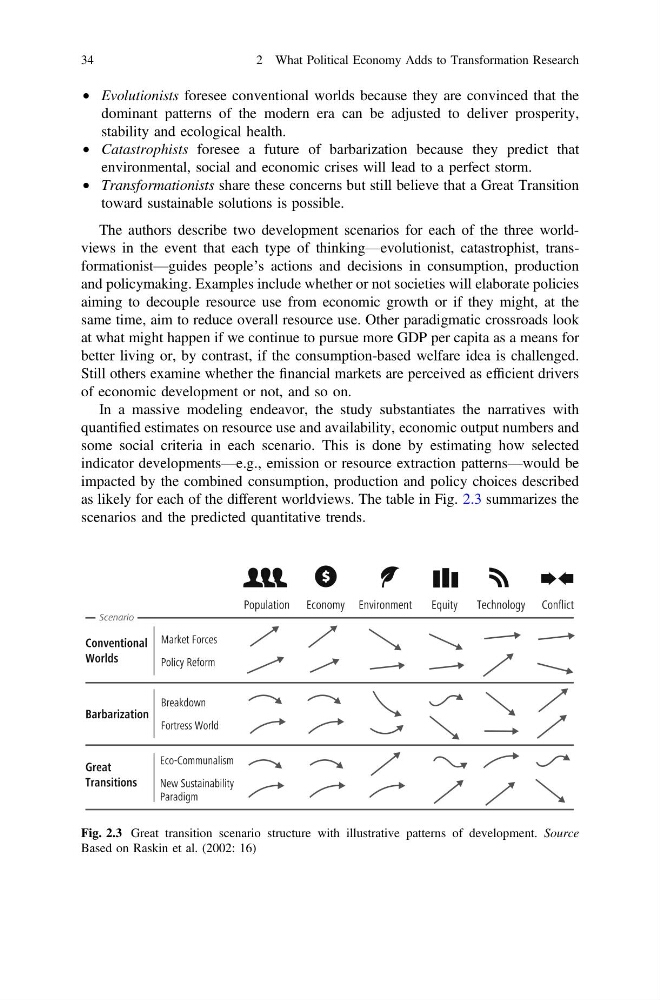
The authors describe two development scenarios for each of the three worldviews in the event that each type of thinking—evolutionist, catastrophist, transformationist—guides people’s actions and decisions in consumption, production
and policymaking. Examples include whether or not societies will elaborate policies
aiming to decouple resource use from economic growth or if they might, at the
same time, aim to reduce overall resource use. Other paradigmatic crossroads look
at what might happen if we continue to pursue more GDP per capita as a means for
better living or, by contrast, if the consumption-based welfare idea is challenged.
Still others examine whether the financial markets are perceived as efficient drivers
of economic development or not, and so on.
In a massive modeling endeavor, the study substantiates the narratives with
quantified estimates on resource use and availability, economic output numbers and
some social criteria in each scenario. This is done by estimating how selected
indicator developments—e.g., emission or resource extraction patterns—would be
impacted by the combined consumption, production and policy choices described
as likely for each of the different worldviews. The table in Fig. 2.3 summarizes the
scenarios and the predicted quantitative trends.
Fig. 2.3 Great transition scenario structure with illustrative patterns of development. Source
Based on Raskin et al. (2002: 16)
34
2 What Political Economy Adds to Transformation Research
dominant patterns of the modern era can be adjusted to deliver prosperity,
stability and ecological health.
• Catastrophists foresee a future of barbarization because they predict that
environmental, social and economic crises will lead to a perfect storm.
• Transformationists share these concerns but still believe that a Great Transition
toward sustainable solutions is possible.
The authors describe two development scenarios for each of the three worldviews in the event that each type of thinking—evolutionist, catastrophist, transformationist—guides people’s actions and decisions in consumption, production
and policymaking. Examples include whether or not societies will elaborate policies
aiming to decouple resource use from economic growth or if they might, at the
same time, aim to reduce overall resource use. Other paradigmatic crossroads look
at what might happen if we continue to pursue more GDP per capita as a means for
better living or, by contrast, if the consumption-based welfare idea is challenged.
Still others examine whether the financial markets are perceived as efficient drivers
of economic development or not, and so on.
In a massive modeling endeavor, the study substantiates the narratives with
quantified estimates on resource use and availability, economic output numbers and
some social criteria in each scenario. This is done by estimating how selected
indicator developments—e.g., emission or resource extraction patterns—would be
impacted by the combined consumption, production and policy choices described
as likely for each of the different worldviews. The table in Fig. 2.3 summarizes the
scenarios and the predicted quantitative trends.
Fig. 2.3 Great transition scenario structure with illustrative patterns of development. Source
Based on Raskin et al. (2002: 16)
34
2 What Political Economy Adds to Transformation Research