

processes of transformation and thus can be applied for many outcome goals of
transformations, like moving toward a safe operating space or institutionalizing a
Second Enlightenment with a new economic paradigm.
The STS transition research community was born in the Netherlands when
professors Jan Rotman, Johan Schot and John Grin combined their respective
research backgrounds for a programmatic approach toward understanding larger
system changes. These scholars primarily study medium-sized systems, often on a
sectoral basis like energy. The duration of transformational changes in these systems is estimated to take about 40–50 years (Grin et al. 2010: 3–7). One of the key
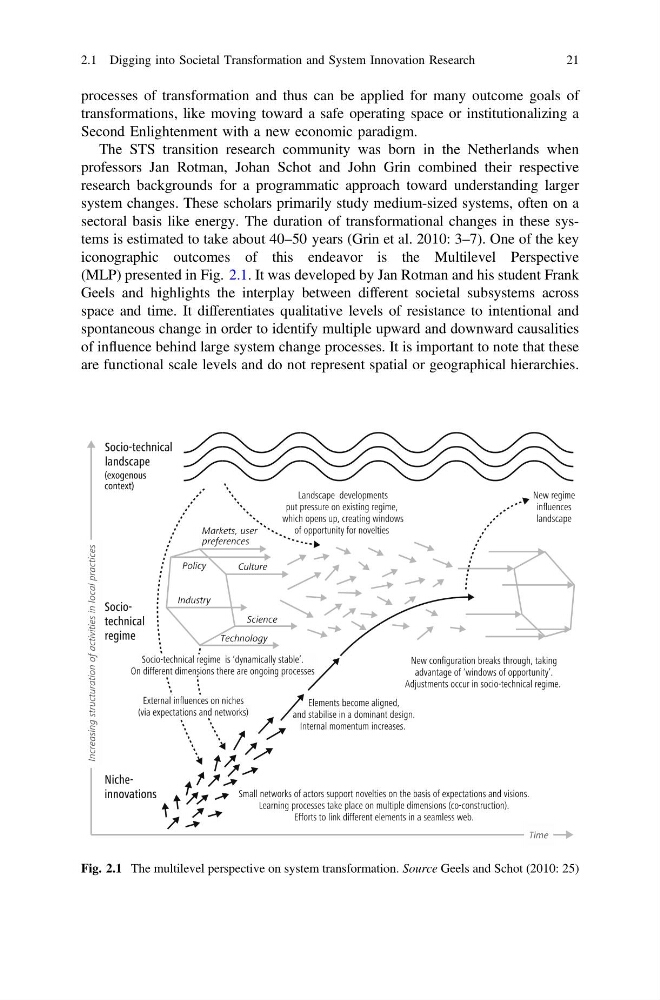
iconographic outcomes of this endeavor is the Multilevel Perspective
(MLP) presented in Fig. 2.1. It was developed by Jan Rotman and his student Frank
Geels and highlights the interplay between different societal subsystems across
space and time. It differentiates qualitative levels of resistance to intentional and
spontaneous change in order to identify multiple upward and downward causalities
of influence behind large system change processes. It is important to note that these
are functional scale levels and do not represent spatial or geographical hierarchies.
Fig. 2.1 The multilevel perspective on system transformation. Source Geels and Schot (2010: 25)
2.1 Digging into Societal Transformation and System Innovation Research
21
transformations, like moving toward a safe operating space or institutionalizing a
Second Enlightenment with a new economic paradigm.
The STS transition research community was born in the Netherlands when
professors Jan Rotman, Johan Schot and John Grin combined their respective
research backgrounds for a programmatic approach toward understanding larger
system changes. These scholars primarily study medium-sized systems, often on a
sectoral basis like energy. The duration of transformational changes in these systems is estimated to take about 40–50 years (Grin et al. 2010: 3–7). One of the key
iconographic outcomes of this endeavor is the Multilevel Perspective
(MLP) presented in Fig. 2.1. It was developed by Jan Rotman and his student Frank
Geels and highlights the interplay between different societal subsystems across
space and time. It differentiates qualitative levels of resistance to intentional and
spontaneous change in order to identify multiple upward and downward causalities
of influence behind large system change processes. It is important to note that these
are functional scale levels and do not represent spatial or geographical hierarchies.
Fig. 2.1 The multilevel perspective on system transformation. Source Geels and Schot (2010: 25)
2.1 Digging into Societal Transformation and System Innovation Research
21