

(2011). Scholz discusses what has been introduced here as the SES camp’s view of
embedded systems, and provides analytical tools for a better understanding of the
inseparable systemic relationships between humans and their natural environment.
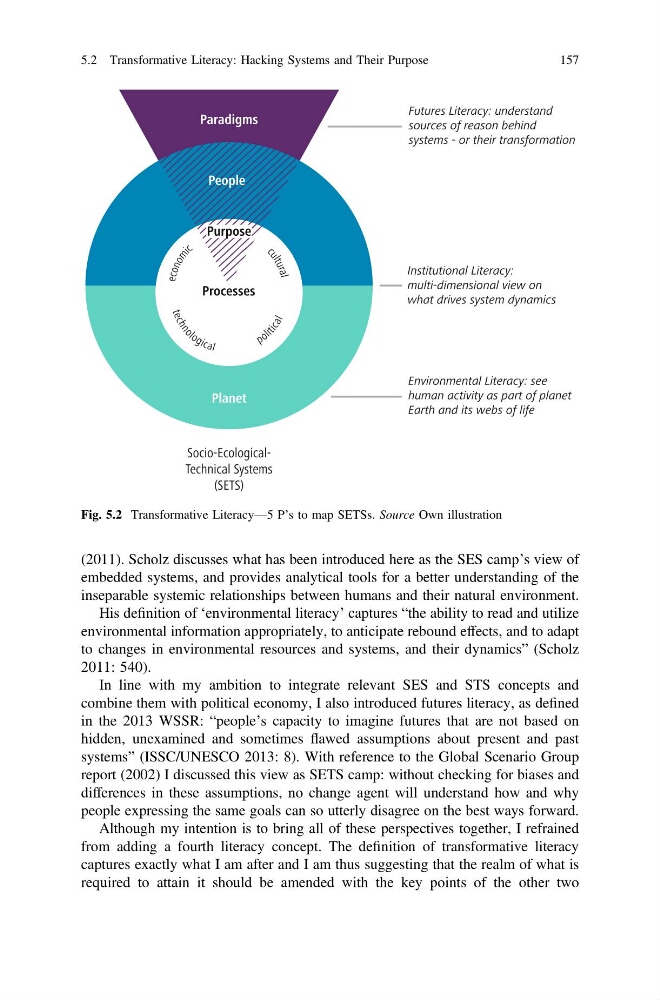
His definition of ‘environmental literacy’ captures “the ability to read and utilize
environmental information appropriately, to anticipate rebound effects, and to adapt
to changes in environmental resources and systems, and their dynamics” (Scholz
2011: 540).
In line with my ambition to integrate relevant SES and STS concepts and
combine them with political economy, I also introduced futures literacy, as defined
in the 2013 WSSR: “people’s capacity to imagine futures that are not based on
hidden, unexamined and sometimes flawed assumptions about present and past
systems” (ISSC/UNESCO 2013: 8). With reference to the Global Scenario Group
report (2002) I discussed this view as SETS camp: without checking for biases and
differences in these assumptions, no change agent will understand how and why
people expressing the same goals can so utterly disagree on the best ways forward.
Although my intention is to bring all of these perspectives together, I refrained
from adding a fourth literacy concept. The definition of transformative literacy
captures exactly what I am after and I am thus suggesting that the realm of what is
required to attain it should be amended with the key points of the other two
Fig. 5.2 Transformative Literacy—5 P’s to map SETSs. Source Own illustration
5.2 Transformative Literacy: Hacking Systems and Their Purpose
157
embedded systems, and provides analytical tools for a better understanding of the
inseparable systemic relationships between humans and their natural environment.
His definition of ‘environmental literacy’ captures “the ability to read and utilize
environmental information appropriately, to anticipate rebound effects, and to adapt
to changes in environmental resources and systems, and their dynamics” (Scholz
2011: 540).
In line with my ambition to integrate relevant SES and STS concepts and
combine them with political economy, I also introduced futures literacy, as defined
in the 2013 WSSR: “people’s capacity to imagine futures that are not based on
hidden, unexamined and sometimes flawed assumptions about present and past
systems” (ISSC/UNESCO 2013: 8). With reference to the Global Scenario Group
report (2002) I discussed this view as SETS camp: without checking for biases and
differences in these assumptions, no change agent will understand how and why
people expressing the same goals can so utterly disagree on the best ways forward.
Although my intention is to bring all of these perspectives together, I refrained
from adding a fourth literacy concept. The definition of transformative literacy
captures exactly what I am after and I am thus suggesting that the realm of what is
required to attain it should be amended with the key points of the other two
Fig. 5.2 Transformative Literacy—5 P’s to map SETSs. Source Own illustration
5.2 Transformative Literacy: Hacking Systems and Their Purpose
157