

5.2 Transformative Literacy: Hacking Systems and Their
Purpose
We saw from Meadows’ list of leverage points that shifting the paradigm is the
most difficult and yet most effective or radical leverage point for system innovations. She paraphrases Kuhn when describing it as long and tedious work:
In a nutshell, you keep pointing at the anomalies and failures in the old paradigm, you keep
speaking louder and with assurance from the new one, you insert people with the new
paradigm in places of public visibility and power. You don’t waste time with reactionaries,
rather you work with active change agents and with the vast middle ground of people who
are open-minded (ibid.: 18).
The good news is that even if there might not be visible changes for a long time,
this work is not undertaken for nothing. Think back to the development and also
ignition phase in the s-curve. Each choice to do differently, each questioning of the
stated purpose or reasons, impacts the former reference frameworks, mind-sets and
knowledge reservoirs. It offers alternative meaning, delegitimizes the notion that
there are no alternative claims, and offers ideas about other ways of acting or doing
things. Of course much structural power rests with those who benefit from the status
quo and its hegemonic paradigm. But as Meadows wrote, many individuals—
change research suggests about 60 % of people in a system—are open minded and
willing to learn.
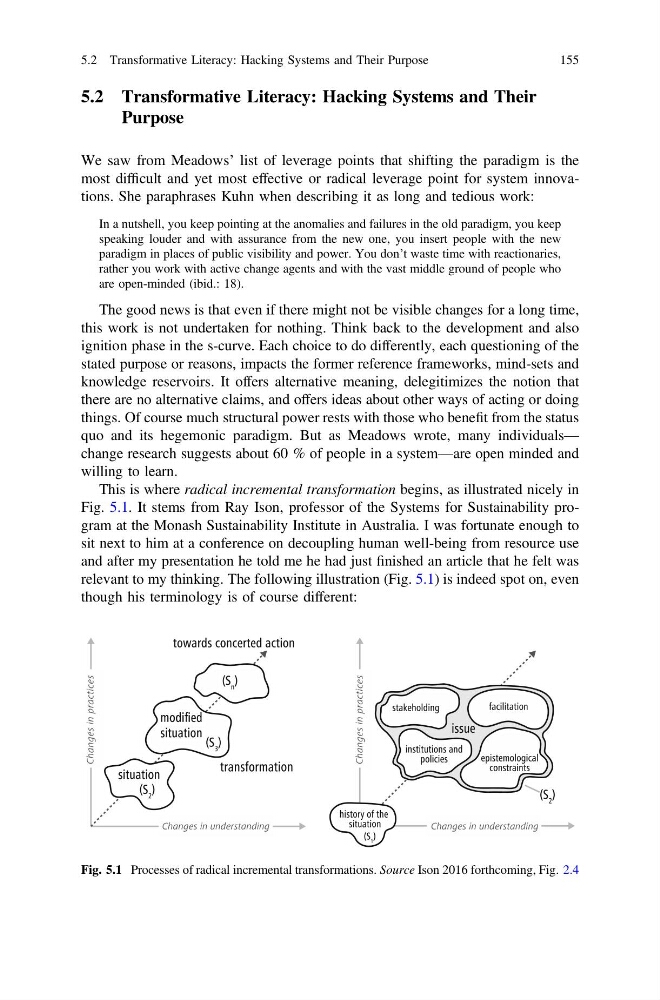
This is where radical incremental transformation begins, as illustrated nicely in
Fig. 5.1. It stems from Ray Ison, professor of the Systems for Sustainability program at the Monash Sustainability Institute in Australia. I was fortunate enough to
sit next to him at a conference on decoupling human well-being from resource use
and after my presentation he told me he had just finished an article that he felt was
relevant to my thinking. The following illustration (Fig. 5.1) is indeed spot on, even
though his terminology is of course different:
Fig. 5.1 Processes of radical incremental transformations. Source Ison 2016 forthcoming, Fig. 2.4
5.2 Transformative Literacy: Hacking Systems and Their Purpose
155
Purpose
We saw from Meadows’ list of leverage points that shifting the paradigm is the
most difficult and yet most effective or radical leverage point for system innovations. She paraphrases Kuhn when describing it as long and tedious work:
In a nutshell, you keep pointing at the anomalies and failures in the old paradigm, you keep
speaking louder and with assurance from the new one, you insert people with the new
paradigm in places of public visibility and power. You don’t waste time with reactionaries,
rather you work with active change agents and with the vast middle ground of people who
are open-minded (ibid.: 18).
The good news is that even if there might not be visible changes for a long time,
this work is not undertaken for nothing. Think back to the development and also
ignition phase in the s-curve. Each choice to do differently, each questioning of the
stated purpose or reasons, impacts the former reference frameworks, mind-sets and
knowledge reservoirs. It offers alternative meaning, delegitimizes the notion that
there are no alternative claims, and offers ideas about other ways of acting or doing
things. Of course much structural power rests with those who benefit from the status
quo and its hegemonic paradigm. But as Meadows wrote, many individuals—
change research suggests about 60 % of people in a system—are open minded and
willing to learn.
This is where radical incremental transformation begins, as illustrated nicely in
Fig. 5.1. It stems from Ray Ison, professor of the Systems for Sustainability program at the Monash Sustainability Institute in Australia. I was fortunate enough to
sit next to him at a conference on decoupling human well-being from resource use
and after my presentation he told me he had just finished an article that he felt was
relevant to my thinking. The following illustration (Fig. 5.1) is indeed spot on, even
though his terminology is of course different:
Fig. 5.1 Processes of radical incremental transformations. Source Ison 2016 forthcoming, Fig. 2.4
5.2 Transformative Literacy: Hacking Systems and Their Purpose
155