

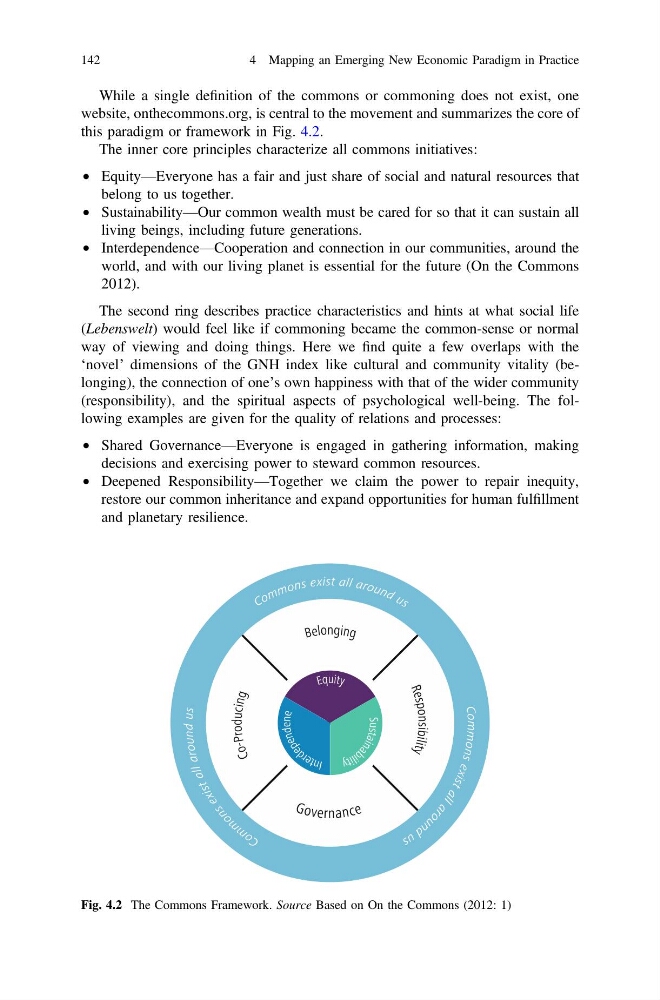
While a single definition of the commons or commoning does not exist, one
website, onthecommons.org, is central to the movement and summarizes the core of
this paradigm or framework in Fig. 4.2.
The inner core principles characterize all commons initiatives:
• Equity—Everyone has a fair and just share of social and natural resources that
belong to us together.
• Sustainability—Our common wealth must be cared for so that it can sustain all
living beings, including future generations.
• Interdependence—Cooperation and connection in our communities, around the
world, and with our living planet is essential for the future (On the Commons
2012).
The second ring describes practice characteristics and hints at what social life
(Lebenswelt) would feel like if commoning became the common-sense or normal
way of viewing and doing things. Here we find quite a few overlaps with the
‘novel’ dimensions of the GNH index like cultural and community vitality (belonging), the connection of one’s own happiness with that of the wider community
(responsibility), and the spiritual aspects of psychological well-being. The following examples are given for the quality of relations and processes:
• Shared Governance—Everyone is engaged in gathering information, making
decisions and exercising power to steward common resources.
• Deepened Responsibility—Together we claim the power to repair inequity,
restore our common inheritance and expand opportunities for human fulfillment
and planetary resilience.
Fig. 4.2 The Commons Framework. Source Based on On the Commons (2012: 1)
142
4 Mapping an Emerging New Economic Paradigm in Practice
website, onthecommons.org, is central to the movement and summarizes the core of
this paradigm or framework in Fig. 4.2.
The inner core principles characterize all commons initiatives:
• Equity—Everyone has a fair and just share of social and natural resources that
belong to us together.
• Sustainability—Our common wealth must be cared for so that it can sustain all
living beings, including future generations.
• Interdependence—Cooperation and connection in our communities, around the
world, and with our living planet is essential for the future (On the Commons
2012).
The second ring describes practice characteristics and hints at what social life
(Lebenswelt) would feel like if commoning became the common-sense or normal
way of viewing and doing things. Here we find quite a few overlaps with the
‘novel’ dimensions of the GNH index like cultural and community vitality (belonging), the connection of one’s own happiness with that of the wider community
(responsibility), and the spiritual aspects of psychological well-being. The following examples are given for the quality of relations and processes:
• Shared Governance—Everyone is engaged in gathering information, making
decisions and exercising power to steward common resources.
• Deepened Responsibility—Together we claim the power to repair inequity,
restore our common inheritance and expand opportunities for human fulfillment
and planetary resilience.
Fig. 4.2 The Commons Framework. Source Based on On the Commons (2012: 1)
142
4 Mapping an Emerging New Economic Paradigm in Practice