

‘means’ or ‘goods’ so that they captured real accessibility and scarcity or
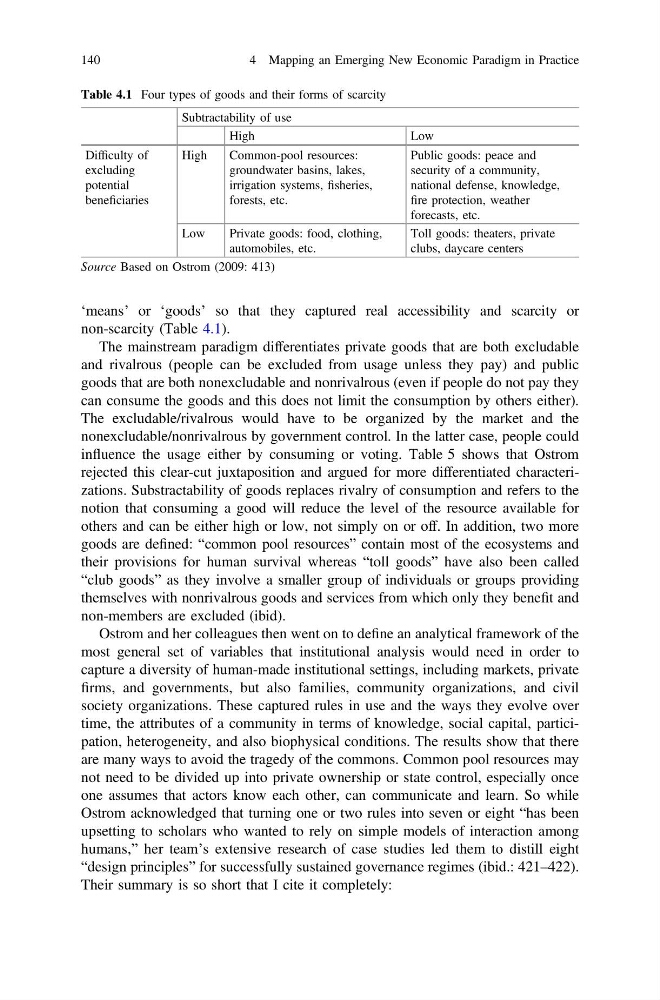
non-scarcity (Table 4.1).
The mainstream paradigm differentiates private goods that are both excludable
and rivalrous (people can be excluded from usage unless they pay) and public
goods that are both nonexcludable and nonrivalrous (even if people do not pay they
can consume the goods and this does not limit the consumption by others either).
The excludable/rivalrous would have to be organized by the market and the
nonexcludable/nonrivalrous by government control. In the latter case, people could
influence the usage either by consuming or voting. Table 5 shows that Ostrom
rejected this clear-cut juxtaposition and argued for more differentiated characterizations. Substractability of goods replaces rivalry of consumption and refers to the
notion that consuming a good will reduce the level of the resource available for
others and can be either high or low, not simply on or off. In addition, two more
goods are defined: “common pool resources” contain most of the ecosystems and
their provisions for human survival whereas “toll goods” have also been called
“club goods” as they involve a smaller group of individuals or groups providing
themselves with nonrivalrous goods and services from which only they benefit and
non-members are excluded (ibid).
Ostrom and her colleagues then went on to define an analytical framework of the
most general set of variables that institutional analysis would need in order to
capture a diversity of human-made institutional settings, including markets, private
firms, and governments, but also families, community organizations, and civil
society organizations. These captured rules in use and the ways they evolve over
time, the attributes of a community in terms of knowledge, social capital, participation, heterogeneity, and also biophysical conditions. The results show that there
are many ways to avoid the tragedy of the commons. Common pool resources may
not need to be divided up into private ownership or state control, especially once
one assumes that actors know each other, can communicate and learn. So while
Ostrom acknowledged that turning one or two rules into seven or eight “has been
upsetting to scholars who wanted to rely on simple models of interaction among
humans,” her team’s extensive research of case studies led them to distill eight
“design principles” for successfully sustained governance regimes (ibid.: 421–422).
Their summary is so short that I cite it completely:
Table 4.1 Four types of goods and their forms of scarcity
Subtractability of use
High
Low
Difficulty of
excluding
potential
beneficiaries
High
Common-pool resources:
groundwater basins, lakes,
irrigation systems, fisheries,
forests, etc.
Public goods: peace and
security of a community,
national defense, knowledge,
fire protection, weather
forecasts, etc.
Low
Private goods: food, clothing,
automobiles, etc.
Toll goods: theaters, private
clubs, daycare centers
Source Based on Ostrom (2009: 413)
140
4 Mapping an Emerging New Economic Paradigm in Practice
non-scarcity (Table 4.1).
The mainstream paradigm differentiates private goods that are both excludable
and rivalrous (people can be excluded from usage unless they pay) and public
goods that are both nonexcludable and nonrivalrous (even if people do not pay they
can consume the goods and this does not limit the consumption by others either).
The excludable/rivalrous would have to be organized by the market and the
nonexcludable/nonrivalrous by government control. In the latter case, people could
influence the usage either by consuming or voting. Table 5 shows that Ostrom
rejected this clear-cut juxtaposition and argued for more differentiated characterizations. Substractability of goods replaces rivalry of consumption and refers to the
notion that consuming a good will reduce the level of the resource available for
others and can be either high or low, not simply on or off. In addition, two more
goods are defined: “common pool resources” contain most of the ecosystems and
their provisions for human survival whereas “toll goods” have also been called
“club goods” as they involve a smaller group of individuals or groups providing
themselves with nonrivalrous goods and services from which only they benefit and
non-members are excluded (ibid).
Ostrom and her colleagues then went on to define an analytical framework of the
most general set of variables that institutional analysis would need in order to
capture a diversity of human-made institutional settings, including markets, private
firms, and governments, but also families, community organizations, and civil
society organizations. These captured rules in use and the ways they evolve over
time, the attributes of a community in terms of knowledge, social capital, participation, heterogeneity, and also biophysical conditions. The results show that there
are many ways to avoid the tragedy of the commons. Common pool resources may
not need to be divided up into private ownership or state control, especially once
one assumes that actors know each other, can communicate and learn. So while
Ostrom acknowledged that turning one or two rules into seven or eight “has been
upsetting to scholars who wanted to rely on simple models of interaction among
humans,” her team’s extensive research of case studies led them to distill eight
“design principles” for successfully sustained governance regimes (ibid.: 421–422).
Their summary is so short that I cite it completely:
Table 4.1 Four types of goods and their forms of scarcity
Subtractability of use
High
Low
Difficulty of
excluding
potential
beneficiaries
High
Common-pool resources:
groundwater basins, lakes,
irrigation systems, fisheries,
forests, etc.
Public goods: peace and
security of a community,
national defense, knowledge,
fire protection, weather
forecasts, etc.
Low
Private goods: food, clothing,
automobiles, etc.
Toll goods: theaters, private
clubs, daycare centers
Source Based on Ostrom (2009: 413)
140
4 Mapping an Emerging New Economic Paradigm in Practice