

Maintaining an unequivocal imaginary and narrative of endless growth might be
politically easier and convenient for privileged groups but cannot be backed by
evidence drawn from the natural sciences of the twenty-first century.
3.2.3 Checking Nature’s Safe Operating Spaces for Human
Growth Aspirations
The third and fourth rows in Table 3.1 bring us to a deeper understanding of why
only economists can argue for unlimited growth. The most popular argument we
hear is that one can decouple economic growth from natural resource use. Make
more with less. There is nothing to say against the efficient and sparing use of
natural resources, but relative savings should not be confused with an absolute
reduction of human-caused exploitation levels. Raw material extraction levels
reached 70 billion tons in 2008. This is unprecedented not only in total but also in
the amount per person: about 10.5 tons. Of course these numbers vary widely
between countries, being lower in India and China and higher in Australia and Chile
(Wiedmann et al. 2015: 6273–75). So it seems like good news that global average
resource intensity or relative decoupling as measured in the standard indicator of
Domestic Material Consumption per unit of GDP (DMC/GDP) has decreased
significantly from 3.6 kg/$ in 1900 to 1.3 kg/$ in 2005 (Wiedmann et al. 2015:
6271). Otherwise the world would look like a big mine shaft. With this indicator, as
OECD reports summarize, it also looks like some countries such as Canada,
Germany, Italy and Japan have decoupled DMC from economic growth in absolute
terms. They get richer but no longer need more natural resources.
Yet, a discussion of the rebound effect hinted that current consumption and
market patterns do give price signals that suggest using fewer resources per product
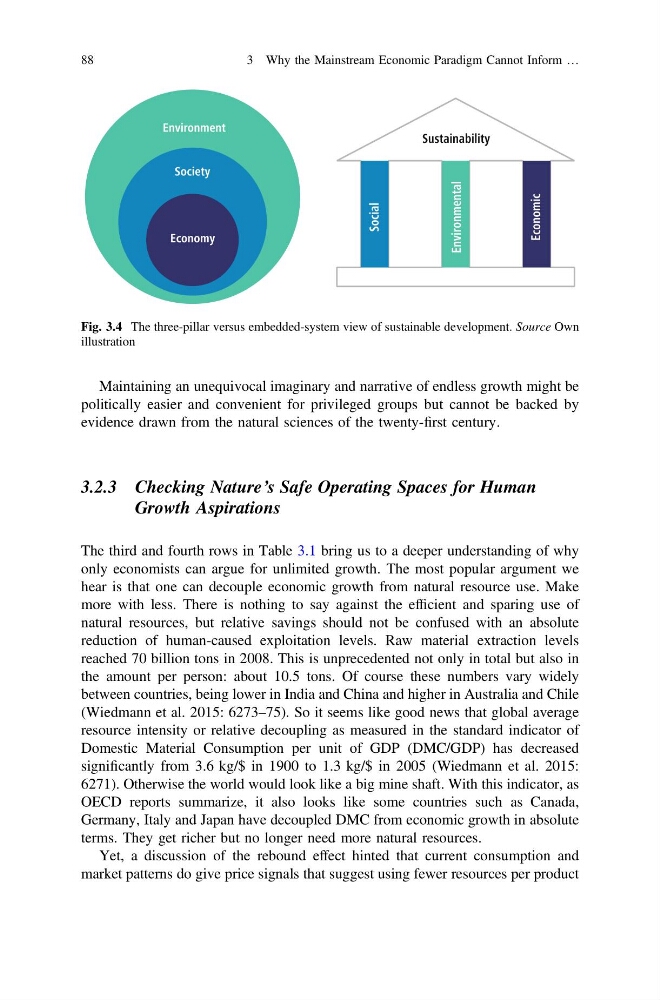
Fig. 3.4 The three-pillar versus embedded-system view of sustainable development. Source Own
illustration
88
3 Why the Mainstream Economic Paradigm Cannot Inform …
politically easier and convenient for privileged groups but cannot be backed by
evidence drawn from the natural sciences of the twenty-first century.
3.2.3 Checking Nature’s Safe Operating Spaces for Human
Growth Aspirations
The third and fourth rows in Table 3.1 bring us to a deeper understanding of why
only economists can argue for unlimited growth. The most popular argument we
hear is that one can decouple economic growth from natural resource use. Make
more with less. There is nothing to say against the efficient and sparing use of
natural resources, but relative savings should not be confused with an absolute
reduction of human-caused exploitation levels. Raw material extraction levels
reached 70 billion tons in 2008. This is unprecedented not only in total but also in
the amount per person: about 10.5 tons. Of course these numbers vary widely
between countries, being lower in India and China and higher in Australia and Chile
(Wiedmann et al. 2015: 6273–75). So it seems like good news that global average
resource intensity or relative decoupling as measured in the standard indicator of
Domestic Material Consumption per unit of GDP (DMC/GDP) has decreased
significantly from 3.6 kg/$ in 1900 to 1.3 kg/$ in 2005 (Wiedmann et al. 2015:
6271). Otherwise the world would look like a big mine shaft. With this indicator, as
OECD reports summarize, it also looks like some countries such as Canada,
Germany, Italy and Japan have decoupled DMC from economic growth in absolute
terms. They get richer but no longer need more natural resources.
Yet, a discussion of the rebound effect hinted that current consumption and
market patterns do give price signals that suggest using fewer resources per product
Fig. 3.4 The three-pillar versus embedded-system view of sustainable development. Source Own
illustration
88
3 Why the Mainstream Economic Paradigm Cannot Inform …