

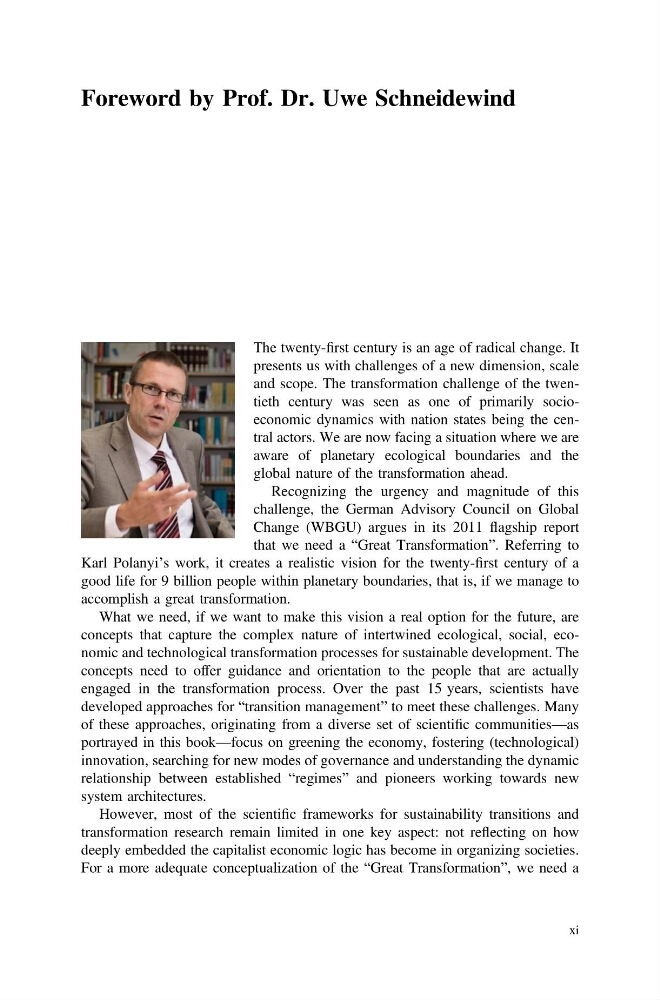
Foreword by Prof. Dr. Uwe Schneidewind
The twenty-first century is an age of radical change. It
presents us with challenges of a new dimension, scale
and scope. The transformation challenge of the twentieth century was seen as one of primarily socioeconomic dynamics with nation states being the central actors. We are now facing a situation where we are
aware of planetary ecological boundaries and the
global nature of the transformation ahead.
Recognizing the urgency and magnitude of this
challenge, the German Advisory Council on Global
Change (WBGU) argues in its 2011 flagship report
that we need a “Great Transformation”. Referring to
Karl Polanyi’s work, it creates a realistic vision for the twenty-first century of a
good life for 9 billion people within planetary boundaries, that is, if we manage to
accomplish a great transformation.
What we need, if we want to make this vision a real option for the future, are
concepts that capture the complex nature of intertwined ecological, social, economic and technological transformation processes for sustainable development. The
concepts need to offer guidance and orientation to the people that are actually
engaged in the transformation process. Over the past 15 years, scientists have
developed approaches for “transition management” to meet these challenges. Many
of these approaches, originating from a diverse set of scientific communities—as
portrayed in this book—focus on greening the economy, fostering (technological)
innovation, searching for new modes of governance and understanding the dynamic
relationship between established “regimes” and pioneers working towards new
system architectures.
However, most of the scientific frameworks for sustainability transitions and
transformation research remain limited in one key aspect: not reflecting on how
deeply embedded the capitalist economic logic has become in organizing societies.
For a more adequate conceptualization of the “Great Transformation”, we need a
xi
The twenty-first century is an age of radical change. It
presents us with challenges of a new dimension, scale
and scope. The transformation challenge of the twentieth century was seen as one of primarily socioeconomic dynamics with nation states being the central actors. We are now facing a situation where we are
aware of planetary ecological boundaries and the
global nature of the transformation ahead.
Recognizing the urgency and magnitude of this
challenge, the German Advisory Council on Global
Change (WBGU) argues in its 2011 flagship report
that we need a “Great Transformation”. Referring to
Karl Polanyi’s work, it creates a realistic vision for the twenty-first century of a
good life for 9 billion people within planetary boundaries, that is, if we manage to
accomplish a great transformation.
What we need, if we want to make this vision a real option for the future, are
concepts that capture the complex nature of intertwined ecological, social, economic and technological transformation processes for sustainable development. The
concepts need to offer guidance and orientation to the people that are actually
engaged in the transformation process. Over the past 15 years, scientists have
developed approaches for “transition management” to meet these challenges. Many
of these approaches, originating from a diverse set of scientific communities—as
portrayed in this book—focus on greening the economy, fostering (technological)
innovation, searching for new modes of governance and understanding the dynamic
relationship between established “regimes” and pioneers working towards new
system architectures.
However, most of the scientific frameworks for sustainability transitions and
transformation research remain limited in one key aspect: not reflecting on how
deeply embedded the capitalist economic logic has become in organizing societies.
For a more adequate conceptualization of the “Great Transformation”, we need a
xi