

downstream application in the pharmaceutical industry is clearly intended. The
search thus excluded LCAs in the broader field of green chemistry and in the
healthcare sector in general (e.g. medical equipment). Using search terms such as
“Life Cycle Assessment”, “LCA”, and “footprint” in combination with ‘pharmaceutical*’ or ‘fine chemical*’ on Google Scholar has so far yielded a notably
limited number of ‘pure’ pharma-LCAs (<30 studies) which have been published in
peer-reviewed journals. These LCAs were conducted for a myriad of purposes,
including comparative assessments of different synthesis routes, processing modes
(e.g. batch vs. continuous processing), drug formulations, varying dosages and
packaging options.
The LCA-studies examined thus far have with very few exceptions all performed
a cradle-to-gate analysis, while often criticizing the lack of sufficient data beyond
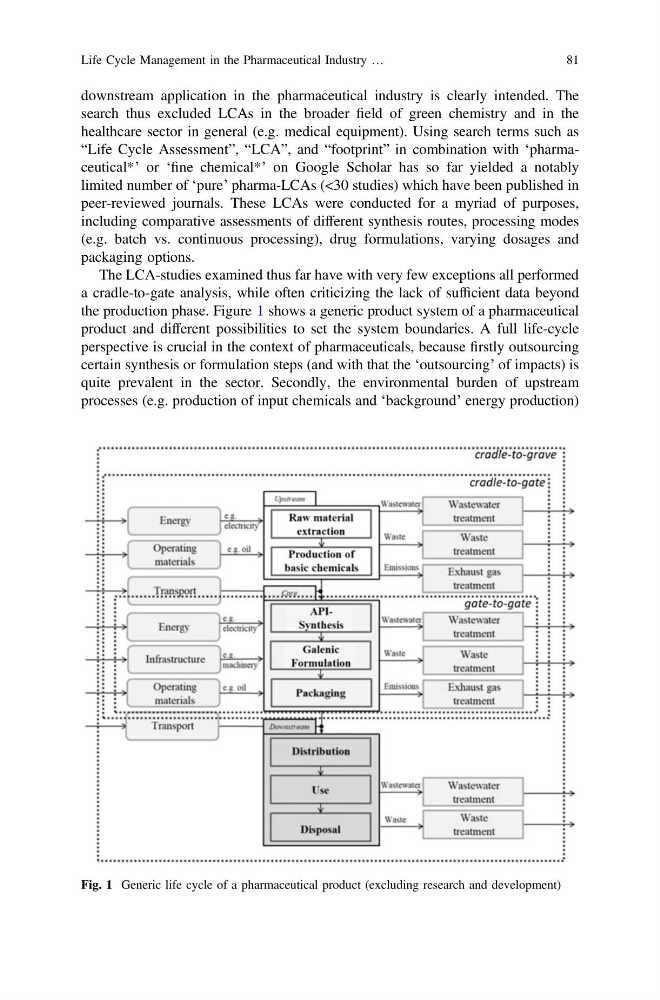
the production phase. Figure 1 shows a generic product system of a pharmaceutical
product and different possibilities to set the system boundaries. A full life-cycle
perspective is crucial in the context of pharmaceuticals, because firstly outsourcing
certain synthesis or formulation steps (and with that the ‘outsourcing’ of impacts) is
quite prevalent in the sector. Secondly, the environmental burden of upstream
processes (e.g. production of input chemicals and ‘background’ energy production)
Fig. 1 Generic life cycle of a pharmaceutical product (excluding research and development)
Life Cycle Management in the Pharmaceutical Industry …
81
search thus excluded LCAs in the broader field of green chemistry and in the
healthcare sector in general (e.g. medical equipment). Using search terms such as
“Life Cycle Assessment”, “LCA”, and “footprint” in combination with ‘pharmaceutical*’ or ‘fine chemical*’ on Google Scholar has so far yielded a notably
limited number of ‘pure’ pharma-LCAs (<30 studies) which have been published in
peer-reviewed journals. These LCAs were conducted for a myriad of purposes,
including comparative assessments of different synthesis routes, processing modes
(e.g. batch vs. continuous processing), drug formulations, varying dosages and
packaging options.
The LCA-studies examined thus far have with very few exceptions all performed
a cradle-to-gate analysis, while often criticizing the lack of sufficient data beyond
the production phase. Figure 1 shows a generic product system of a pharmaceutical
product and different possibilities to set the system boundaries. A full life-cycle
perspective is crucial in the context of pharmaceuticals, because firstly outsourcing
certain synthesis or formulation steps (and with that the ‘outsourcing’ of impacts) is
quite prevalent in the sector. Secondly, the environmental burden of upstream
processes (e.g. production of input chemicals and ‘background’ energy production)
Fig. 1 Generic life cycle of a pharmaceutical product (excluding research and development)
Life Cycle Management in the Pharmaceutical Industry …
81