

significantly, it will improve their environmental impacts considerably which will
bring environmental performances closer to the one from organic cotton. It is
anticipated that fertilisers consumption can further be optimised which would
further result in mitigation of environmental impacts. Moreover, BCI cotton is a
holistic approach to sustainable cotton production which covers all three pillars of
sustainability: environmental, social and economic. The system is designed to
ensure the exchange of good practices, and to encourage the scaling up of collective
action. In case of organic farming, the only additives come in the form of manures,
and the soil quality is controlled by crop rotation. The impact on the environment is
reduced drastically. Organic farming is best suited for small and marginal farms.
Overall, the region of India considered in the study has been battered by multiple
droughts and considered amongst the least developed with farmers having poor
socio-economic living conditions due to rising cost and declining production yield.
With continuous efforts on implementation of BCI initiative and organic cotton
farming, Arvind Limited brought around an economic transformation with thousands of farmers, enhancing their farm productivity. The details of environmental
performances effects are discussed later in this chapter.
Figure 2 shows the LCIA contribution analysis for all three farming practices.
Acidification Potential (AP): Acidification Potential is calculated in terms of kg
SO 2 -eq/1 ton of cotton seed. Nitrogen oxide, Sulphur dioxide and Ammonia are the
major contributor for this impact category. Ammonia released from field emissions
is the highest contributor for the three practices (7.47 kg for conventional, 6.93 kg
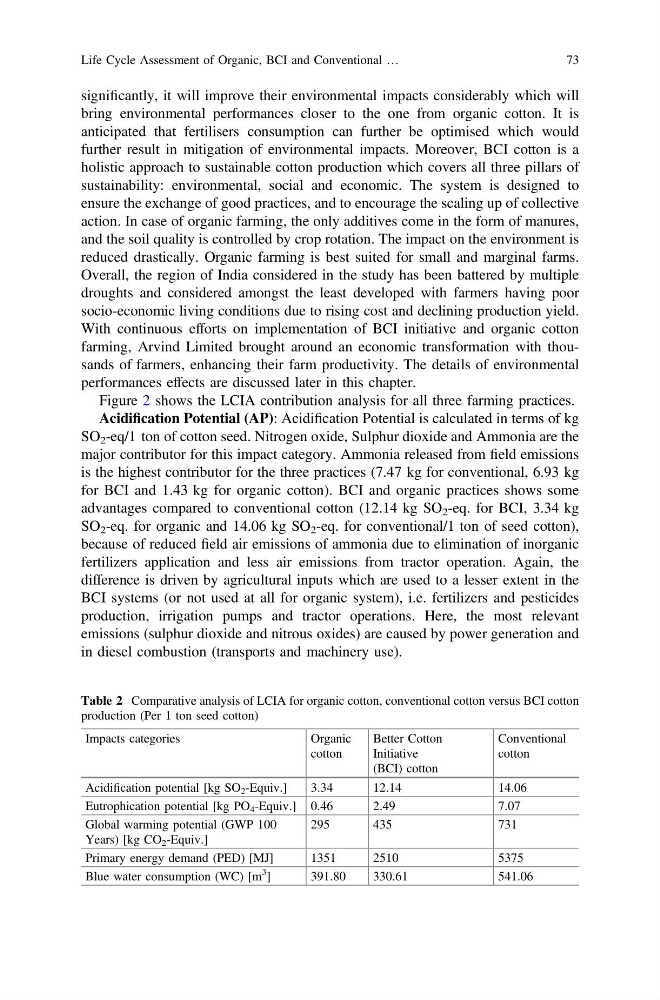
for BCI and 1.43 kg for organic cotton). BCI and organic practices shows some
advantages compared to conventional cotton (12.14 kg SO 2 -eq. for BCI, 3.34 kg
SO 2 -eq. for organic and 14.06 kg SO 2 -eq. for conventional/1 ton of seed cotton),
because of reduced field air emissions of ammonia due to elimination of inorganic
fertilizers application and less air emissions from tractor operation. Again, the
difference is driven by agricultural inputs which are used to a lesser extent in the
BCI systems (or not used at all for organic system), i.e. fertilizers and pesticides
production, irrigation pumps and tractor operations. Here, the most relevant
emissions (sulphur dioxide and nitrous oxides) are caused by power generation and
in diesel combustion (transports and machinery use).
Table 2 Comparative analysis of LCIA for organic cotton, conventional cotton versus BCI cotton
production (Per 1 ton seed cotton)
Impacts categories
Organic
cotton
Better Cotton
Initiative
(BCI) cotton
Conventional
cotton
Acidification potential [kg SO 2 -Equiv.]
3.34
12.14
14.06
Eutrophication potential [kg PO 4 -Equiv.] 0.46
2.49
7.07
Global warming potential (GWP 100
Years) [kg CO 2 -Equiv.]
295
435
731
Primary energy demand (PED) [MJ]
1351
2510
5375
Blue water consumption (WC) [m
3
]
391.80
330.61
541.06
Life Cycle Assessment of Organic, BCI and Conventional …
73
bring environmental performances closer to the one from organic cotton. It is
anticipated that fertilisers consumption can further be optimised which would
further result in mitigation of environmental impacts. Moreover, BCI cotton is a
holistic approach to sustainable cotton production which covers all three pillars of
sustainability: environmental, social and economic. The system is designed to
ensure the exchange of good practices, and to encourage the scaling up of collective
action. In case of organic farming, the only additives come in the form of manures,
and the soil quality is controlled by crop rotation. The impact on the environment is
reduced drastically. Organic farming is best suited for small and marginal farms.
Overall, the region of India considered in the study has been battered by multiple
droughts and considered amongst the least developed with farmers having poor
socio-economic living conditions due to rising cost and declining production yield.
With continuous efforts on implementation of BCI initiative and organic cotton
farming, Arvind Limited brought around an economic transformation with thousands of farmers, enhancing their farm productivity. The details of environmental
performances effects are discussed later in this chapter.
Figure 2 shows the LCIA contribution analysis for all three farming practices.
Acidification Potential (AP): Acidification Potential is calculated in terms of kg
SO 2 -eq/1 ton of cotton seed. Nitrogen oxide, Sulphur dioxide and Ammonia are the
major contributor for this impact category. Ammonia released from field emissions
is the highest contributor for the three practices (7.47 kg for conventional, 6.93 kg
for BCI and 1.43 kg for organic cotton). BCI and organic practices shows some
advantages compared to conventional cotton (12.14 kg SO 2 -eq. for BCI, 3.34 kg
SO 2 -eq. for organic and 14.06 kg SO 2 -eq. for conventional/1 ton of seed cotton),
because of reduced field air emissions of ammonia due to elimination of inorganic
fertilizers application and less air emissions from tractor operation. Again, the
difference is driven by agricultural inputs which are used to a lesser extent in the
BCI systems (or not used at all for organic system), i.e. fertilizers and pesticides
production, irrigation pumps and tractor operations. Here, the most relevant
emissions (sulphur dioxide and nitrous oxides) are caused by power generation and
in diesel combustion (transports and machinery use).
Table 2 Comparative analysis of LCIA for organic cotton, conventional cotton versus BCI cotton
production (Per 1 ton seed cotton)
Impacts categories
Organic
cotton
Better Cotton
Initiative
(BCI) cotton
Conventional
cotton
Acidification potential [kg SO 2 -Equiv.]
3.34
12.14
14.06
Eutrophication potential [kg PO 4 -Equiv.] 0.46
2.49
7.07
Global warming potential (GWP 100
Years) [kg CO 2 -Equiv.]
295
435
731
Primary energy demand (PED) [MJ]
1351
2510
5375
Blue water consumption (WC) [m
3
]
391.80
330.61
541.06
Life Cycle Assessment of Organic, BCI and Conventional …
73