

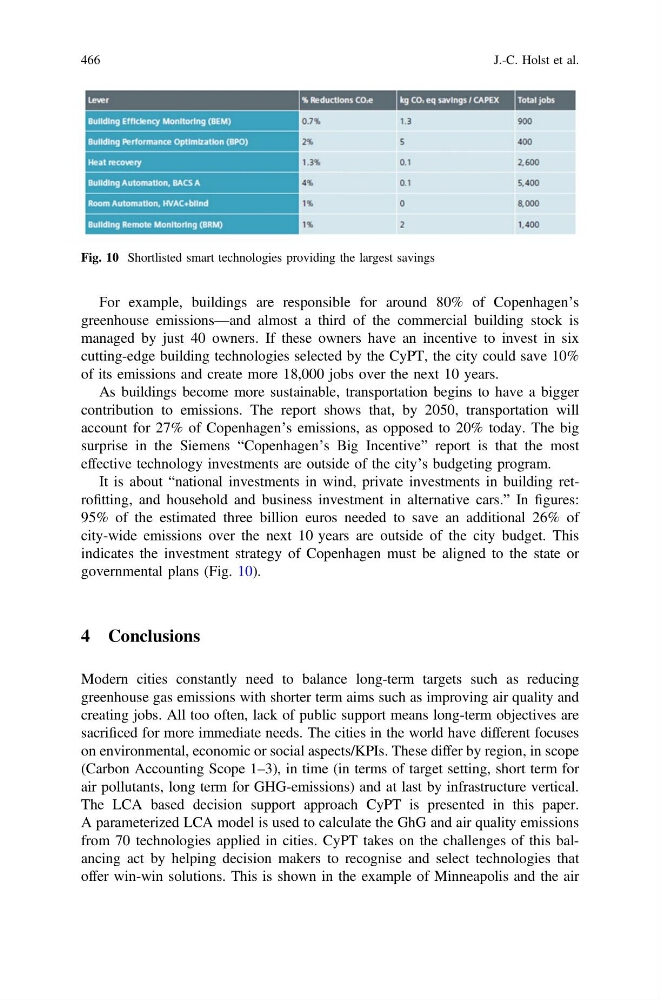
For example, buildings are responsible for around 80% of Copenhagen’s
greenhouse emissions—and almost a third of the commercial building stock is
managed by just 40 owners. If these owners have an incentive to invest in six
cutting-edge building technologies selected by the CyPT, the city could save 10%
of its emissions and create more 18,000 jobs over the next 10 years.
As buildings become more sustainable, transportation begins to have a bigger
contribution to emissions. The report shows that, by 2050, transportation will
account for 27% of Copenhagen’s emissions, as opposed to 20% today. The big
surprise in the Siemens “Copenhagen’s Big Incentive” report is that the most
effective technology investments are outside of the city’s budgeting program.
It is about “national investments in wind, private investments in building retrofitting, and household and business investment in alternative cars.” In figures:
95% of the estimated three billion euros needed to save an additional 26% of
city-wide emissions over the next 10 years are outside of the city budget. This
indicates the investment strategy of Copenhagen must be aligned to the state or
governmental plans (Fig. 10).
4 Conclusions
Modern cities constantly need to balance long-term targets such as reducing
greenhouse gas emissions with shorter term aims such as improving air quality and
creating jobs. All too often, lack of public support means long-term objectives are
sacrificed for more immediate needs. The cities in the world have different focuses
on environmental, economic or social aspects/KPIs. These differ by region, in scope
(Carbon Accounting Scope 1–3), in time (in terms of target setting, short term for
air pollutants, long term for GHG-emissions) and at last by infrastructure vertical.
The LCA based decision support approach CyPT is presented in this paper.
A parameterized LCA model is used to calculate the GhG and air quality emissions
from 70 technologies applied in cities. CyPT takes on the challenges of this balancing act by helping decision makers to recognise and select technologies that
offer win-win solutions. This is shown in the example of Minneapolis and the air
Fig. 10 Shortlisted smart technologies providing the largest savings
466
J.-C. Holst et al.
greenhouse emissions—and almost a third of the commercial building stock is
managed by just 40 owners. If these owners have an incentive to invest in six
cutting-edge building technologies selected by the CyPT, the city could save 10%
of its emissions and create more 18,000 jobs over the next 10 years.
As buildings become more sustainable, transportation begins to have a bigger
contribution to emissions. The report shows that, by 2050, transportation will
account for 27% of Copenhagen’s emissions, as opposed to 20% today. The big
surprise in the Siemens “Copenhagen’s Big Incentive” report is that the most
effective technology investments are outside of the city’s budgeting program.
It is about “national investments in wind, private investments in building retrofitting, and household and business investment in alternative cars.” In figures:
95% of the estimated three billion euros needed to save an additional 26% of
city-wide emissions over the next 10 years are outside of the city budget. This
indicates the investment strategy of Copenhagen must be aligned to the state or
governmental plans (Fig. 10).
4 Conclusions
Modern cities constantly need to balance long-term targets such as reducing
greenhouse gas emissions with shorter term aims such as improving air quality and
creating jobs. All too often, lack of public support means long-term objectives are
sacrificed for more immediate needs. The cities in the world have different focuses
on environmental, economic or social aspects/KPIs. These differ by region, in scope
(Carbon Accounting Scope 1–3), in time (in terms of target setting, short term for
air pollutants, long term for GHG-emissions) and at last by infrastructure vertical.
The LCA based decision support approach CyPT is presented in this paper.
A parameterized LCA model is used to calculate the GhG and air quality emissions
from 70 technologies applied in cities. CyPT takes on the challenges of this balancing act by helping decision makers to recognise and select technologies that
offer win-win solutions. This is shown in the example of Minneapolis and the air
Fig. 10 Shortlisted smart technologies providing the largest savings
466
J.-C. Holst et al.