

6 Conclusions
This paper illustrated the use of LCA methods to link human wellbeing to resource
consumption. This linkage enables sectoral LCA analyses to be integrated and
compared for use in holistic development policy planning. This provides policymakers with insights on trade-offs, and helps assign priorities among sectors. We
illustrate the relative contribution of technological uncertainty in different sectors,
as well the trade-offs between upfront and long-term operating energy costs. We
also show how these trade-offs differ in different geographic conditions, illustrated
with India and Brazil.
We did not aim for this study to provide comprehensive empirical findings on
development energy needs—for instance, we do not include here the energy
associated with building out infrastructure to meet development gaps—rather, we
focused on annual energy outflows and their drivers. We illustrate, nevertheless,
several empirical insights. For instance, the transport sector dominates energy needs
to meet a basic living standard in Brazil, but not in India. In both country we show
that traditional building materials in the long term may offer a win-win for both
reducing energy use and costs of housing.
References
1. Finnveden G, et al., Recent developments in Life Cycle Assessment, Journal of Environmental
Management, Vol. 91, 2009, pp. 1–21.
2. http://economictimes.indiatimes.com/news/economy/infrastructure/india-needs-1-5-trillion-forinfrastructure-arun-jaitley/printarticle/52922015.cms, (Accessed 15.06.2017).
3. Tiwari P, Rao J, Day J, Development Paradigms for Urban Housing in BRICS Countries. 2016.
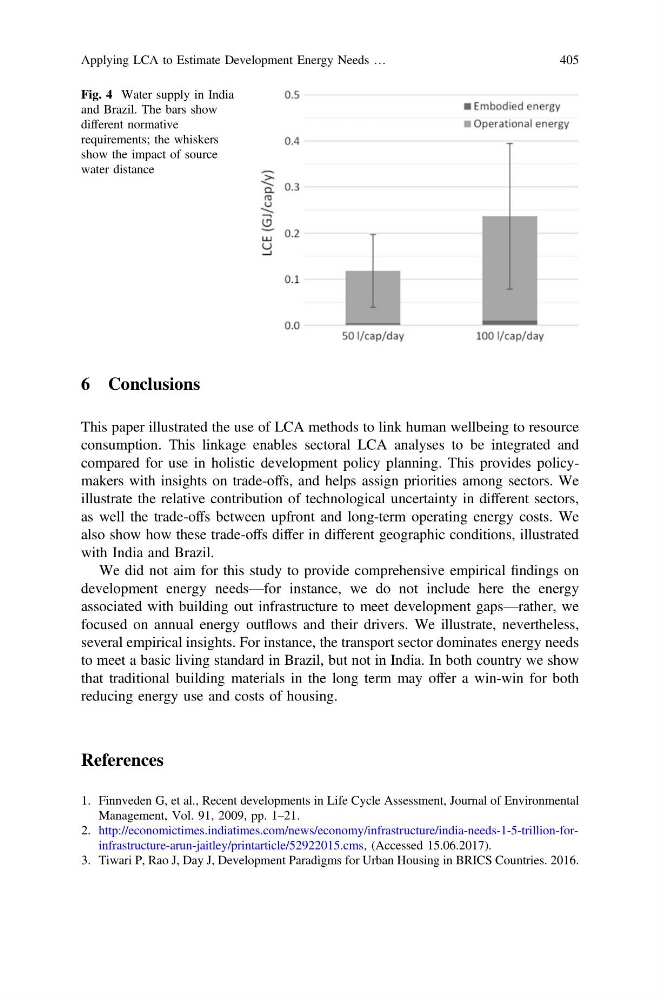
Fig. 4 Water supply in India
and Brazil. The bars show
different normative
requirements; the whiskers
show the impact of source
water distance
Applying LCA to Estimate Development Energy Needs …
405
This paper illustrated the use of LCA methods to link human wellbeing to resource
consumption. This linkage enables sectoral LCA analyses to be integrated and
compared for use in holistic development policy planning. This provides policymakers with insights on trade-offs, and helps assign priorities among sectors. We
illustrate the relative contribution of technological uncertainty in different sectors,
as well the trade-offs between upfront and long-term operating energy costs. We
also show how these trade-offs differ in different geographic conditions, illustrated
with India and Brazil.
We did not aim for this study to provide comprehensive empirical findings on
development energy needs—for instance, we do not include here the energy
associated with building out infrastructure to meet development gaps—rather, we
focused on annual energy outflows and their drivers. We illustrate, nevertheless,
several empirical insights. For instance, the transport sector dominates energy needs
to meet a basic living standard in Brazil, but not in India. In both country we show
that traditional building materials in the long term may offer a win-win for both
reducing energy use and costs of housing.
References
1. Finnveden G, et al., Recent developments in Life Cycle Assessment, Journal of Environmental
Management, Vol. 91, 2009, pp. 1–21.
2. http://economictimes.indiatimes.com/news/economy/infrastructure/india-needs-1-5-trillion-forinfrastructure-arun-jaitley/printarticle/52922015.cms, (Accessed 15.06.2017).
3. Tiwari P, Rao J, Day J, Development Paradigms for Urban Housing in BRICS Countries. 2016.
Fig. 4 Water supply in India
and Brazil. The bars show
different normative
requirements; the whiskers
show the impact of source
water distance
Applying LCA to Estimate Development Energy Needs …
405