

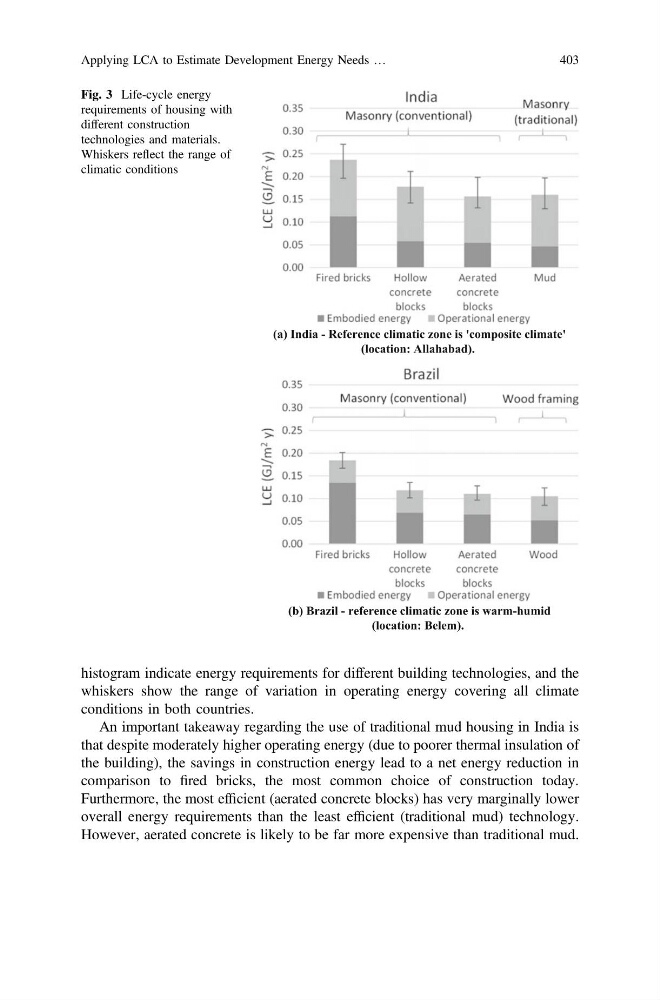
histogram indicate energy requirements for different building technologies, and the
whiskers show the range of variation in operating energy covering all climate
conditions in both countries.
An important takeaway regarding the use of traditional mud housing in India is
that despite moderately higher operating energy (due to poorer thermal insulation of
the building), the savings in construction energy lead to a net energy reduction in
comparison to fired bricks, the most common choice of construction today.
Furthermore, the most efficient (aerated concrete blocks) has very marginally lower
overall energy requirements than the least efficient (traditional mud) technology.
However, aerated concrete is likely to be far more expensive than traditional mud.
(a) India - Reference climatic zone is 'composite climate'
(location: Allahabad).
(b) Brazil - reference climatic zone is warm-humid
(location: Belem).
Fig. 3 Life-cycle energy
requirements of housing with
different construction
technologies and materials.
Whiskers reflect the range of
climatic conditions
Applying LCA to Estimate Development Energy Needs …
403
whiskers show the range of variation in operating energy covering all climate
conditions in both countries.
An important takeaway regarding the use of traditional mud housing in India is
that despite moderately higher operating energy (due to poorer thermal insulation of
the building), the savings in construction energy lead to a net energy reduction in
comparison to fired bricks, the most common choice of construction today.
Furthermore, the most efficient (aerated concrete blocks) has very marginally lower
overall energy requirements than the least efficient (traditional mud) technology.
However, aerated concrete is likely to be far more expensive than traditional mud.
(a) India - Reference climatic zone is 'composite climate'
(location: Allahabad).
(b) Brazil - reference climatic zone is warm-humid
(location: Belem).
Fig. 3 Life-cycle energy
requirements of housing with
different construction
technologies and materials.
Whiskers reflect the range of
climatic conditions
Applying LCA to Estimate Development Energy Needs …
403