

identified by the manufacturing department as well as the engineers wanting to
make a difference. It also became clear that communication between design and
manufacturing had to be enhanced, and that a tool in the form of a checklist could
help in strengthening that communication.
Finally regarding the identification of users, involved actors, inputs and useful
outputs that tools need to consider and/or provide in order to support decision-making
in the early stages of design, the EnvS tool(s) at Volvo Group identified the users of the
tool as personnel from the manufacturing, engineering, purchasing, aftermarket and
styling departments. The inputs for the tool came from external and internal sources,
an example being the increasing awareness of environmental impact and enthusiasm
from the engineering department to change the status quo.
The outputs are then useful for analysing decisions and acting on them.
Information from a Design for Remanufacturing (DfReman), Design for Recycling
(DfRecycling) or LCA study are some of the inputs to the EnvS checklist then
providing outputs for actions such as choice of concept improvement of supplier
demands and compliance with ISO 14001. It also illustrates that a checklist can
serve the purpose of addressing both design and management decisions.
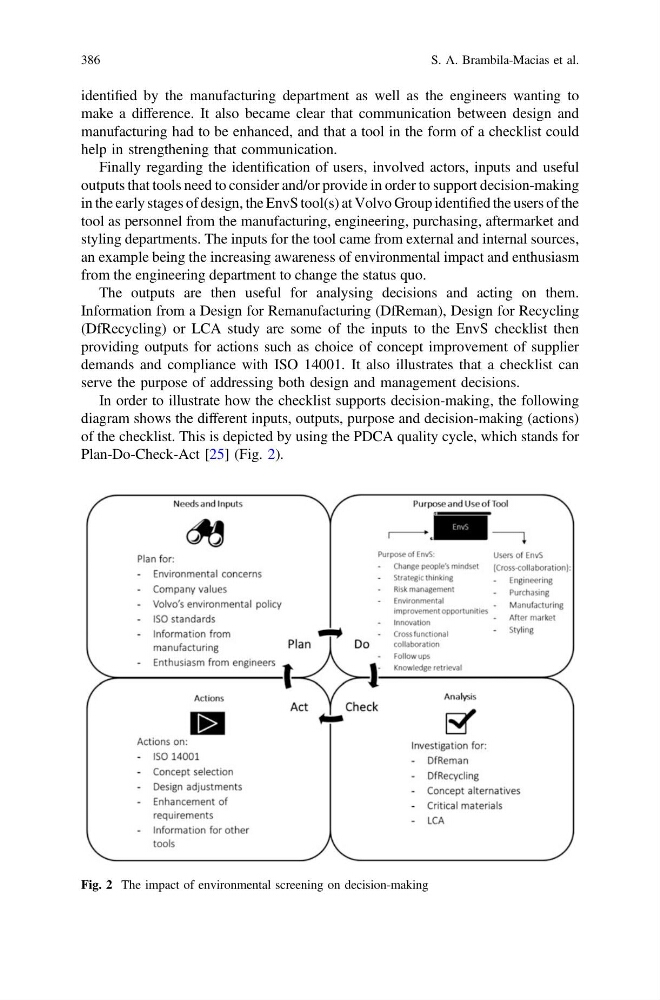
In order to illustrate how the checklist supports decision-making, the following
diagram shows the different inputs, outputs, purpose and decision-making (actions)
of the checklist. This is depicted by using the PDCA quality cycle, which stands for
Plan-Do-Check-Act [25] (Fig. 2).
Fig. 2 The impact of environmental screening on decision-making
386
S. A. Brambila-Macias et al.
make a difference. It also became clear that communication between design and
manufacturing had to be enhanced, and that a tool in the form of a checklist could
help in strengthening that communication.
Finally regarding the identification of users, involved actors, inputs and useful
outputs that tools need to consider and/or provide in order to support decision-making
in the early stages of design, the EnvS tool(s) at Volvo Group identified the users of the
tool as personnel from the manufacturing, engineering, purchasing, aftermarket and
styling departments. The inputs for the tool came from external and internal sources,
an example being the increasing awareness of environmental impact and enthusiasm
from the engineering department to change the status quo.
The outputs are then useful for analysing decisions and acting on them.
Information from a Design for Remanufacturing (DfReman), Design for Recycling
(DfRecycling) or LCA study are some of the inputs to the EnvS checklist then
providing outputs for actions such as choice of concept improvement of supplier
demands and compliance with ISO 14001. It also illustrates that a checklist can
serve the purpose of addressing both design and management decisions.
In order to illustrate how the checklist supports decision-making, the following
diagram shows the different inputs, outputs, purpose and decision-making (actions)
of the checklist. This is depicted by using the PDCA quality cycle, which stands for
Plan-Do-Check-Act [25] (Fig. 2).
Fig. 2 The impact of environmental screening on decision-making
386
S. A. Brambila-Macias et al.