

began using the Environmental Failure Mode Analysis (E-FMEA) in 1997 in order
to fulfil requirements in ISO 14001 for product development. However, since
FMEA was a protected name the group changed it to the one described by Lindahl
and Tingström, Environmental Effect Analysis (EEA) [22]. After some time, Volvo
Group renamed the tool as Environmental Impact Analysis (EIA), which was later
standardized within the group. Due to internal and external needs EIA was further
developed, customized and replaced in some projects by the Environmental
Screening (EnvS) tool.
The EIA as well as EnvS are based on forms to be filled in at cross-functional
meetings for Product Development (PD) projects where representatives from PD,
production including logistics, aftermarket and purchasing (when relevant) participate. A facilitator who has prepared and also has knowledge of the method and
environmental aspects leads the meeting and fills in the forms. At the meeting,
actions are determined and followed up on afterwards. The EIA has most frequently
been used to evaluate new design of powertrain components since these components may impact the environment, especially during the use phase. The tool has
also to a great extent been used to evaluate the design of packaging materials, since
these are often volume products and easy to assess. It has, however, not been used
for all PD projects. A reason for this is that users considered the tool to be too time
consuming, and with little benefit since there already are checklists for this (e.g.,
chemical use and standards for marking of parts, facilitation of recycling) and
environmental demands are already in place for technical requirements in PD
projects. Another reason for the lack of use of the EIA tool has been that it is also
highly dependent on the knowledge and experience of the meeting participants,
increasing the possibility to miss environmental risks and making it more dependent
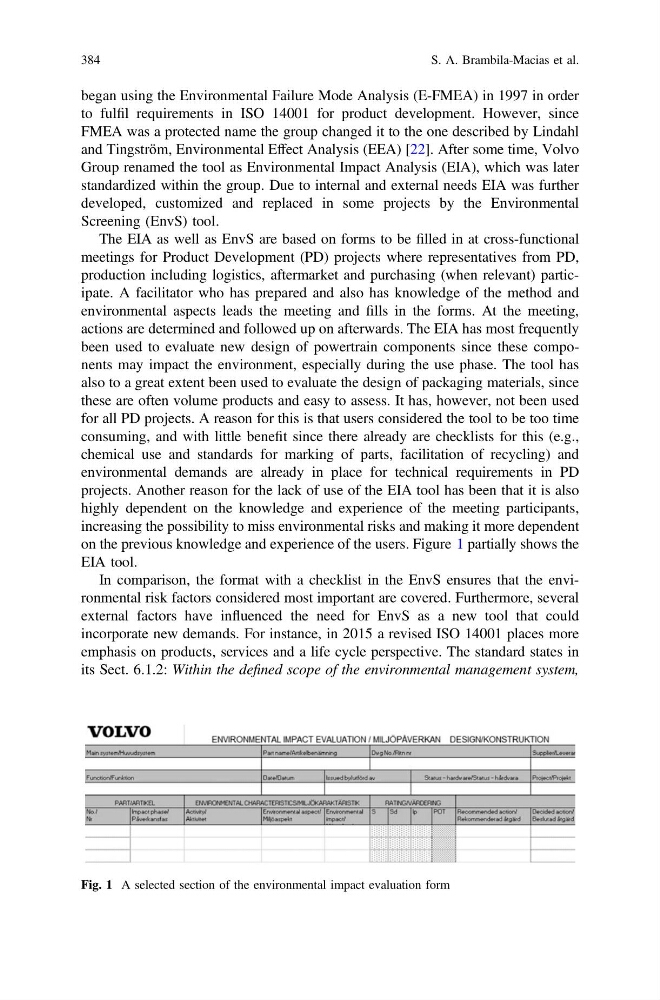
on the previous knowledge and experience of the users. Figure 1 partially shows the
EIA tool.
In comparison, the format with a checklist in the EnvS ensures that the environmental risk factors considered most important are covered. Furthermore, several
external factors have influenced the need for EnvS as a new tool that could
incorporate new demands. For instance, in 2015 a revised ISO 14001 places more
emphasis on products, services and a life cycle perspective. The standard states in
its Sect. 6.1.2: Within the defined scope of the environmental management system,
Fig. 1 A selected section of the environmental impact evaluation form
384
S. A. Brambila-Macias et al.
to fulfil requirements in ISO 14001 for product development. However, since
FMEA was a protected name the group changed it to the one described by Lindahl
and Tingström, Environmental Effect Analysis (EEA) [22]. After some time, Volvo
Group renamed the tool as Environmental Impact Analysis (EIA), which was later
standardized within the group. Due to internal and external needs EIA was further
developed, customized and replaced in some projects by the Environmental
Screening (EnvS) tool.
The EIA as well as EnvS are based on forms to be filled in at cross-functional
meetings for Product Development (PD) projects where representatives from PD,
production including logistics, aftermarket and purchasing (when relevant) participate. A facilitator who has prepared and also has knowledge of the method and
environmental aspects leads the meeting and fills in the forms. At the meeting,
actions are determined and followed up on afterwards. The EIA has most frequently
been used to evaluate new design of powertrain components since these components may impact the environment, especially during the use phase. The tool has
also to a great extent been used to evaluate the design of packaging materials, since
these are often volume products and easy to assess. It has, however, not been used
for all PD projects. A reason for this is that users considered the tool to be too time
consuming, and with little benefit since there already are checklists for this (e.g.,
chemical use and standards for marking of parts, facilitation of recycling) and
environmental demands are already in place for technical requirements in PD
projects. Another reason for the lack of use of the EIA tool has been that it is also
highly dependent on the knowledge and experience of the meeting participants,
increasing the possibility to miss environmental risks and making it more dependent
on the previous knowledge and experience of the users. Figure 1 partially shows the
EIA tool.
In comparison, the format with a checklist in the EnvS ensures that the environmental risk factors considered most important are covered. Furthermore, several
external factors have influenced the need for EnvS as a new tool that could
incorporate new demands. For instance, in 2015 a revised ISO 14001 places more
emphasis on products, services and a life cycle perspective. The standard states in
its Sect. 6.1.2: Within the defined scope of the environmental management system,
Fig. 1 A selected section of the environmental impact evaluation form
384
S. A. Brambila-Macias et al.