

car. Both micro-hybrid systems require extra parts to be added to the vehicle. For
innovative solution Inno_1, the hybridization requires a lead battery heavier than
the normal one, an electronically-controlled gearbox instead of the manual gearbox,
a reversible starter-alternator ensuring the Stop and Start function, and an ultracapacitor to supply the required power. The innovative solution is 42% heavier than
the initial solution; nevertheless, a diesel consumption reduction of 11% was
measured on the NEDC homologation test. Concerning innovative solution Inno_2,
the gearbox and the powertrain adaptation are largely affected, an ultracapacitor is
also added, while the lead battery mass is reduced. The innovation solution is 151%
heavier than the initial solution; nevertheless, a 35% reduction in gasoline consumption was measured on the NEDC homologation test. Table 2 is a synthesis of
the vehicle characteristics for selecting the EMEECS, which are available to the
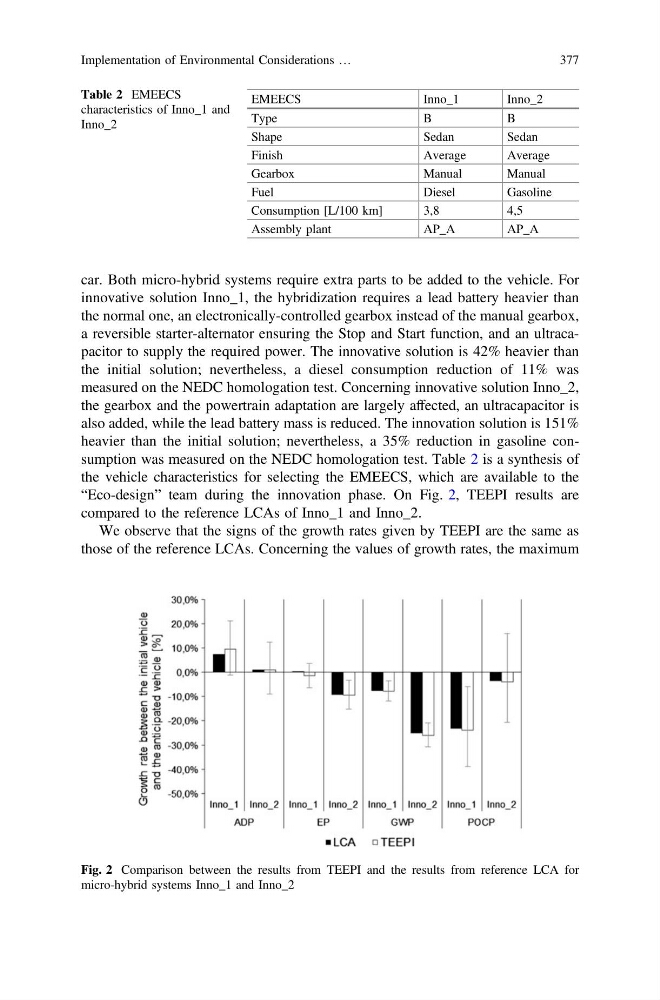
“Eco-design” team during the innovation phase. On Fig. 2, TEEPI results are
compared to the reference LCAs of Inno_1 and Inno_2.
We observe that the signs of the growth rates given by TEEPI are the same as
those of the reference LCAs. Concerning the values of growth rates, the maximum
Table 2 EMEECS
characteristics of Inno_1 and
Inno_2
EMEECS
Inno_1
Inno_2
Type
B
B
Shape
Sedan
Sedan
Finish
Average
Average
Gearbox
Manual
Manual
Fuel
Diesel
Gasoline
Consumption [L/100 km]
3,8
4,5
Assembly plant
AP_A
AP_A
Fig. 2 Comparison between the results from TEEPI and the results from reference LCA for
micro-hybrid systems Inno_1 and Inno_2
Implementation of Environmental Considerations …
377
innovative solution Inno_1, the hybridization requires a lead battery heavier than
the normal one, an electronically-controlled gearbox instead of the manual gearbox,
a reversible starter-alternator ensuring the Stop and Start function, and an ultracapacitor to supply the required power. The innovative solution is 42% heavier than
the initial solution; nevertheless, a diesel consumption reduction of 11% was
measured on the NEDC homologation test. Concerning innovative solution Inno_2,
the gearbox and the powertrain adaptation are largely affected, an ultracapacitor is
also added, while the lead battery mass is reduced. The innovation solution is 151%
heavier than the initial solution; nevertheless, a 35% reduction in gasoline consumption was measured on the NEDC homologation test. Table 2 is a synthesis of
the vehicle characteristics for selecting the EMEECS, which are available to the
“Eco-design” team during the innovation phase. On Fig. 2, TEEPI results are
compared to the reference LCAs of Inno_1 and Inno_2.
We observe that the signs of the growth rates given by TEEPI are the same as
those of the reference LCAs. Concerning the values of growth rates, the maximum
Table 2 EMEECS
characteristics of Inno_1 and
Inno_2
EMEECS
Inno_1
Inno_2
Type
B
B
Shape
Sedan
Sedan
Finish
Average
Average
Gearbox
Manual
Manual
Fuel
Diesel
Gasoline
Consumption [L/100 km]
3,8
4,5
Assembly plant
AP_A
AP_A
Fig. 2 Comparison between the results from TEEPI and the results from reference LCA for
micro-hybrid systems Inno_1 and Inno_2
Implementation of Environmental Considerations …
377