

4 Numerical Results
4.1 Short Description of the DWPP
The optimization approaches developed in the frame of the OASIS project have
been applied to a realistic model of an existing DWPP from France [13].
The DWPP treatment chain of the inlet river water contains the main unit process
(see Fig. 1): pumping, a first ozonation, coagulation/flocculation, settling, biolite
filtration, a second ozonation, granular activated carbon filtration, and bleach disinfection. A set of six relevant decision variables is considered, namely (see Fig. 1):
the ozone transfer efficiency and the pure oxygen fraction in feed gas in units T4
and T17, the coagulant dose in unit T7, and the granular activated carbon regeneration frequency in unit T20.
4.2 Results Using off-the-Shelf Global Search Algorithms
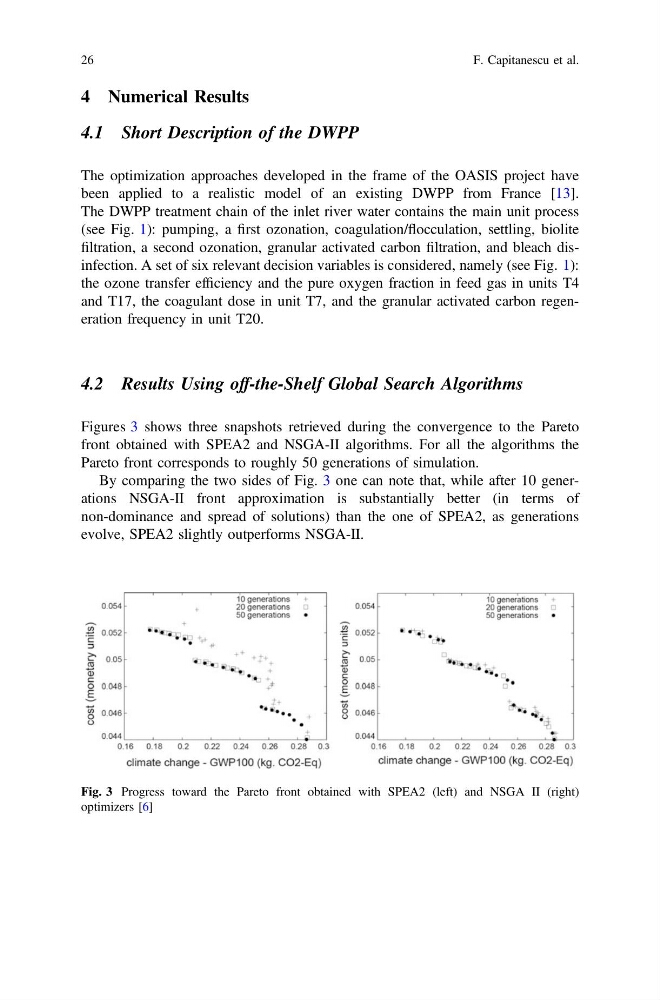
Figures 3 shows three snapshots retrieved during the convergence to the Pareto
front obtained with SPEA2 and NSGA-II algorithms. For all the algorithms the
Pareto front corresponds to roughly 50 generations of simulation.
By comparing the two sides of Fig. 3 one can note that, while after 10 generations NSGA-II front approximation is substantially better (in terms of
non-dominance and spread of solutions) than the one of SPEA2, as generations
evolve, SPEA2 slightly outperforms NSGA-II.
Fig. 3 Progress toward the Pareto front obtained with SPEA2 (left) and NSGA II (right)
optimizers [6]
26
F. Capitanescu et al.
4.1 Short Description of the DWPP
The optimization approaches developed in the frame of the OASIS project have
been applied to a realistic model of an existing DWPP from France [13].
The DWPP treatment chain of the inlet river water contains the main unit process
(see Fig. 1): pumping, a first ozonation, coagulation/flocculation, settling, biolite
filtration, a second ozonation, granular activated carbon filtration, and bleach disinfection. A set of six relevant decision variables is considered, namely (see Fig. 1):
the ozone transfer efficiency and the pure oxygen fraction in feed gas in units T4
and T17, the coagulant dose in unit T7, and the granular activated carbon regeneration frequency in unit T20.
4.2 Results Using off-the-Shelf Global Search Algorithms
Figures 3 shows three snapshots retrieved during the convergence to the Pareto
front obtained with SPEA2 and NSGA-II algorithms. For all the algorithms the
Pareto front corresponds to roughly 50 generations of simulation.
By comparing the two sides of Fig. 3 one can note that, while after 10 generations NSGA-II front approximation is substantially better (in terms of
non-dominance and spread of solutions) than the one of SPEA2, as generations
evolve, SPEA2 slightly outperforms NSGA-II.
Fig. 3 Progress toward the Pareto front obtained with SPEA2 (left) and NSGA II (right)
optimizers [6]
26
F. Capitanescu et al.