

approaches in systems science: What are the differences in goal and scope? What
are the potentials and limitations of combined systems approaches?
3.1 Differences in Goal and Scope
Systems approaches are based on the goals and the scope of the study. To say
something about how valid the different results of the multiple perspectives are in
relation to each other, it is important to understand the object and the scope of
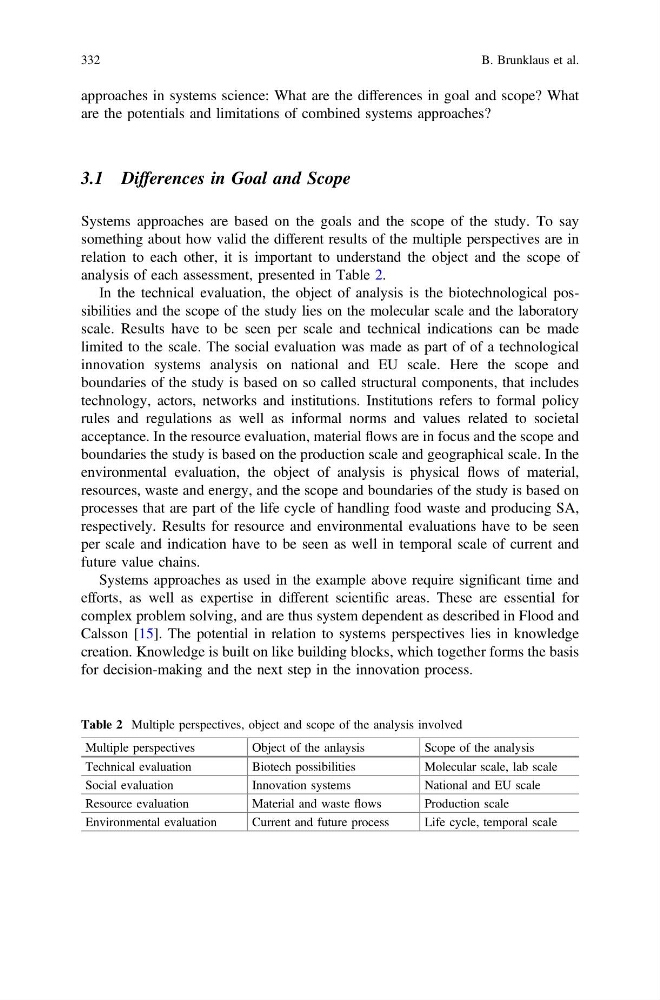
analysis of each assessment, presented in Table 2.
In the technical evaluation, the object of analysis is the biotechnological possibilities and the scope of the study lies on the molecular scale and the laboratory
scale. Results have to be seen per scale and technical indications can be made
limited to the scale. The social evaluation was made as part of of a technological
innovation systems analysis on national and EU scale. Here the scope and
boundaries of the study is based on so called structural components, that includes
technology, actors, networks and institutions. Institutions refers to formal policy
rules and regulations as well as informal norms and values related to societal
acceptance. In the resource evaluation, material flows are in focus and the scope and
boundaries the study is based on the production scale and geographical scale. In the
environmental evaluation, the object of analysis is physical flows of material,
resources, waste and energy, and the scope and boundaries of the study is based on
processes that are part of the life cycle of handling food waste and producing SA,
respectively. Results for resource and environmental evaluations have to be seen
per scale and indication have to be seen as well in temporal scale of current and
future value chains.
Systems approaches as used in the example above require significant time and
efforts, as well as expertise in different scientific areas. These are essential for
complex problem solving, and are thus system dependent as described in Flood and
Calsson [15]. The potential in relation to systems perspectives lies in knowledge
creation. Knowledge is built on like building blocks, which together forms the basis
for decision-making and the next step in the innovation process.
Table 2 Multiple perspectives, object and scope of the analysis involved
Multiple perspectives
Object of the anlaysis
Scope of the analysis
Technical evaluation
Biotech possibilities
Molecular scale, lab scale
Social evaluation
Innovation systems
National and EU scale
Resource evaluation
Material and waste flows
Production scale
Environmental evaluation
Current and future process
Life cycle, temporal scale
332
B. Brunklaus et al.
are the potentials and limitations of combined systems approaches?
3.1 Differences in Goal and Scope
Systems approaches are based on the goals and the scope of the study. To say
something about how valid the different results of the multiple perspectives are in
relation to each other, it is important to understand the object and the scope of
analysis of each assessment, presented in Table 2.
In the technical evaluation, the object of analysis is the biotechnological possibilities and the scope of the study lies on the molecular scale and the laboratory
scale. Results have to be seen per scale and technical indications can be made
limited to the scale. The social evaluation was made as part of of a technological
innovation systems analysis on national and EU scale. Here the scope and
boundaries of the study is based on so called structural components, that includes
technology, actors, networks and institutions. Institutions refers to formal policy
rules and regulations as well as informal norms and values related to societal
acceptance. In the resource evaluation, material flows are in focus and the scope and
boundaries the study is based on the production scale and geographical scale. In the
environmental evaluation, the object of analysis is physical flows of material,
resources, waste and energy, and the scope and boundaries of the study is based on
processes that are part of the life cycle of handling food waste and producing SA,
respectively. Results for resource and environmental evaluations have to be seen
per scale and indication have to be seen as well in temporal scale of current and
future value chains.
Systems approaches as used in the example above require significant time and
efforts, as well as expertise in different scientific areas. These are essential for
complex problem solving, and are thus system dependent as described in Flood and
Calsson [15]. The potential in relation to systems perspectives lies in knowledge
creation. Knowledge is built on like building blocks, which together forms the basis
for decision-making and the next step in the innovation process.
Table 2 Multiple perspectives, object and scope of the analysis involved
Multiple perspectives
Object of the anlaysis
Scope of the analysis
Technical evaluation
Biotech possibilities
Molecular scale, lab scale
Social evaluation
Innovation systems
National and EU scale
Resource evaluation
Material and waste flows
Production scale
Environmental evaluation
Current and future process
Life cycle, temporal scale
332
B. Brunklaus et al.