

4 Conclusions
The Environmental Assessment of NBS Understanding the environmental impacts
of NBS requires different levels of results: urban level, object and area level, and the
interactions and temporal patterns for different scales. While LCA is a wellestablished environmental assessment method guided by ISO standards 14040 and
14044, the results it generates are only as good as the data in the hands of the
practitioner. Therefore, a major challenge in rendering the multi benefit and
interlinked nature of NBS is to model the urban system efficiently. This requires
collecting reliable data for this model, and estimating temporal patterns via suitable
modelling approaches.
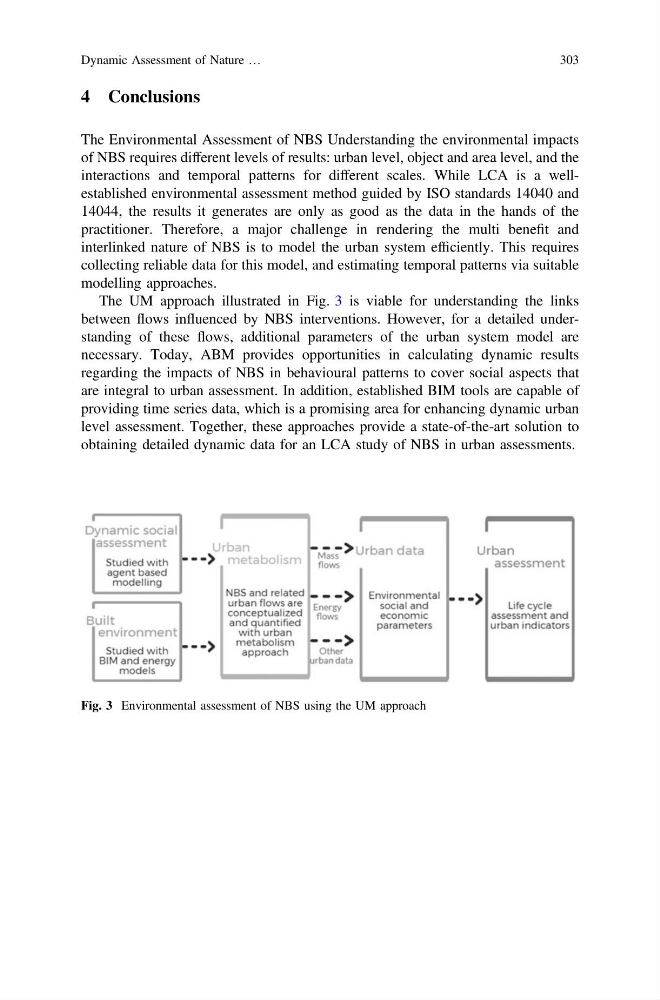
The UM approach illustrated in Fig. 3 is viable for understanding the links
between flows influenced by NBS interventions. However, for a detailed understanding of these flows, additional parameters of the urban system model are
necessary. Today, ABM provides opportunities in calculating dynamic results
regarding the impacts of NBS in behavioural patterns to cover social aspects that
are integral to urban assessment. In addition, established BIM tools are capable of
providing time series data, which is a promising area for enhancing dynamic urban
level assessment. Together, these approaches provide a state-of-the-art solution to
obtaining detailed dynamic data for an LCA study of NBS in urban assessments.
Fig. 3 Environmental assessment of NBS using the UM approach
Dynamic Assessment of Nature …
303
The Environmental Assessment of NBS Understanding the environmental impacts
of NBS requires different levels of results: urban level, object and area level, and the
interactions and temporal patterns for different scales. While LCA is a wellestablished environmental assessment method guided by ISO standards 14040 and
14044, the results it generates are only as good as the data in the hands of the
practitioner. Therefore, a major challenge in rendering the multi benefit and
interlinked nature of NBS is to model the urban system efficiently. This requires
collecting reliable data for this model, and estimating temporal patterns via suitable
modelling approaches.
The UM approach illustrated in Fig. 3 is viable for understanding the links
between flows influenced by NBS interventions. However, for a detailed understanding of these flows, additional parameters of the urban system model are
necessary. Today, ABM provides opportunities in calculating dynamic results
regarding the impacts of NBS in behavioural patterns to cover social aspects that
are integral to urban assessment. In addition, established BIM tools are capable of
providing time series data, which is a promising area for enhancing dynamic urban
level assessment. Together, these approaches provide a state-of-the-art solution to
obtaining detailed dynamic data for an LCA study of NBS in urban assessments.
Fig. 3 Environmental assessment of NBS using the UM approach
Dynamic Assessment of Nature …
303