

context and migrated into design as the use of nature as a component or a subject of
study for solutions inspired by it. Following their use in ecosystem-based adaptation for reducing climate-based risks, the use of NBS for urban planning has been
referred to by the UN Secretary General in 2013 [10] and is currently on the
research agenda of the EU [9]. They respond to the complex problems of cities with
multiple purpose solutions, and enrich the urban environment by re-naturing.
To illustrate the applicability of NBS across scales for multiple challenges, two
examples can be used. The Cheong Gye Cheon Restoration Project in Korea is an
example of large scale urban generation by NBS, where an overpass was removed
and the exposed river channel was landscaped. This intervention generated benefits
to the whole urban area, including those related to biodiversity, economic growth,
tourism, and urban revitalisation while mitigating urban heat island by a 3.6 °C
thermal relief measured on July 27th [11].
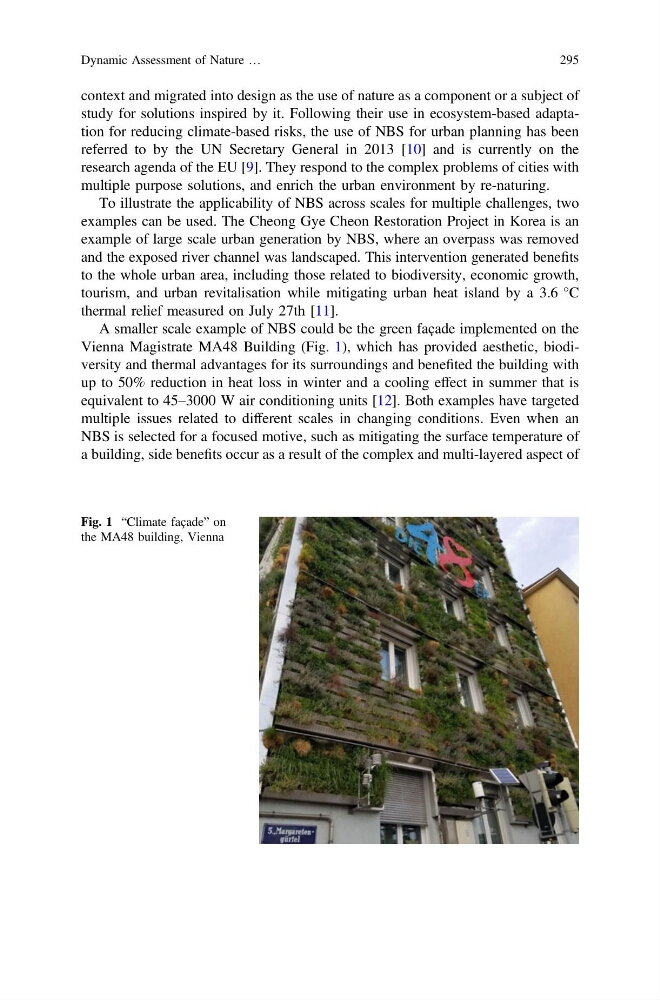
A smaller scale example of NBS could be the green façade implemented on the
Vienna Magistrate MA48 Building (Fig. 1), which has provided aesthetic, biodiversity and thermal advantages for its surroundings and benefited the building with
up to 50% reduction in heat loss in winter and a cooling effect in summer that is
equivalent to 45–3000 W air conditioning units [12]. Both examples have targeted
multiple issues related to different scales in changing conditions. Even when an
NBS is selected for a focused motive, such as mitigating the surface temperature of
a building, side benefits occur as a result of the complex and multi-layered aspect of
Fig. 1 “Climate façade” on
the MA48 building, Vienna
Dynamic Assessment of Nature …
295
study for solutions inspired by it. Following their use in ecosystem-based adaptation for reducing climate-based risks, the use of NBS for urban planning has been
referred to by the UN Secretary General in 2013 [10] and is currently on the
research agenda of the EU [9]. They respond to the complex problems of cities with
multiple purpose solutions, and enrich the urban environment by re-naturing.
To illustrate the applicability of NBS across scales for multiple challenges, two
examples can be used. The Cheong Gye Cheon Restoration Project in Korea is an
example of large scale urban generation by NBS, where an overpass was removed
and the exposed river channel was landscaped. This intervention generated benefits
to the whole urban area, including those related to biodiversity, economic growth,
tourism, and urban revitalisation while mitigating urban heat island by a 3.6 °C
thermal relief measured on July 27th [11].
A smaller scale example of NBS could be the green façade implemented on the
Vienna Magistrate MA48 Building (Fig. 1), which has provided aesthetic, biodiversity and thermal advantages for its surroundings and benefited the building with
up to 50% reduction in heat loss in winter and a cooling effect in summer that is
equivalent to 45–3000 W air conditioning units [12]. Both examples have targeted
multiple issues related to different scales in changing conditions. Even when an
NBS is selected for a focused motive, such as mitigating the surface temperature of
a building, side benefits occur as a result of the complex and multi-layered aspect of
Fig. 1 “Climate façade” on
the MA48 building, Vienna
Dynamic Assessment of Nature …
295