

is needed. By automatically looping through a number of material variants and
calculating the median this simple measure can be provided easily and
time-efficiently. In the case study, each calculation took less than 0.1 s, which
allows to calculate the median within less than 0.6 s. According to Nielsen [24] a
response time of 1 s is acceptable for designers to not feel interrupted in their flow
of thoughts. As such, the computer can loop through typical materials and provide
an LCP before materials have been assigned. Using this measure, the designer can
optimize the geometry without having information usually required for an LCA.
Ideally speaking, this method frees the designer from worrying about HVAC
systems and building materials in early design stages and allows focusing on the
geometry.
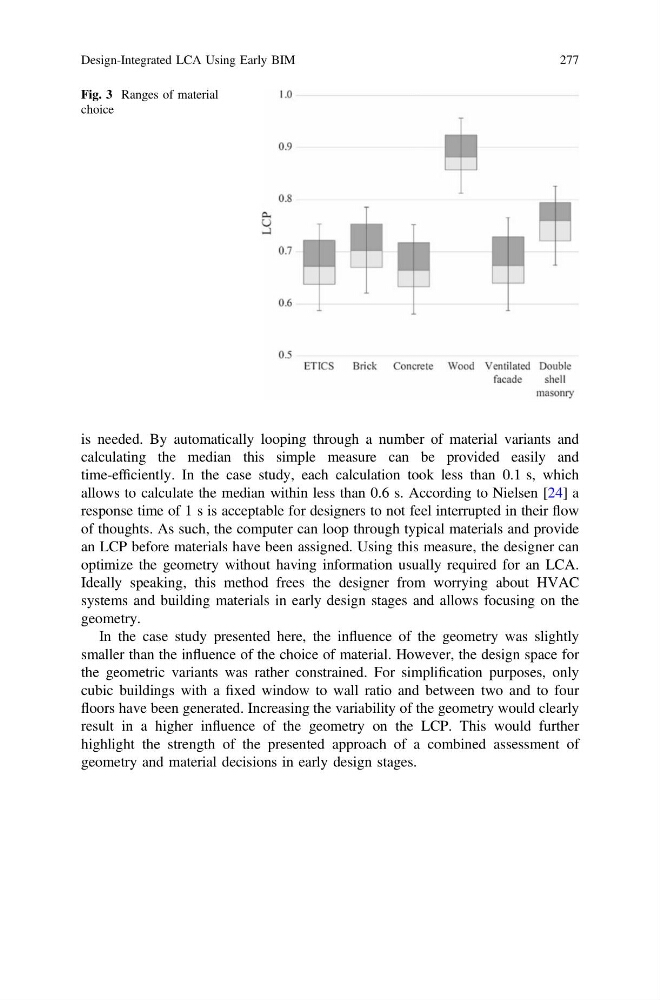
In the case study presented here, the influence of the geometry was slightly
smaller than the influence of the choice of material. However, the design space for
the geometric variants was rather constrained. For simplification purposes, only
cubic buildings with a fixed window to wall ratio and between two and to four
floors have been generated. Increasing the variability of the geometry would clearly
result in a higher influence of the geometry on the LCP. This would further
highlight the strength of the presented approach of a combined assessment of
geometry and material decisions in early design stages.
Fig. 3 Ranges of material
choice
Design-Integrated LCA Using Early BIM
277
calculating the median this simple measure can be provided easily and
time-efficiently. In the case study, each calculation took less than 0.1 s, which
allows to calculate the median within less than 0.6 s. According to Nielsen [24] a
response time of 1 s is acceptable for designers to not feel interrupted in their flow
of thoughts. As such, the computer can loop through typical materials and provide
an LCP before materials have been assigned. Using this measure, the designer can
optimize the geometry without having information usually required for an LCA.
Ideally speaking, this method frees the designer from worrying about HVAC
systems and building materials in early design stages and allows focusing on the
geometry.
In the case study presented here, the influence of the geometry was slightly
smaller than the influence of the choice of material. However, the design space for
the geometric variants was rather constrained. For simplification purposes, only
cubic buildings with a fixed window to wall ratio and between two and to four
floors have been generated. Increasing the variability of the geometry would clearly
result in a higher influence of the geometry on the LCP. This would further
highlight the strength of the presented approach of a combined assessment of
geometry and material decisions in early design stages.
Fig. 3 Ranges of material
choice
Design-Integrated LCA Using Early BIM
277