

demand [2] and environmental impact [3] while featuring the smallest costs for
changes to the design [4]. Optimization in these early design stages can only be
achieved by generating and comparing design variants. To allow for
design-integrated assessment of the environmental performance a simplified and
time-efficient method for LCA is needed. The additional effort for designers has to
be kept to a minimum to avoid barriers for assessment. Therefore, tools for LCA
should ideally be integrated in the usual design environment. Recently, various
solutions to integrated LCA using BIM have been developed [5]. However, the
conventional BIM is typically used in detailed design stages [6]. In early design
stages, conceptional mass models are employed to quickly modify and generate
variants at a low level of detail. Therefore, this paper discusses the use of simplified
digital building models—referred to as early BIM—for LCA. The objective is to
allow for time-efficient improvement of the environmental performance in early
design at a point where many parameters needed for conventional BIM-LCA
approaches are still unknown. The proposed approach is applied to a case study of
the conceptional design of a neighbourhood.
2 Early BIM-LCA Using Parametric Models
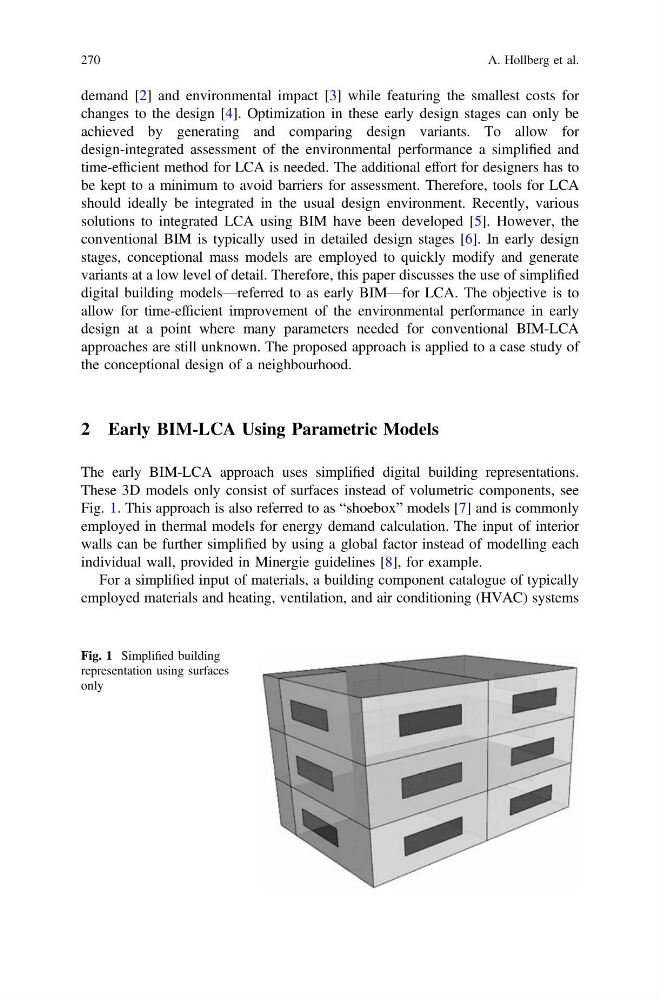
The early BIM-LCA approach uses simplified digital building representations.
These 3D models only consist of surfaces instead of volumetric components, see
Fig. 1. This approach is also referred to as “shoebox” models [7] and is commonly
employed in thermal models for energy demand calculation. The input of interior
walls can be further simplified by using a global factor instead of modelling each
individual wall, provided in Minergie guidelines [8], for example.
For a simplified input of materials, a building component catalogue of typically
employed materials and heating, ventilation, and air conditioning (HVAC) systems
Fig. 1 Simplified building
representation using surfaces
only
270
A. Hollberg et al.
changes to the design [4]. Optimization in these early design stages can only be
achieved by generating and comparing design variants. To allow for
design-integrated assessment of the environmental performance a simplified and
time-efficient method for LCA is needed. The additional effort for designers has to
be kept to a minimum to avoid barriers for assessment. Therefore, tools for LCA
should ideally be integrated in the usual design environment. Recently, various
solutions to integrated LCA using BIM have been developed [5]. However, the
conventional BIM is typically used in detailed design stages [6]. In early design
stages, conceptional mass models are employed to quickly modify and generate
variants at a low level of detail. Therefore, this paper discusses the use of simplified
digital building models—referred to as early BIM—for LCA. The objective is to
allow for time-efficient improvement of the environmental performance in early
design at a point where many parameters needed for conventional BIM-LCA
approaches are still unknown. The proposed approach is applied to a case study of
the conceptional design of a neighbourhood.
2 Early BIM-LCA Using Parametric Models
The early BIM-LCA approach uses simplified digital building representations.
These 3D models only consist of surfaces instead of volumetric components, see
Fig. 1. This approach is also referred to as “shoebox” models [7] and is commonly
employed in thermal models for energy demand calculation. The input of interior
walls can be further simplified by using a global factor instead of modelling each
individual wall, provided in Minergie guidelines [8], for example.
For a simplified input of materials, a building component catalogue of typically
employed materials and heating, ventilation, and air conditioning (HVAC) systems
Fig. 1 Simplified building
representation using surfaces
only
270
A. Hollberg et al.