

equipment. On the other hand, in addition to these fixed values, the engineering
team define values to adjust the unit process to the specificities of the customer
needs. These are the operating variables. These actions will have a direct effect on
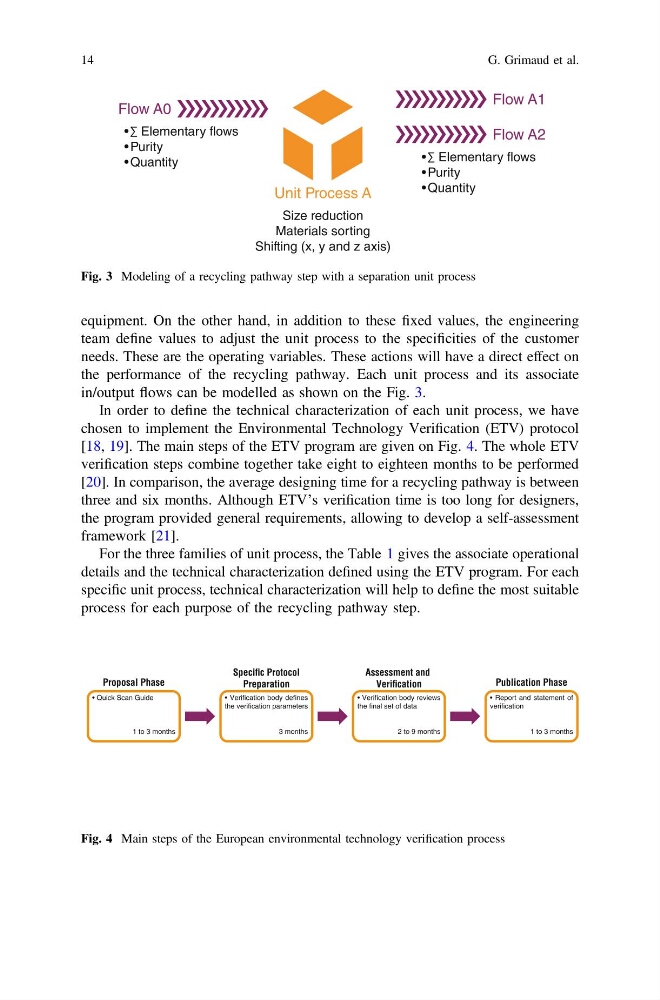
the performance of the recycling pathway. Each unit process and its associate
in/output flows can be modelled as shown on the Fig. 3.
In order to define the technical characterization of each unit process, we have
chosen to implement the Environmental Technology Verification (ETV) protocol
[18, 19]. The main steps of the ETV program are given on Fig. 4. The whole ETV
verification steps combine together take eight to eighteen months to be performed
[20]. In comparison, the average designing time for a recycling pathway is between
three and six months. Although ETV’s verification time is too long for designers,
the program provided general requirements, allowing to develop a self-assessment
framework [21].
For the three families of unit process, the Table 1 gives the associate operational
details and the technical characterization defined using the ETV program. For each
specific unit process, technical characterization will help to define the most suitable
process for each purpose of the recycling pathway step.
Fig. 3 Modeling of a recycling pathway step with a separation unit process
Fig. 4 Main steps of the European environmental technology verification process
14
G. Grimaud et al.
team define values to adjust the unit process to the specificities of the customer
needs. These are the operating variables. These actions will have a direct effect on
the performance of the recycling pathway. Each unit process and its associate
in/output flows can be modelled as shown on the Fig. 3.
In order to define the technical characterization of each unit process, we have
chosen to implement the Environmental Technology Verification (ETV) protocol
[18, 19]. The main steps of the ETV program are given on Fig. 4. The whole ETV
verification steps combine together take eight to eighteen months to be performed
[20]. In comparison, the average designing time for a recycling pathway is between
three and six months. Although ETV’s verification time is too long for designers,
the program provided general requirements, allowing to develop a self-assessment
framework [21].
For the three families of unit process, the Table 1 gives the associate operational
details and the technical characterization defined using the ETV program. For each
specific unit process, technical characterization will help to define the most suitable
process for each purpose of the recycling pathway step.
Fig. 3 Modeling of a recycling pathway step with a separation unit process
Fig. 4 Main steps of the European environmental technology verification process
14
G. Grimaud et al.