

The circular economy offers a partial answer to resource depletion [7]. Recycling is
inherent in the circular economy strategies making industrial companies looking for
stepping recycling rates up. To do so one of the most efficient way is to implement
product centric End-of-Life (EoL) strategies using closed loop recycling [8]. It
shows good environmental performances but they rely on specific EoL processes.
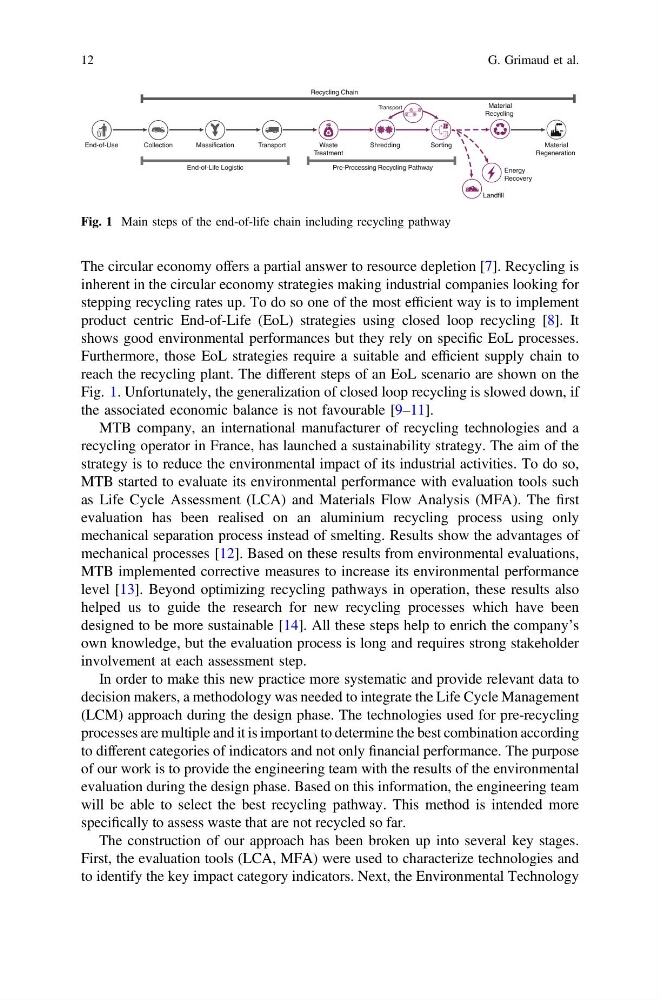
Furthermore, those EoL strategies require a suitable and efficient supply chain to
reach the recycling plant. The different steps of an EoL scenario are shown on the
Fig. 1. Unfortunately, the generalization of closed loop recycling is slowed down, if
the associated economic balance is not favourable [9–11].
MTB company, an international manufacturer of recycling technologies and a
recycling operator in France, has launched a sustainability strategy. The aim of the
strategy is to reduce the environmental impact of its industrial activities. To do so,
MTB started to evaluate its environmental performance with evaluation tools such
as Life Cycle Assessment (LCA) and Materials Flow Analysis (MFA). The first
evaluation has been realised on an aluminium recycling process using only
mechanical separation process instead of smelting. Results show the advantages of
mechanical processes [12]. Based on these results from environmental evaluations,
MTB implemented corrective measures to increase its environmental performance
level [13]. Beyond optimizing recycling pathways in operation, these results also
helped us to guide the research for new recycling processes which have been
designed to be more sustainable [14]. All these steps help to enrich the company’s
own knowledge, but the evaluation process is long and requires strong stakeholder
involvement at each assessment step.
In order to make this new practice more systematic and provide relevant data to
decision makers, a methodology was needed to integrate the Life Cycle Management
(LCM) approach during the design phase. The technologies used for pre-recycling
processes are multiple and it is important to determine the best combination according
to different categories of indicators and not only financial performance. The purpose
of our work is to provide the engineering team with the results of the environmental
evaluation during the design phase. Based on this information, the engineering team
will be able to select the best recycling pathway. This method is intended more
specifically to assess waste that are not recycled so far.
The construction of our approach has been broken up into several key stages.
First, the evaluation tools (LCA, MFA) were used to characterize technologies and
to identify the key impact category indicators. Next, the Environmental Technology
Fig. 1 Main steps of the end-of-life chain including recycling pathway
12
G. Grimaud et al.
inherent in the circular economy strategies making industrial companies looking for
stepping recycling rates up. To do so one of the most efficient way is to implement
product centric End-of-Life (EoL) strategies using closed loop recycling [8]. It
shows good environmental performances but they rely on specific EoL processes.
Furthermore, those EoL strategies require a suitable and efficient supply chain to
reach the recycling plant. The different steps of an EoL scenario are shown on the
Fig. 1. Unfortunately, the generalization of closed loop recycling is slowed down, if
the associated economic balance is not favourable [9–11].
MTB company, an international manufacturer of recycling technologies and a
recycling operator in France, has launched a sustainability strategy. The aim of the
strategy is to reduce the environmental impact of its industrial activities. To do so,
MTB started to evaluate its environmental performance with evaluation tools such
as Life Cycle Assessment (LCA) and Materials Flow Analysis (MFA). The first
evaluation has been realised on an aluminium recycling process using only
mechanical separation process instead of smelting. Results show the advantages of
mechanical processes [12]. Based on these results from environmental evaluations,
MTB implemented corrective measures to increase its environmental performance
level [13]. Beyond optimizing recycling pathways in operation, these results also
helped us to guide the research for new recycling processes which have been
designed to be more sustainable [14]. All these steps help to enrich the company’s
own knowledge, but the evaluation process is long and requires strong stakeholder
involvement at each assessment step.
In order to make this new practice more systematic and provide relevant data to
decision makers, a methodology was needed to integrate the Life Cycle Management
(LCM) approach during the design phase. The technologies used for pre-recycling
processes are multiple and it is important to determine the best combination according
to different categories of indicators and not only financial performance. The purpose
of our work is to provide the engineering team with the results of the environmental
evaluation during the design phase. Based on this information, the engineering team
will be able to select the best recycling pathway. This method is intended more
specifically to assess waste that are not recycled so far.
The construction of our approach has been broken up into several key stages.
First, the evaluation tools (LCA, MFA) were used to characterize technologies and
to identify the key impact category indicators. Next, the Environmental Technology
Fig. 1 Main steps of the end-of-life chain including recycling pathway
12
G. Grimaud et al.