

4 Interdisciplinary Engineering Processes
In the following, an interdisciplinary engineering process for the conceptual
development of lightweight vehicle structures is presented. This addresses the first
key requirement as described in the previous section. The presented process extends
prior work that focused on a functional modelling level [15]. Building on that, a
holistic view on the conceptual development process of hybrid lightweight structures is in the focus of the current work. In this course, a detailed description of
interfaces between component design, production engineering as well as life cycle
evaluation is provided. Current component development processes consider the
disciplines in various depths. Technical, economic and environmental performance
are key targets in component development. While a constant tracking of the first
two is established, environmental evaluation for new technologies is performed as
upstream and downstream activity. The increasing complexity and concept variety
through the introduction of lightweight structures, e.g. regarding their materials or
joining technologies, suggests a constant tracking of environmental performance
within the vehicle development process [14, 20]. Each of the disciplines rely on
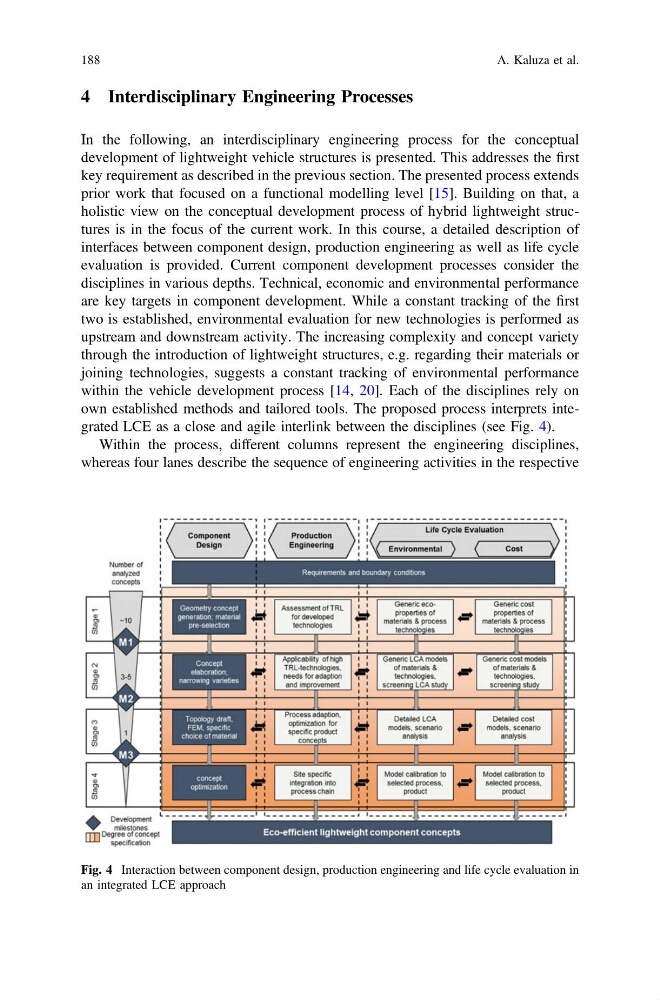
own established methods and tailored tools. The proposed process interprets integrated LCE as a close and agile interlink between the disciplines (see Fig. 4).
Within the process, different columns represent the engineering disciplines,
whereas four lanes describe the sequence of engineering activities in the respective
Fig. 4 Interaction between component design, production engineering and life cycle evaluation in
an integrated LCE approach
188
A. Kaluza et al.
In the following, an interdisciplinary engineering process for the conceptual
development of lightweight vehicle structures is presented. This addresses the first
key requirement as described in the previous section. The presented process extends
prior work that focused on a functional modelling level [15]. Building on that, a
holistic view on the conceptual development process of hybrid lightweight structures is in the focus of the current work. In this course, a detailed description of
interfaces between component design, production engineering as well as life cycle
evaluation is provided. Current component development processes consider the
disciplines in various depths. Technical, economic and environmental performance
are key targets in component development. While a constant tracking of the first
two is established, environmental evaluation for new technologies is performed as
upstream and downstream activity. The increasing complexity and concept variety
through the introduction of lightweight structures, e.g. regarding their materials or
joining technologies, suggests a constant tracking of environmental performance
within the vehicle development process [14, 20]. Each of the disciplines rely on
own established methods and tailored tools. The proposed process interprets integrated LCE as a close and agile interlink between the disciplines (see Fig. 4).
Within the process, different columns represent the engineering disciplines,
whereas four lanes describe the sequence of engineering activities in the respective
Fig. 4 Interaction between component design, production engineering and life cycle evaluation in
an integrated LCE approach
188
A. Kaluza et al.