

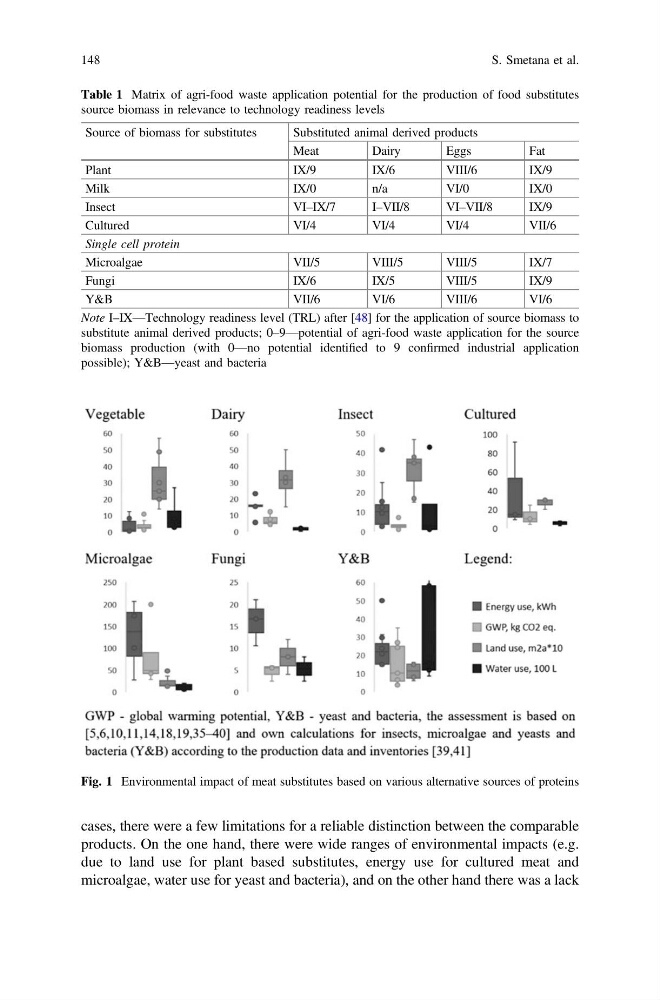
cases, there were a few limitations for a reliable distinction between the comparable
products. On the one hand, there were wide ranges of environmental impacts (e.g.
due to land use for plant based substitutes, energy use for cultured meat and
microalgae, water use for yeast and bacteria), and on the other hand there was a lack
Table 1 Matrix of agri-food waste application potential for the production of food substitutes
source biomass in relevance to technology readiness levels
Source of biomass for substitutes
Substituted animal derived products
Meat
Dairy
Eggs
Fat
Plant
IX/9
IX/6
VIII/6
IX/9
Milk
IX/0
n/a
VI/0
IX/0
Insect
VI–IX/7
I–VII/8
VI–VII/8
IX/9
Cultured
VI/4
VI/4
VI/4
VII/6
Single cell protein
Microalgae
VII/5
VIII/5
VIII/5
IX/7
Fungi
IX/6
IX/5
VIII/5
IX/9
Y&B
VII/6
VI/6
VIII/6
VI/6
Note I–IX—Technology readiness level (TRL) after [48] for the application of source biomass to
substitute animal derived products; 0–9—potential of agri-food waste application for the source
biomass production (with 0—no potential identified to 9 confirmed industrial application
possible); Y&B—yeast and bacteria
Fig. 1 Environmental impact of meat substitutes based on various alternative sources of proteins
148
S. Smetana et al.
products. On the one hand, there were wide ranges of environmental impacts (e.g.
due to land use for plant based substitutes, energy use for cultured meat and
microalgae, water use for yeast and bacteria), and on the other hand there was a lack
Table 1 Matrix of agri-food waste application potential for the production of food substitutes
source biomass in relevance to technology readiness levels
Source of biomass for substitutes
Substituted animal derived products
Meat
Dairy
Eggs
Fat
Plant
IX/9
IX/6
VIII/6
IX/9
Milk
IX/0
n/a
VI/0
IX/0
Insect
VI–IX/7
I–VII/8
VI–VII/8
IX/9
Cultured
VI/4
VI/4
VI/4
VII/6
Single cell protein
Microalgae
VII/5
VIII/5
VIII/5
IX/7
Fungi
IX/6
IX/5
VIII/5
IX/9
Y&B
VII/6
VI/6
VIII/6
VI/6
Note I–IX—Technology readiness level (TRL) after [48] for the application of source biomass to
substitute animal derived products; 0–9—potential of agri-food waste application for the source
biomass production (with 0—no potential identified to 9 confirmed industrial application
possible); Y&B—yeast and bacteria
Fig. 1 Environmental impact of meat substitutes based on various alternative sources of proteins
148
S. Smetana et al.