

and N mineralisation associated with eventual SOM loss. Agricultural supplies
were experimentally estimated for each year of cardoon cultivation and then
averaged out; so, for example, the CO 2 equivalents needed for seed production to
grow one hectare of cardoon was divided by six.
3 Results and Discussions
The model was firstly applied to cardoon cropping system, but it could be applied
even to any other crop system (i.e. food and non-food) [8, 9]. Assessed scenarios
showed that SOM increased by the supply of exogenous OM rich in humifiable
materials, such as high-quality compost. The magnitude of GHG emissions or
sequestrations caused by SOM variation depended on soil characteristics (Table 1).
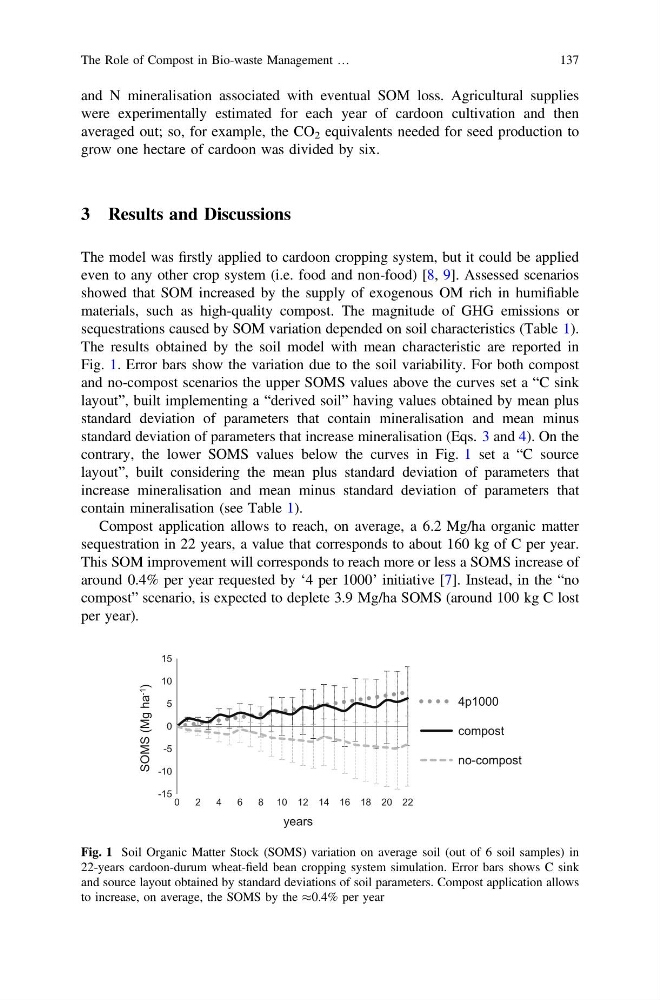
The results obtained by the soil model with mean characteristic are reported in
Fig. 1. Error bars show the variation due to the soil variability. For both compost
and no-compost scenarios the upper SOMS values above the curves set a “C sink
layout”, built implementing a “derived soil” having values obtained by mean plus
standard deviation of parameters that contain mineralisation and mean minus
standard deviation of parameters that increase mineralisation (Eqs. 3 and 4). On the
contrary, the lower SOMS values below the curves in Fig. 1 set a “C source
layout”, built considering the mean plus standard deviation of parameters that
increase mineralisation and mean minus standard deviation of parameters that
contain mineralisation (see Table 1).
Compost application allows to reach, on average, a 6.2 Mg/ha organic matter
sequestration in 22 years, a value that corresponds to about 160 kg of C per year.
This SOM improvement will corresponds to reach more or less a SOMS increase of
around 0.4% per year requested by ‘4 per 1000’ initiative [7]. Instead, in the “no
compost” scenario, is expected to deplete 3.9 Mg/ha SOMS (around 100 kg C lost
per year).
-15
-10
-5
0
5
10
15
0
2
4
6
8 10 12 14 16 18 20 22
SOMS (Mg ha -1
)
years
4p1000
compost
no-compost
Fig. 1 Soil Organic Matter Stock (SOMS) variation on average soil (out of 6 soil samples) in
22-years cardoon-durum wheat-field bean cropping system simulation. Error bars shows C sink
and source layout obtained by standard deviations of soil parameters. Compost application allows
to increase, on average, the SOMS by the %0.4% per year
The Role of Compost in Bio-waste Management …
137
were experimentally estimated for each year of cardoon cultivation and then
averaged out; so, for example, the CO 2 equivalents needed for seed production to
grow one hectare of cardoon was divided by six.
3 Results and Discussions
The model was firstly applied to cardoon cropping system, but it could be applied
even to any other crop system (i.e. food and non-food) [8, 9]. Assessed scenarios
showed that SOM increased by the supply of exogenous OM rich in humifiable
materials, such as high-quality compost. The magnitude of GHG emissions or
sequestrations caused by SOM variation depended on soil characteristics (Table 1).
The results obtained by the soil model with mean characteristic are reported in
Fig. 1. Error bars show the variation due to the soil variability. For both compost
and no-compost scenarios the upper SOMS values above the curves set a “C sink
layout”, built implementing a “derived soil” having values obtained by mean plus
standard deviation of parameters that contain mineralisation and mean minus
standard deviation of parameters that increase mineralisation (Eqs. 3 and 4). On the
contrary, the lower SOMS values below the curves in Fig. 1 set a “C source
layout”, built considering the mean plus standard deviation of parameters that
increase mineralisation and mean minus standard deviation of parameters that
contain mineralisation (see Table 1).
Compost application allows to reach, on average, a 6.2 Mg/ha organic matter
sequestration in 22 years, a value that corresponds to about 160 kg of C per year.
This SOM improvement will corresponds to reach more or less a SOMS increase of
around 0.4% per year requested by ‘4 per 1000’ initiative [7]. Instead, in the “no
compost” scenario, is expected to deplete 3.9 Mg/ha SOMS (around 100 kg C lost
per year).
-15
-10
-5
0
5
10
15
0
2
4
6
8 10 12 14 16 18 20 22
SOMS (Mg ha -1
)
years
4p1000
compost
no-compost
Fig. 1 Soil Organic Matter Stock (SOMS) variation on average soil (out of 6 soil samples) in
22-years cardoon-durum wheat-field bean cropping system simulation. Error bars shows C sink
and source layout obtained by standard deviations of soil parameters. Compost application allows
to increase, on average, the SOMS by the %0.4% per year
The Role of Compost in Bio-waste Management …
137