

two types of cleantech for irrigation (C): solar power (C1) and integration of a
variable frequency drive that reduces the electricity demand of the water pump
(C2). The measures are described in more detail in Chapter “A Synthesis of
Optimization Approaches for LCA-Integrated Industrial Process Modeling:
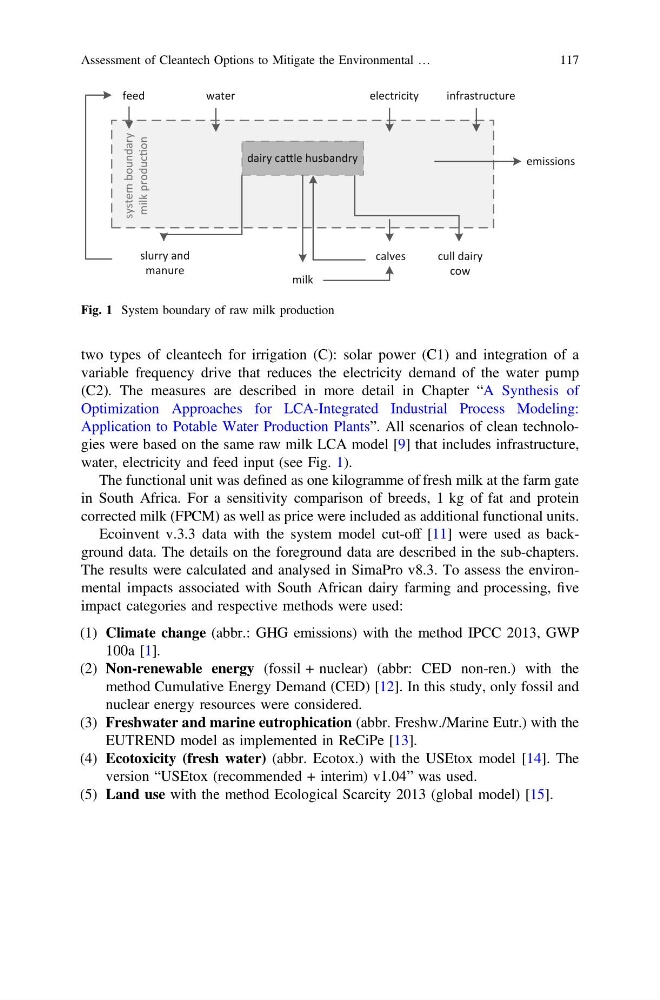
Application to Potable Water Production Plants”. All scenarios of clean technologies were based on the same raw milk LCA model [9] that includes infrastructure,
water, electricity and feed input (see Fig. 1).
The functional unit was defined as one kilogramme of fresh milk at the farm gate
in South Africa. For a sensitivity comparison of breeds, 1 kg of fat and protein
corrected milk (FPCM) as well as price were included as additional functional units.
Ecoinvent v.3.3 data with the system model cut-off [11] were used as background data. The details on the foreground data are described in the sub-chapters.
The results were calculated and analysed in SimaPro v8.3. To assess the environmental impacts associated with South African dairy farming and processing, five
impact categories and respective methods were used:
(1) Climate change (abbr.: GHG emissions) with the method IPCC 2013, GWP
100a [1].
(2) Non-renewable energy (fossil + nuclear) (abbr: CED non-ren.) with the
method Cumulative Energy Demand (CED) [12]. In this study, only fossil and
nuclear energy resources were considered.
(3) Freshwater and marine eutrophication (abbr. Freshw./Marine Eutr.) with the
EUTREND model as implemented in ReCiPe [13].
(4) Ecotoxicity (fresh water) (abbr. Ecotox.) with the USEtox model [14]. The
version “USEtox (recommended + interim) v1.04” was used.
(5) Land use with the method Ecological Scarcity 2013 (global model) [15].
dairy caƩle husbandry
calves
cull dairy
cow
slurry and
manure
infrastructure
feed
system boundary
milk producƟon
water
electricity
emissions
milk
Fig. 1 System boundary of raw milk production
Assessment of Cleantech Options to Mitigate the Environmental …
117
variable frequency drive that reduces the electricity demand of the water pump
(C2). The measures are described in more detail in Chapter “A Synthesis of
Optimization Approaches for LCA-Integrated Industrial Process Modeling:
Application to Potable Water Production Plants”. All scenarios of clean technologies were based on the same raw milk LCA model [9] that includes infrastructure,
water, electricity and feed input (see Fig. 1).
The functional unit was defined as one kilogramme of fresh milk at the farm gate
in South Africa. For a sensitivity comparison of breeds, 1 kg of fat and protein
corrected milk (FPCM) as well as price were included as additional functional units.
Ecoinvent v.3.3 data with the system model cut-off [11] were used as background data. The details on the foreground data are described in the sub-chapters.
The results were calculated and analysed in SimaPro v8.3. To assess the environmental impacts associated with South African dairy farming and processing, five
impact categories and respective methods were used:
(1) Climate change (abbr.: GHG emissions) with the method IPCC 2013, GWP
100a [1].
(2) Non-renewable energy (fossil + nuclear) (abbr: CED non-ren.) with the
method Cumulative Energy Demand (CED) [12]. In this study, only fossil and
nuclear energy resources were considered.
(3) Freshwater and marine eutrophication (abbr. Freshw./Marine Eutr.) with the
EUTREND model as implemented in ReCiPe [13].
(4) Ecotoxicity (fresh water) (abbr. Ecotox.) with the USEtox model [14]. The
version “USEtox (recommended + interim) v1.04” was used.
(5) Land use with the method Ecological Scarcity 2013 (global model) [15].
dairy caƩle husbandry
calves
cull dairy
cow
slurry and
manure
infrastructure
feed
system boundary
milk producƟon
water
electricity
emissions
milk
Fig. 1 System boundary of raw milk production
Assessment of Cleantech Options to Mitigate the Environmental …
117