

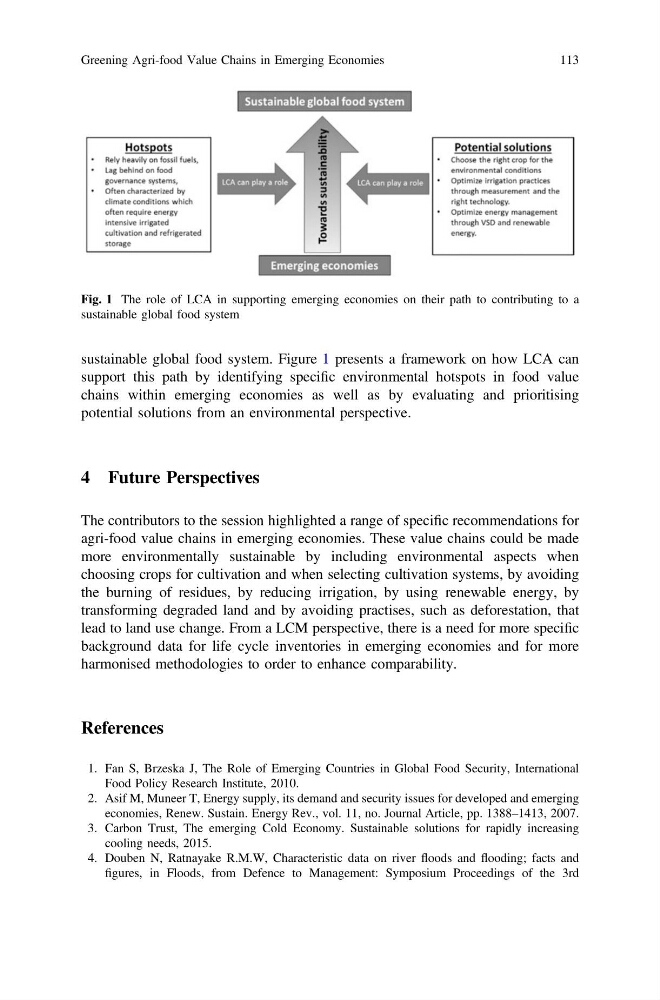
sustainable global food system. Figure 1 presents a framework on how LCA can
support this path by identifying specific environmental hotspots in food value
chains within emerging economies as well as by evaluating and prioritising
potential solutions from an environmental perspective.
4 Future Perspectives
The contributors to the session highlighted a range of specific recommendations for
agri-food value chains in emerging economies. These value chains could be made
more environmentally sustainable by including environmental aspects when
choosing crops for cultivation and when selecting cultivation systems, by avoiding
the burning of residues, by reducing irrigation, by using renewable energy, by
transforming degraded land and by avoiding practises, such as deforestation, that
lead to land use change. From a LCM perspective, there is a need for more specific
background data for life cycle inventories in emerging economies and for more
harmonised methodologies to order to enhance comparability.
References
1. Fan S, Brzeska J, The Role of Emerging Countries in Global Food Security, International
Food Policy Research Institute, 2010.
2. Asif M, Muneer T, Energy supply, its demand and security issues for developed and emerging
economies, Renew. Sustain. Energy Rev., vol. 11, no. Journal Article, pp. 1388–1413, 2007.
3. Carbon Trust, The emerging Cold Economy. Sustainable solutions for rapidly increasing
cooling needs, 2015.
4. Douben N, Ratnayake R.M.W, Characteristic data on river floods and flooding; facts and
figures, in Floods, from Defence to Management: Symposium Proceedings of the 3rd
Fig. 1 The role of LCA in supporting emerging economies on their path to contributing to a
sustainable global food system
Greening Agri-food Value Chains in Emerging Economies
113
support this path by identifying specific environmental hotspots in food value
chains within emerging economies as well as by evaluating and prioritising
potential solutions from an environmental perspective.
4 Future Perspectives
The contributors to the session highlighted a range of specific recommendations for
agri-food value chains in emerging economies. These value chains could be made
more environmentally sustainable by including environmental aspects when
choosing crops for cultivation and when selecting cultivation systems, by avoiding
the burning of residues, by reducing irrigation, by using renewable energy, by
transforming degraded land and by avoiding practises, such as deforestation, that
lead to land use change. From a LCM perspective, there is a need for more specific
background data for life cycle inventories in emerging economies and for more
harmonised methodologies to order to enhance comparability.
References
1. Fan S, Brzeska J, The Role of Emerging Countries in Global Food Security, International
Food Policy Research Institute, 2010.
2. Asif M, Muneer T, Energy supply, its demand and security issues for developed and emerging
economies, Renew. Sustain. Energy Rev., vol. 11, no. Journal Article, pp. 1388–1413, 2007.
3. Carbon Trust, The emerging Cold Economy. Sustainable solutions for rapidly increasing
cooling needs, 2015.
4. Douben N, Ratnayake R.M.W, Characteristic data on river floods and flooding; facts and
figures, in Floods, from Defence to Management: Symposium Proceedings of the 3rd
Fig. 1 The role of LCA in supporting emerging economies on their path to contributing to a
sustainable global food system
Greening Agri-food Value Chains in Emerging Economies
113