

79
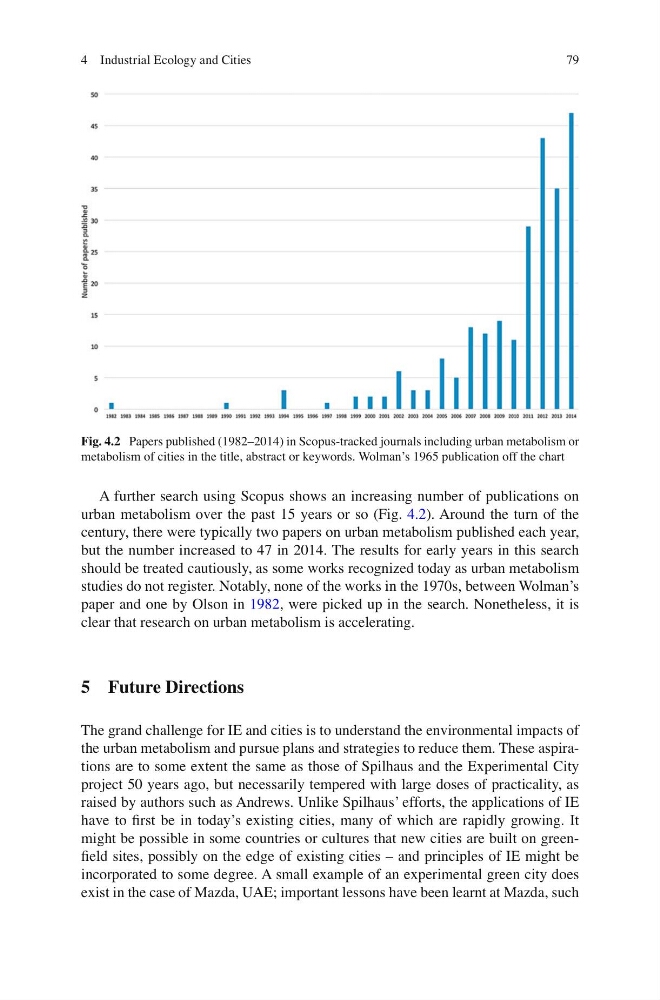
A further search using Scopus shows an increasing number of publications on
urban metabolism over the past 15 years or so (Fig. 4.2 ). Around the turn of the
century, there were typically two papers on urban metabolism published each year,
but the number increased to 47 in 2014. The results for early years in this search
should be treated cautiously, as some works recognized today as urban metabolism
studies do not register. Notably, none of the works in the 1970s, between Wolman’s
paper and one by Olson in 1982 , were picked up in the search. Nonetheless, it is
clear that research on urban metabolism is accelerating.
5 Future Directions
The grand challenge for IE and cities is to understand the environmental impacts of
the urban metabolism and pursue plans and strategies to reduce them. These aspirations are to some extent the same as those of Spilhaus and the Experimental City
project 50 years ago, but necessarily tempered with large doses of practicality, as
raised by authors such as Andrews. Unlike Spilhaus’ efforts, the applications of IE
have to fi rst be in today’s existing cities, many of which are rapidly growing. It
might be possible in some countries or cultures that new cities are built on greenfi eld sites, possibly on the edge of existing cities – and principles of IE might be
incorporated to some degree. A small example of an experimental green city does
exist in the case of Mazda, UAE; important lessons have been learnt at Mazda, such
Fig. 4.2 Papers published (1982–2014) in Scopus-tracked journals including urban metabolism or
metabolism of cities in the title, abstract or keywords. Wolman’s 1965 publication off the chart
4 Industrial Ecology and Cities
A further search using Scopus shows an increasing number of publications on
urban metabolism over the past 15 years or so (Fig. 4.2 ). Around the turn of the
century, there were typically two papers on urban metabolism published each year,
but the number increased to 47 in 2014. The results for early years in this search
should be treated cautiously, as some works recognized today as urban metabolism
studies do not register. Notably, none of the works in the 1970s, between Wolman’s
paper and one by Olson in 1982 , were picked up in the search. Nonetheless, it is
clear that research on urban metabolism is accelerating.
5 Future Directions
The grand challenge for IE and cities is to understand the environmental impacts of
the urban metabolism and pursue plans and strategies to reduce them. These aspirations are to some extent the same as those of Spilhaus and the Experimental City
project 50 years ago, but necessarily tempered with large doses of practicality, as
raised by authors such as Andrews. Unlike Spilhaus’ efforts, the applications of IE
have to fi rst be in today’s existing cities, many of which are rapidly growing. It
might be possible in some countries or cultures that new cities are built on greenfi eld sites, possibly on the edge of existing cities – and principles of IE might be
incorporated to some degree. A small example of an experimental green city does
exist in the case of Mazda, UAE; important lessons have been learnt at Mazda, such
Fig. 4.2 Papers published (1982–2014) in Scopus-tracked journals including urban metabolism or
metabolism of cities in the title, abstract or keywords. Wolman’s 1965 publication off the chart
4 Industrial Ecology and Cities