

63
References
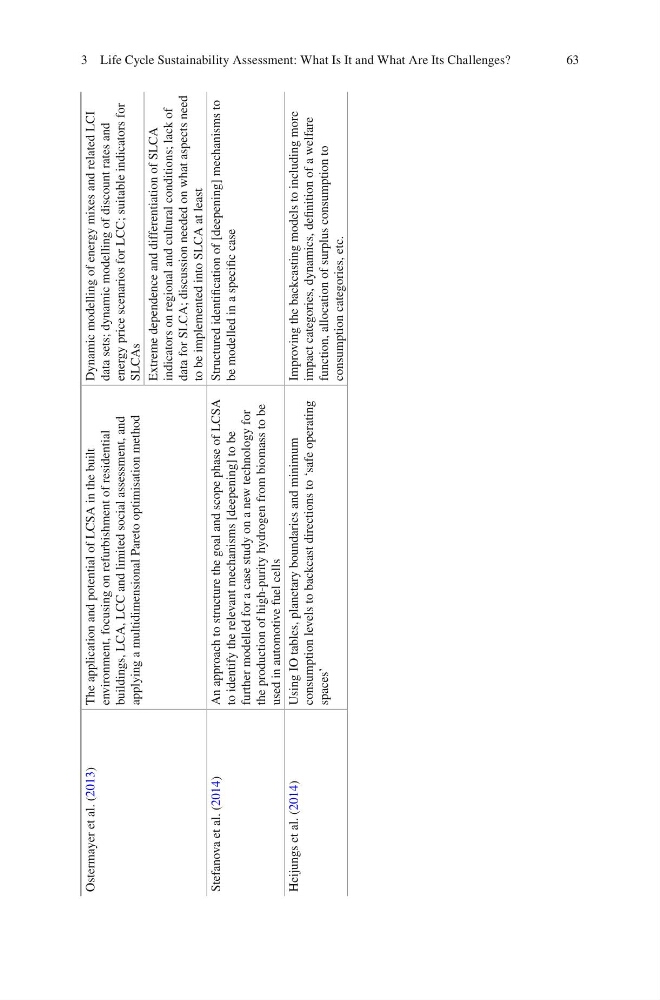
Short topic description
Challenges faced
Ostermayer et al. ( 2013 )
The application and potential of LCSA in the built
environment, focusing on refurbishment of residential
buildings, LCA, LCC and limited social assessment, and
applying a multidimensional Pareto optimisation method
Dynamic modelling of energy mixes and related LCI
data sets; dynamic modelling of discount rates and
energy price scenarios for LCC; suitable indicators for
SLCAs
Extreme dependence and differentiation of SLCA
indicators on regional and cultural conditions; lack of
data for SLCA; discussion needed on what aspects need
to be implemented into SLCA at least
Stefanova et al. ( 2014 )
An approach to structure the goal and scope phase of LCSA
to identify the relevant mechanisms [deepening] to be
further modelled for a case study on a new technology for
the production of high-purity hydrogen from biomass to be
used in automotive fuel cells
Structured identifi cation of [deepening] mechanisms to
be modelled in a specifi c case
Heijungs et al. ( 2014 )
Using IO tables, planetary boundaries and minimum
consumption levels to backcast directions to ‘safe operating
spaces’
Improving the backcasting models to including more
impact categories, dynamics, defi nition of a welfare
function, allocation of surplus consumption to
consumption categories, etc.
3 Life Cycle Sustainability Assessment: What Is It and What Are Its Challenges?
References
Short topic description
Challenges faced
Ostermayer et al. ( 2013 )
The application and potential of LCSA in the built
environment, focusing on refurbishment of residential
buildings, LCA, LCC and limited social assessment, and
applying a multidimensional Pareto optimisation method
Dynamic modelling of energy mixes and related LCI
data sets; dynamic modelling of discount rates and
energy price scenarios for LCC; suitable indicators for
SLCAs
Extreme dependence and differentiation of SLCA
indicators on regional and cultural conditions; lack of
data for SLCA; discussion needed on what aspects need
to be implemented into SLCA at least
Stefanova et al. ( 2014 )
An approach to structure the goal and scope phase of LCSA
to identify the relevant mechanisms [deepening] to be
further modelled for a case study on a new technology for
the production of high-purity hydrogen from biomass to be
used in automotive fuel cells
Structured identifi cation of [deepening] mechanisms to
be modelled in a specifi c case
Heijungs et al. ( 2014 )
Using IO tables, planetary boundaries and minimum
consumption levels to backcast directions to ‘safe operating
spaces’
Improving the backcasting models to including more
impact categories, dynamics, defi nition of a welfare
function, allocation of surplus consumption to
consumption categories, etc.
3 Life Cycle Sustainability Assessment: What Is It and What Are Its Challenges?