

344
1 Introduction: Brief History of Industrial Symbiosis
in the Humber Region
The Humber is the largest river system in the UK and is responsible for draining
20 % of the UK’s land mass. It captures drainage waters as far south as Birmingham
through the Trent River system and north into Yorkshire through the Ouse. The river
itself is the boundary between Yorkshire and Northern Lincolnshire. It is a major
navigation channel and its banks are home to signifi cant industrial clusters. The
natural geography and geology of the Humber bring signifi cant advantages for the
location of industry. The deep water channel swings fi rst to the south bank and then
to the north. The ports of Immingham, Grimsby and Hull are located at these touching points and in combination make up the largest tonnage port complex in the
UK. Twenty-seven per cent of UK’s refi ning capacity is located here; 25 % of UK’s
rail freight originates here, much of which fi nds home in the steel and power industries; just north of the Humber estuary, 20 % of UK’s gas is landed at Easington, fed
by the Langeled pipeline, the world’s longest underwater pipeline, via the Sleipner
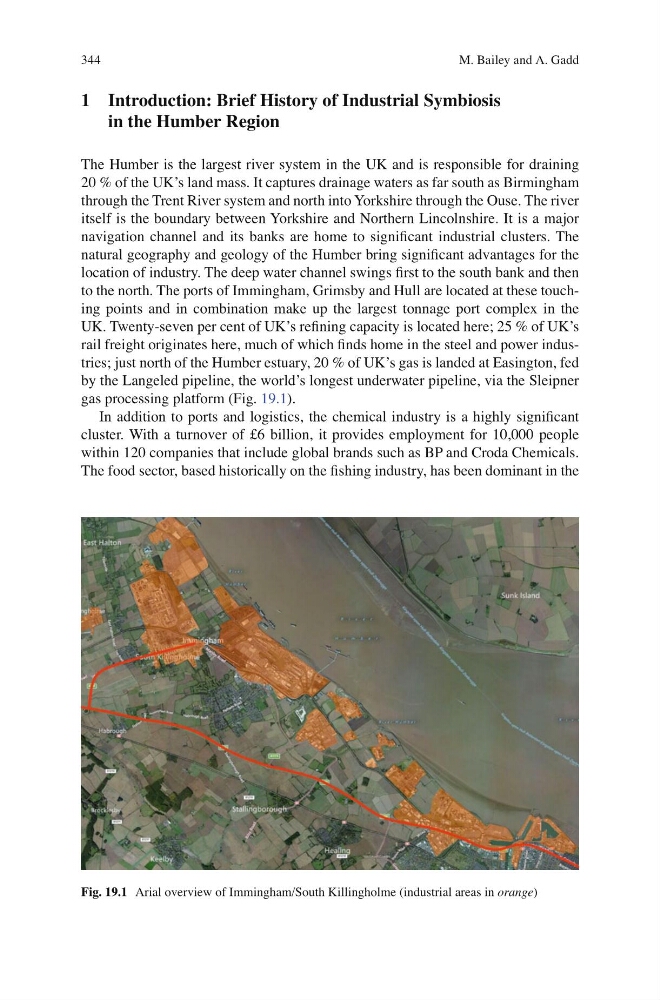
gas processing platform (Fig. 19.1 ).
In addition to ports and logistics, the chemical industry is a highly signifi cant
cluster. With a turnover of £6 billion, it provides employment for 10,000 people
within 120 companies that include global brands such as BP and Croda Chemicals.
The food sector, based historically on the fi shing industry, has been dominant in the
Fig. 19.1 Arial overview of Immingham/South Killingholme (industrial areas in orange )
M. Bailey and A. Gadd
1 Introduction: Brief History of Industrial Symbiosis
in the Humber Region
The Humber is the largest river system in the UK and is responsible for draining
20 % of the UK’s land mass. It captures drainage waters as far south as Birmingham
through the Trent River system and north into Yorkshire through the Ouse. The river
itself is the boundary between Yorkshire and Northern Lincolnshire. It is a major
navigation channel and its banks are home to signifi cant industrial clusters. The
natural geography and geology of the Humber bring signifi cant advantages for the
location of industry. The deep water channel swings fi rst to the south bank and then
to the north. The ports of Immingham, Grimsby and Hull are located at these touching points and in combination make up the largest tonnage port complex in the
UK. Twenty-seven per cent of UK’s refi ning capacity is located here; 25 % of UK’s
rail freight originates here, much of which fi nds home in the steel and power industries; just north of the Humber estuary, 20 % of UK’s gas is landed at Easington, fed
by the Langeled pipeline, the world’s longest underwater pipeline, via the Sleipner
gas processing platform (Fig. 19.1 ).
In addition to ports and logistics, the chemical industry is a highly signifi cant
cluster. With a turnover of £6 billion, it provides employment for 10,000 people
within 120 companies that include global brands such as BP and Croda Chemicals.
The food sector, based historically on the fi shing industry, has been dominant in the
Fig. 19.1 Arial overview of Immingham/South Killingholme (industrial areas in orange )
M. Bailey and A. Gadd