

310
4 Managing Products at End of Life
There are many thousands of different producers, and usually many hundreds or
thousands of waste collection points within any country. As a consequence, under
EPR it is absolutely infeasible for each producer to set-up an individual system to
collect their own branded products from all possible municipal collection centres
and households. Conversely, it would also be an overwhelming task for each householder, or municipal waste collection point, to sort all their waste by hundreds of
brands on a daily basis and try work out which producer to contact to arrange collection (assuming even that the original producer still exists).
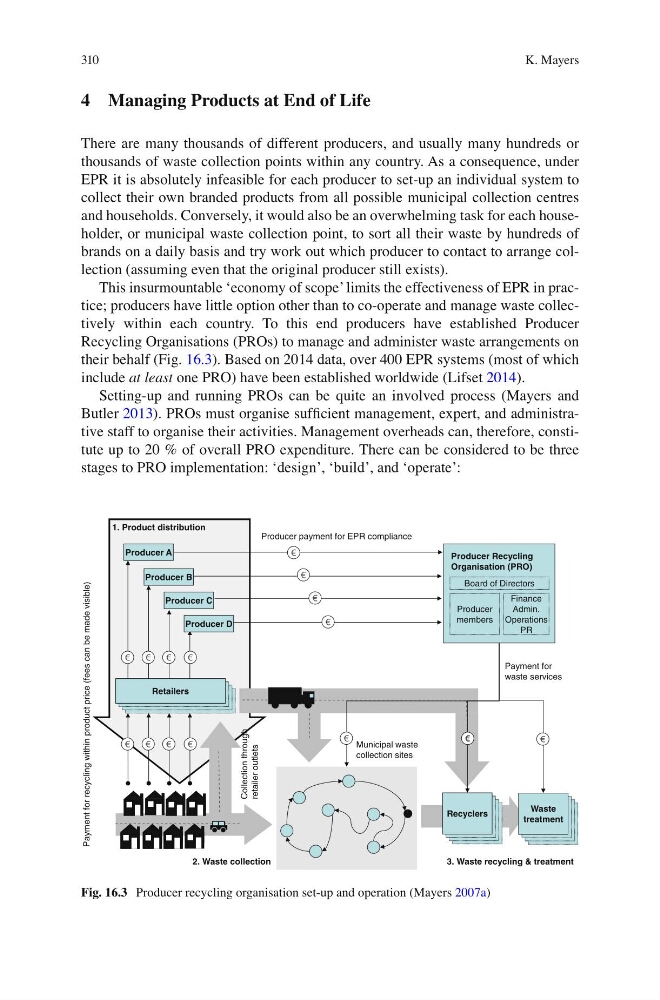
This insurmountable ‘economy of scope’ limits the effectiveness of EPR in practice; producers have little option other than to co-operate and manage waste collectively within each country. To this end producers have established Producer
Recycling Organisations (PROs) to manage and administer waste arrangements on
their behalf (Fig. 16.3 ). Based on 2014 data, over 400 EPR systems (most of which
include at least one PRO ) have been established worldwide (Lifset 2014 ).
Setting-up and running PROs can be quite an involved process (Mayers and
Butler 2013 ). PROs must organise suffi cient management, expert, and administrative staff to organise their activities. Management overheads can, therefore, constitute up to 20 % of overall PRO expenditure. There can be considered to be three
stages to PRO implementation: ‘design’, ‘build’, and ‘operate’:
Recyclers
Waste
treatment
Retailers
Municipal waste
collection sites
Producer A
Producer B
Producer C
Producer D
1. Product distribution
Collection through
retailer outlets
Producer payment for EPR compliance
Payment for
waste services
Payment for recycling within product price (fees can be made visible)
Producer Recycling
Organisation (PRO)
Board of Directors
Producer
members
Finance
Admin.
Operations
PR
2. Waste collection
3. Waste recycling & treatment
Fig. 16.3 Producer recycling organisation set-up and operation (Mayers 2007a )
K. Mayers
4 Managing Products at End of Life
There are many thousands of different producers, and usually many hundreds or
thousands of waste collection points within any country. As a consequence, under
EPR it is absolutely infeasible for each producer to set-up an individual system to
collect their own branded products from all possible municipal collection centres
and households. Conversely, it would also be an overwhelming task for each householder, or municipal waste collection point, to sort all their waste by hundreds of
brands on a daily basis and try work out which producer to contact to arrange collection (assuming even that the original producer still exists).
This insurmountable ‘economy of scope’ limits the effectiveness of EPR in practice; producers have little option other than to co-operate and manage waste collectively within each country. To this end producers have established Producer
Recycling Organisations (PROs) to manage and administer waste arrangements on
their behalf (Fig. 16.3 ). Based on 2014 data, over 400 EPR systems (most of which
include at least one PRO ) have been established worldwide (Lifset 2014 ).
Setting-up and running PROs can be quite an involved process (Mayers and
Butler 2013 ). PROs must organise suffi cient management, expert, and administrative staff to organise their activities. Management overheads can, therefore, constitute up to 20 % of overall PRO expenditure. There can be considered to be three
stages to PRO implementation: ‘design’, ‘build’, and ‘operate’:
Recyclers
Waste
treatment
Retailers
Municipal waste
collection sites
Producer A
Producer B
Producer C
Producer D
1. Product distribution
Collection through
retailer outlets
Producer payment for EPR compliance
Payment for
waste services
Payment for recycling within product price (fees can be made visible)
Producer Recycling
Organisation (PRO)
Board of Directors
Producer
members
Finance
Admin.
Operations
PR
2. Waste collection
3. Waste recycling & treatment
Fig. 16.3 Producer recycling organisation set-up and operation (Mayers 2007a )
K. Mayers