

308
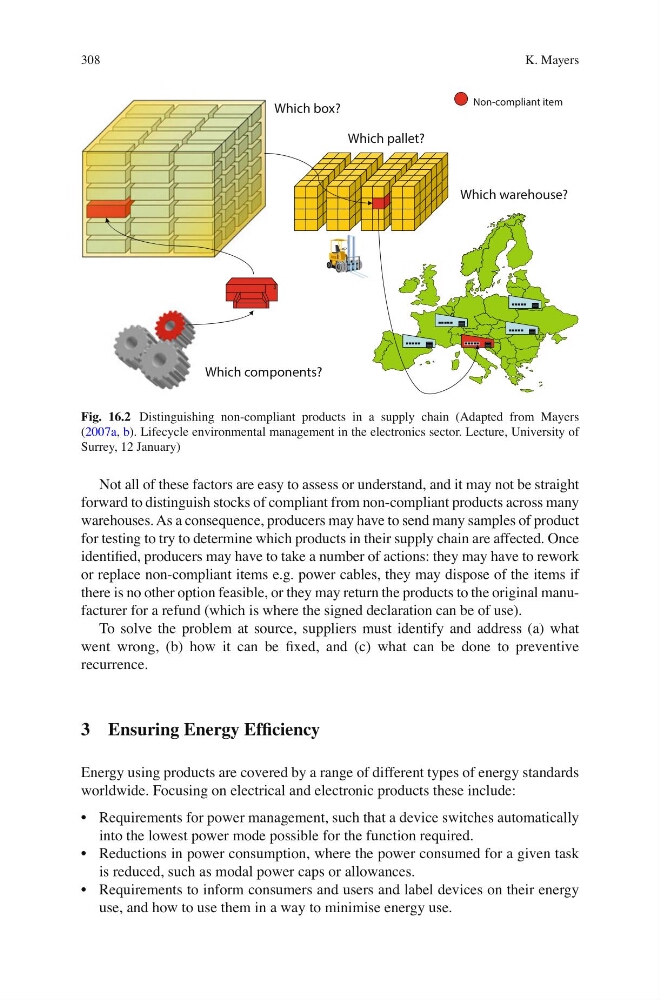
Not all of these factors are easy to assess or understand, and it may not be straight
forward to distinguish stocks of compliant from non-compliant products across many
warehouses. As a consequence, producers may have to send many samples of product
for testing to try to determine which products in their supply chain are affected. Once
identifi ed, producers may have to take a number of actions: they may have to rework
or replace non-compliant items e.g. power cables, they may dispose of the items if
there is no other option feasible, or they may return the products to the original manufacturer for a refund (which is where the signed declaration can be of use).
To solve the problem at source, suppliers must identify and address (a) what
went wrong, (b) how it can be fi xed, and (c) what can be done to preventive
recurrence.
3 Ensuring Energy Effi ciency
Energy using products are covered by a range of different types of energy standards
worldwide. Focusing on electrical and electronic products these include:
• Requirements for power management, such that a device switches automatically
into the lowest power mode possible for the function required.
• Reductions in power consumption, where the power consumed for a given task
is reduced, such as modal power caps or allowances.
• Requirements to inform consumers and users and label devices on their energy
use, and how to use them in a way to minimise energy use.
Which components?
Which box?
Which pallet?
Which warehouse?
Non-compliant item
Fig. 16.2 Distinguishing non-compliant products in a supply chain (Adapted from Mayers
( 2007a , b ). Lifecycle environmental management in the electronics sector. Lecture, University of
Surrey, 12 January)
K. Mayers
Not all of these factors are easy to assess or understand, and it may not be straight
forward to distinguish stocks of compliant from non-compliant products across many
warehouses. As a consequence, producers may have to send many samples of product
for testing to try to determine which products in their supply chain are affected. Once
identifi ed, producers may have to take a number of actions: they may have to rework
or replace non-compliant items e.g. power cables, they may dispose of the items if
there is no other option feasible, or they may return the products to the original manufacturer for a refund (which is where the signed declaration can be of use).
To solve the problem at source, suppliers must identify and address (a) what
went wrong, (b) how it can be fi xed, and (c) what can be done to preventive
recurrence.
3 Ensuring Energy Effi ciency
Energy using products are covered by a range of different types of energy standards
worldwide. Focusing on electrical and electronic products these include:
• Requirements for power management, such that a device switches automatically
into the lowest power mode possible for the function required.
• Reductions in power consumption, where the power consumed for a given task
is reduced, such as modal power caps or allowances.
• Requirements to inform consumers and users and label devices on their energy
use, and how to use them in a way to minimise energy use.
Which components?
Which box?
Which pallet?
Which warehouse?
Non-compliant item
Fig. 16.2 Distinguishing non-compliant products in a supply chain (Adapted from Mayers
( 2007a , b ). Lifecycle environmental management in the electronics sector. Lecture, University of
Surrey, 12 January)
K. Mayers