

283
technology). Target setting for each regional company was a major innovation in the
planning process in Portugal, as in the past the national target did not result in specifi c targets for each of the MSW RMS. The targets for each system were based not
only in their development stage and technology profi les but also on exogenous factors such as population density, in order to ensure proportionality of the effort by
each MSW RMS.
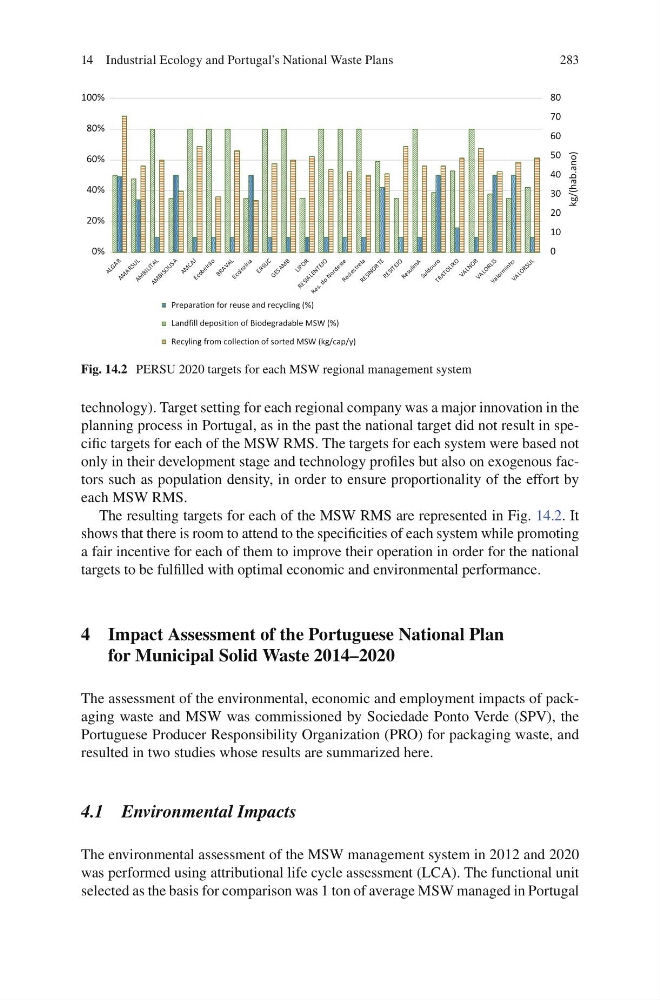
The resulting targets for each of the MSW RMS are represented in Fig. 14.2 . It
shows that there is room to attend to the specifi cities of each system while promoting
a fair incentive for each of them to improve their operation in order for the national
targets to be fulfi lled with optimal economic and environmental performance.
4 Impact Assessment of the Portuguese National Plan
for Municipal Solid Waste 2014–2020
The assessment of the environmental, economic and employment impacts of packaging waste and MSW was commissioned by Sociedade Ponto Verde (SPV), the
Portuguese Producer Responsibility Organization ( PRO ) for packaging waste, and
resulted in two studies whose results are summarized here.
4.1 Environmental Impacts
The environmental assessment of the MSW management system in 2012 and 2020
was performed using attributional life cycle assessment (LCA). The functional unit
selected as the basis for comparison was 1 ton of average MSW managed in Portugal
0
10
20
30
40
50
60
70
80
0%
20%
40%
60%
80%
100%
kg/(hab.ano)
Preparation for reuse and recycling (%)
Landfill deposition of Biodegradable MSW (%)
Recyling from collection of sorted MSW (kg/cap/y)
Fig. 14.2 PERSU 2020 targets for each MSW regional management system
14 Industrial Ecology and Portugal’s National Waste Plans
technology). Target setting for each regional company was a major innovation in the
planning process in Portugal, as in the past the national target did not result in specifi c targets for each of the MSW RMS. The targets for each system were based not
only in their development stage and technology profi les but also on exogenous factors such as population density, in order to ensure proportionality of the effort by
each MSW RMS.
The resulting targets for each of the MSW RMS are represented in Fig. 14.2 . It
shows that there is room to attend to the specifi cities of each system while promoting
a fair incentive for each of them to improve their operation in order for the national
targets to be fulfi lled with optimal economic and environmental performance.
4 Impact Assessment of the Portuguese National Plan
for Municipal Solid Waste 2014–2020
The assessment of the environmental, economic and employment impacts of packaging waste and MSW was commissioned by Sociedade Ponto Verde (SPV), the
Portuguese Producer Responsibility Organization ( PRO ) for packaging waste, and
resulted in two studies whose results are summarized here.
4.1 Environmental Impacts
The environmental assessment of the MSW management system in 2012 and 2020
was performed using attributional life cycle assessment (LCA). The functional unit
selected as the basis for comparison was 1 ton of average MSW managed in Portugal
0
10
20
30
40
50
60
70
80
0%
20%
40%
60%
80%
100%
kg/(hab.ano)
Preparation for reuse and recycling (%)
Landfill deposition of Biodegradable MSW (%)
Recyling from collection of sorted MSW (kg/cap/y)
Fig. 14.2 PERSU 2020 targets for each MSW regional management system
14 Industrial Ecology and Portugal’s National Waste Plans