

269
security, as related to the environmental impacts and reputational threats of raw materials as much as to access. It also made recommendations for how UK policy could
support the development of more circular approaches in pursuit of greater resource
security. The report was well received by Government Ministers and by businesses.
5 Waste Prevention Plans
The Article 29 requirement of the revised EU Waste Framework Directive (2008/98/EC)
that every member state should produce a Waste Prevention Programme by the end of
2013 provided a vehicle for countries that were so minded to produce something close
to circular economy plans. Of the UK’s devolved administrations, the most engagement
has been seen in Scotland and Wales, with Zero Waste initiatives in Scotland developing
rapidly before and during the independence referendum debates in 2014.
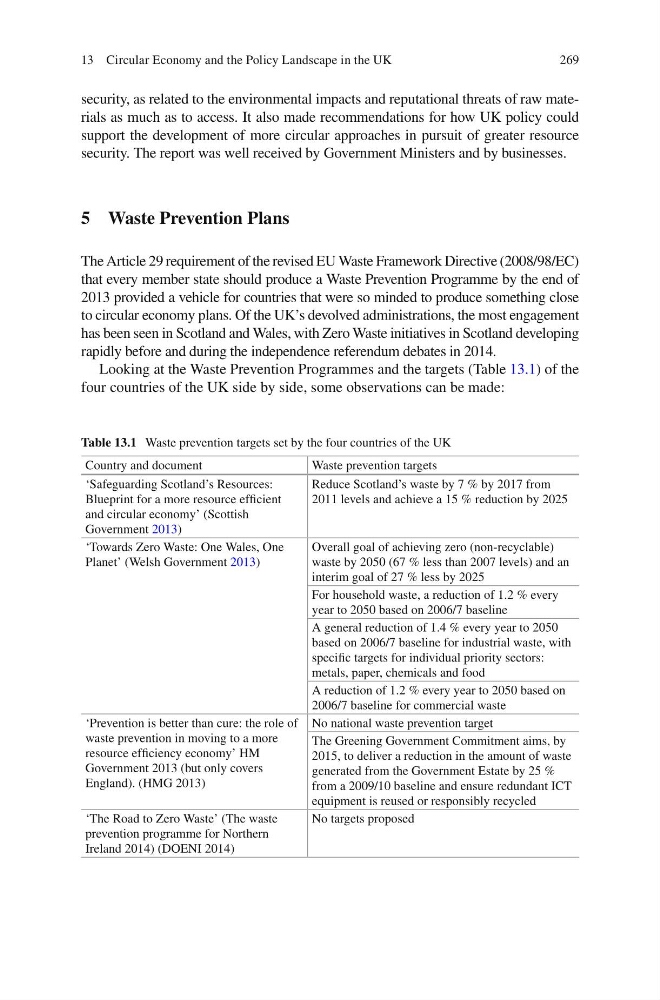
Looking at the Waste Prevention Programmes and the targets (Table 13.1 ) of the
four countries of the UK side by side, some observations can be made:
Table 13.1 Waste prevention targets set by the four countries of the UK
Country and document
Waste prevention targets
‘Safeguarding Scotland’s Resources:
Blueprint for a more resource effi cient
and circular economy’ (Scottish
Government 2013 )
Reduce Scotland’s waste by 7 % by 2017 from
2011 levels and achieve a 15 % reduction by 2025
‘Towards Zero Waste: One Wales, One
Planet’ (Welsh Government 2013 )
Overall goal of achieving zero (non-recyclable)
waste by 2050 (67 % less than 2007 levels) and an
interim goal of 27 % less by 2025
For household waste, a reduction of 1.2 % every
year to 2050 based on 2006/7 baseline
A general reduction of 1.4 % every year to 2050
based on 2006/7 baseline for industrial waste, with
specifi c targets for individual priority sectors:
metals, paper, chemicals and food
A reduction of 1.2 % every year to 2050 based on
2006/7 baseline for commercial waste
‘Prevention is better than cure: the role of
waste prevention in moving to a more
resource effi ciency economy’ HM
Government 2013 (but only covers
England). (HMG 2013)
No national waste prevention target
The Greening Government Commitment aims, by
2015, to deliver a reduction in the amount of waste
generated from the Government Estate by 25 %
from a 2009/10 baseline and ensure redundant ICT
equipment is reused or responsibly recycled
‘The Road to Zero Waste’ (The waste
prevention programme for Northern
Ireland 2014) (DOENI 2014)
No targets proposed
13 Circular Economy and the Policy Landscape in the UK
security, as related to the environmental impacts and reputational threats of raw materials as much as to access. It also made recommendations for how UK policy could
support the development of more circular approaches in pursuit of greater resource
security. The report was well received by Government Ministers and by businesses.
5 Waste Prevention Plans
The Article 29 requirement of the revised EU Waste Framework Directive (2008/98/EC)
that every member state should produce a Waste Prevention Programme by the end of
2013 provided a vehicle for countries that were so minded to produce something close
to circular economy plans. Of the UK’s devolved administrations, the most engagement
has been seen in Scotland and Wales, with Zero Waste initiatives in Scotland developing
rapidly before and during the independence referendum debates in 2014.
Looking at the Waste Prevention Programmes and the targets (Table 13.1 ) of the
four countries of the UK side by side, some observations can be made:
Table 13.1 Waste prevention targets set by the four countries of the UK
Country and document
Waste prevention targets
‘Safeguarding Scotland’s Resources:
Blueprint for a more resource effi cient
and circular economy’ (Scottish
Government 2013 )
Reduce Scotland’s waste by 7 % by 2017 from
2011 levels and achieve a 15 % reduction by 2025
‘Towards Zero Waste: One Wales, One
Planet’ (Welsh Government 2013 )
Overall goal of achieving zero (non-recyclable)
waste by 2050 (67 % less than 2007 levels) and an
interim goal of 27 % less by 2025
For household waste, a reduction of 1.2 % every
year to 2050 based on 2006/7 baseline
A general reduction of 1.4 % every year to 2050
based on 2006/7 baseline for industrial waste, with
specifi c targets for individual priority sectors:
metals, paper, chemicals and food
A reduction of 1.2 % every year to 2050 based on
2006/7 baseline for commercial waste
‘Prevention is better than cure: the role of
waste prevention in moving to a more
resource effi ciency economy’ HM
Government 2013 (but only covers
England). (HMG 2013)
No national waste prevention target
The Greening Government Commitment aims, by
2015, to deliver a reduction in the amount of waste
generated from the Government Estate by 25 %
from a 2009/10 baseline and ensure redundant ICT
equipment is reused or responsibly recycled
‘The Road to Zero Waste’ (The waste
prevention programme for Northern
Ireland 2014) (DOENI 2014)
No targets proposed
13 Circular Economy and the Policy Landscape in the UK