

184
While many studies explore the carbon emissions embedded in trade,
4 some studies focus specifi cally on the role of imported goods and services and their associated
emissions in the carbon footprints of households
5 (Hertwich and Peters 2009 ; Lenzen
et al. 2006 ; Munksgaard et al. 2005 ; Nijdam et al. 2005 ; Peters and Hertwich 2006b ).
Peters and Hertwich ( 2006a ) put forward a general rule that countries with a high
proportion of imports and relatively clean electricity generation are likely to have a
signifi cant proportion of their household carbon emissions attributed to imports.
This means that, due to the supply chain emissions embedded in imported goods,
households drive emissions in other countries as well as in their own country. For
example, Weber and Mathews ( 2008 ) found that nearly 30 % of the carbon dioxide
emitted to meet household demand in the US occurred outside the borders of the US.
Accounting according to the consumption perspective is commonly known as
‘footprinting’: this is the approach adopted in this chapter, and in particular the
chapter is concerned with carbon footprinting. However, the defi nition of what is
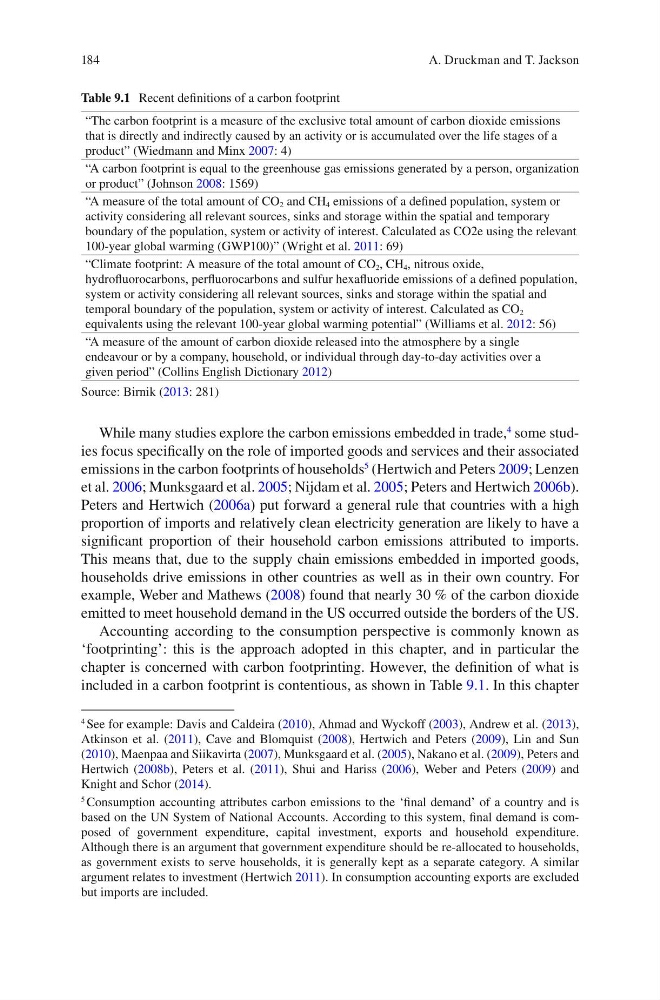
included in a carbon footprint is contentious, as shown in Table 9.1 . In this chapter
4 See for example: Davis and Caldeira ( 2010 ), Ahmad and Wyckoff ( 2003 ), Andrew et al. ( 2013 ),
Atkinson et al. ( 2011 ), Cave and Blomquist ( 2008 ), Hertwich and Peters ( 2009 ), Lin and Sun
( 2010 ), Maenpaa and Siikavirta ( 2007 ), Munksgaard et al. ( 2005 ), Nakano et al. ( 2009 ), Peters and
Hertwich ( 2008b ), Peters et al. ( 2011 ), Shui and Hariss ( 2006 ), Weber and Peters ( 2009 ) and
Knight and Schor ( 2014 ).
5 Consumption accounting attributes carbon emissions to the ‘fi nal demand’ of a country and is
based on the UN System of National Accounts. According to this system, fi nal demand is composed of government expenditure, capital investment, exports and household expenditure.
Although there is an argument that government expenditure should be re-allocated to households,
as government exists to serve households, it is generally kept as a separate category. A similar
argument relates to investment (Hertwich 2011 ). In consumption accounting exports are excluded
but imports are included.
Table 9.1 Recent defi nitions of a carbon footprint
“The carbon footprint is a measure of the exclusive total amount of carbon dioxide emissions
that is directly and indirectly caused by an activity or is accumulated over the life stages of a
product” (Wiedmann and Minx 2007 : 4)
“A carbon footprint is equal to the greenhouse gas emissions generated by a person, organization
or product” (Johnson 2008 : 1569)
“A measure of the total amount of CO 2 and CH 4 emissions of a defi ned population, system or
activity considering all relevant sources, sinks and storage within the spatial and temporary
boundary of the population, system or activity of interest. Calculated as CO2e using the relevant
100-year global warming (GWP100)” (Wright et al. 2011 : 69)
“Climate footprint: A measure of the total amount of CO 2 , CH 4 , nitrous oxide,
hydrofl uorocarbons, perfl uorocarbons and sulfur hexafl uoride emissions of a defi ned population,
system or activity considering all relevant sources, sinks and storage within the spatial and
temporal boundary of the population, system or activity of interest. Calculated as CO 2
equivalents using the relevant 100-year global warming potential” (Williams et al. 2012 : 56)
“A measure of the amount of carbon dioxide released into the atmosphere by a single
endeavour or by a company, household, or individual through day-to-day activities over a
given period” (Collins English Dictionary 2012 )
Source: Birnik ( 2013 : 281)
A. Druckman and T. Jackson
While many studies explore the carbon emissions embedded in trade,
4 some studies focus specifi cally on the role of imported goods and services and their associated
emissions in the carbon footprints of households
5 (Hertwich and Peters 2009 ; Lenzen
et al. 2006 ; Munksgaard et al. 2005 ; Nijdam et al. 2005 ; Peters and Hertwich 2006b ).
Peters and Hertwich ( 2006a ) put forward a general rule that countries with a high
proportion of imports and relatively clean electricity generation are likely to have a
signifi cant proportion of their household carbon emissions attributed to imports.
This means that, due to the supply chain emissions embedded in imported goods,
households drive emissions in other countries as well as in their own country. For
example, Weber and Mathews ( 2008 ) found that nearly 30 % of the carbon dioxide
emitted to meet household demand in the US occurred outside the borders of the US.
Accounting according to the consumption perspective is commonly known as
‘footprinting’: this is the approach adopted in this chapter, and in particular the
chapter is concerned with carbon footprinting. However, the defi nition of what is
included in a carbon footprint is contentious, as shown in Table 9.1 . In this chapter
4 See for example: Davis and Caldeira ( 2010 ), Ahmad and Wyckoff ( 2003 ), Andrew et al. ( 2013 ),
Atkinson et al. ( 2011 ), Cave and Blomquist ( 2008 ), Hertwich and Peters ( 2009 ), Lin and Sun
( 2010 ), Maenpaa and Siikavirta ( 2007 ), Munksgaard et al. ( 2005 ), Nakano et al. ( 2009 ), Peters and
Hertwich ( 2008b ), Peters et al. ( 2011 ), Shui and Hariss ( 2006 ), Weber and Peters ( 2009 ) and
Knight and Schor ( 2014 ).
5 Consumption accounting attributes carbon emissions to the ‘fi nal demand’ of a country and is
based on the UN System of National Accounts. According to this system, fi nal demand is composed of government expenditure, capital investment, exports and household expenditure.
Although there is an argument that government expenditure should be re-allocated to households,
as government exists to serve households, it is generally kept as a separate category. A similar
argument relates to investment (Hertwich 2011 ). In consumption accounting exports are excluded
but imports are included.
Table 9.1 Recent defi nitions of a carbon footprint
“The carbon footprint is a measure of the exclusive total amount of carbon dioxide emissions
that is directly and indirectly caused by an activity or is accumulated over the life stages of a
product” (Wiedmann and Minx 2007 : 4)
“A carbon footprint is equal to the greenhouse gas emissions generated by a person, organization
or product” (Johnson 2008 : 1569)
“A measure of the total amount of CO 2 and CH 4 emissions of a defi ned population, system or
activity considering all relevant sources, sinks and storage within the spatial and temporary
boundary of the population, system or activity of interest. Calculated as CO2e using the relevant
100-year global warming (GWP100)” (Wright et al. 2011 : 69)
“Climate footprint: A measure of the total amount of CO 2 , CH 4 , nitrous oxide,
hydrofl uorocarbons, perfl uorocarbons and sulfur hexafl uoride emissions of a defi ned population,
system or activity considering all relevant sources, sinks and storage within the spatial and
temporal boundary of the population, system or activity of interest. Calculated as CO 2
equivalents using the relevant 100-year global warming potential” (Williams et al. 2012 : 56)
“A measure of the amount of carbon dioxide released into the atmosphere by a single
endeavour or by a company, household, or individual through day-to-day activities over a
given period” (Collins English Dictionary 2012 )
Source: Birnik ( 2013 : 281)
A. Druckman and T. Jackson