

163
these supply chain impacts are said to be ‘embodied’ in the product, even if there is
no direct physical connection. This may be exemplifi ed best in the context of water
use, where the term ‘virtual’ has been used widely (e.g. Chen and Chen 2013 ; Dalin
et al. 2012 ; Orlowsky et al. 2014 ). The virtual water is not actually physically
embodied in a traded product – yet the term ‘embodied’ is widely used in the literature to describe indirect impacts. Another expression introduced by Lenzen et al.
2012 is the word ‘implicated’ which was used by the authors to indicate a connection between consumption in one country and threat to species in other countries,
even though it would be diffi cult to prove a direct causal relationship between the
two (a point also made with respect to CO 2 emissions embodied in trade, see Jakob
and Marschinski 2013 ). The term ‘implicated’ is again used in Alsamawi et al.
2014b to indicate the inequality associated with the trade of commodities between
nations.
As an overarching model of evaluating the embodied impacts of consumption,
the concept of environmental footprints has been used widely (Hoekstra and
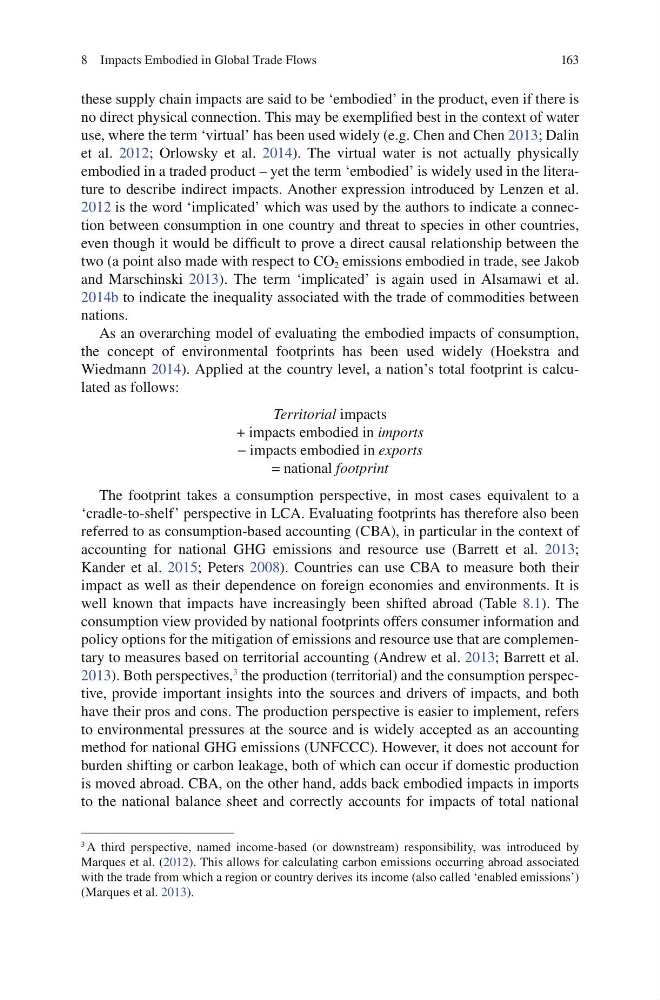
Wiedmann 2014 ). Applied at the country level, a nation’s total footprint is calculated as follows:
Territorial impacts
+ impacts embodied in imports
− impacts embodied in exports
= national footprint
The footprint takes a consumption perspective, in most cases equivalent to a
‘cradle-to-shelf’ perspective in LCA. Evaluating footprints has therefore also been
referred to as consumption-based accounting (CBA), in particular in the context of
accounting for national GHG emissions and resource use (Barrett et al. 2013 ;
Kander et al. 2015 ; Peters 2008 ). Countries can use CBA to measure both their
impact as well as their dependence on foreign economies and environments. It is
well known that impacts have increasingly been shifted abroad (Table 8.1 ). The
consumption view provided by national footprints offers consumer information and
policy options for the mitigation of emissions and resource use that are complementary to measures based on territorial accounting (Andrew et al. 2013 ; Barrett et al.
2013 ). Both perspectives,
3 the production (territorial) and the consumption perspective, provide important insights into the sources and drivers of impacts, and both
have their pros and cons. The production perspective is easier to implement, refers
to environmental pressures at the source and is widely accepted as an accounting
method for national GHG emissions (UNFCCC). However, it does not account for
burden shifting or carbon leakage, both of which can occur if domestic production
is moved abroad. CBA, on the other hand, adds back embodied impacts in imports
to the national balance sheet and correctly accounts for impacts of total national
3 A third perspective, named income-based (or downstream) responsibility, was introduced by
Marques et al. ( 2012 ). This allows for calculating carbon emissions occurring abroad associated
with the trade from which a region or country derives its income (also called ‘enabled emissions’)
(Marques et al. 2013 ).
8 Impacts Embodied in Global Trade Flows
these supply chain impacts are said to be ‘embodied’ in the product, even if there is
no direct physical connection. This may be exemplifi ed best in the context of water
use, where the term ‘virtual’ has been used widely (e.g. Chen and Chen 2013 ; Dalin
et al. 2012 ; Orlowsky et al. 2014 ). The virtual water is not actually physically
embodied in a traded product – yet the term ‘embodied’ is widely used in the literature to describe indirect impacts. Another expression introduced by Lenzen et al.
2012 is the word ‘implicated’ which was used by the authors to indicate a connection between consumption in one country and threat to species in other countries,
even though it would be diffi cult to prove a direct causal relationship between the
two (a point also made with respect to CO 2 emissions embodied in trade, see Jakob
and Marschinski 2013 ). The term ‘implicated’ is again used in Alsamawi et al.
2014b to indicate the inequality associated with the trade of commodities between
nations.
As an overarching model of evaluating the embodied impacts of consumption,
the concept of environmental footprints has been used widely (Hoekstra and
Wiedmann 2014 ). Applied at the country level, a nation’s total footprint is calculated as follows:
Territorial impacts
+ impacts embodied in imports
− impacts embodied in exports
= national footprint
The footprint takes a consumption perspective, in most cases equivalent to a
‘cradle-to-shelf’ perspective in LCA. Evaluating footprints has therefore also been
referred to as consumption-based accounting (CBA), in particular in the context of
accounting for national GHG emissions and resource use (Barrett et al. 2013 ;
Kander et al. 2015 ; Peters 2008 ). Countries can use CBA to measure both their
impact as well as their dependence on foreign economies and environments. It is
well known that impacts have increasingly been shifted abroad (Table 8.1 ). The
consumption view provided by national footprints offers consumer information and
policy options for the mitigation of emissions and resource use that are complementary to measures based on territorial accounting (Andrew et al. 2013 ; Barrett et al.
2013 ). Both perspectives,
3 the production (territorial) and the consumption perspective, provide important insights into the sources and drivers of impacts, and both
have their pros and cons. The production perspective is easier to implement, refers
to environmental pressures at the source and is widely accepted as an accounting
method for national GHG emissions (UNFCCC). However, it does not account for
burden shifting or carbon leakage, both of which can occur if domestic production
is moved abroad. CBA, on the other hand, adds back embodied impacts in imports
to the national balance sheet and correctly accounts for impacts of total national
3 A third perspective, named income-based (or downstream) responsibility, was introduced by
Marques et al. ( 2012 ). This allows for calculating carbon emissions occurring abroad associated
with the trade from which a region or country derives its income (also called ‘enabled emissions’)
(Marques et al. 2013 ).
8 Impacts Embodied in Global Trade Flows