

152
Labour-inout per weight (mh/kh)
Value per weight (€/kg)
€/kg
1
100
mio
1
10
high
mh/kg
high
Stone age goods industrial goods smart goods
Life sciences
nanotech
reuse
Selling performance
remanufacturing
low
low
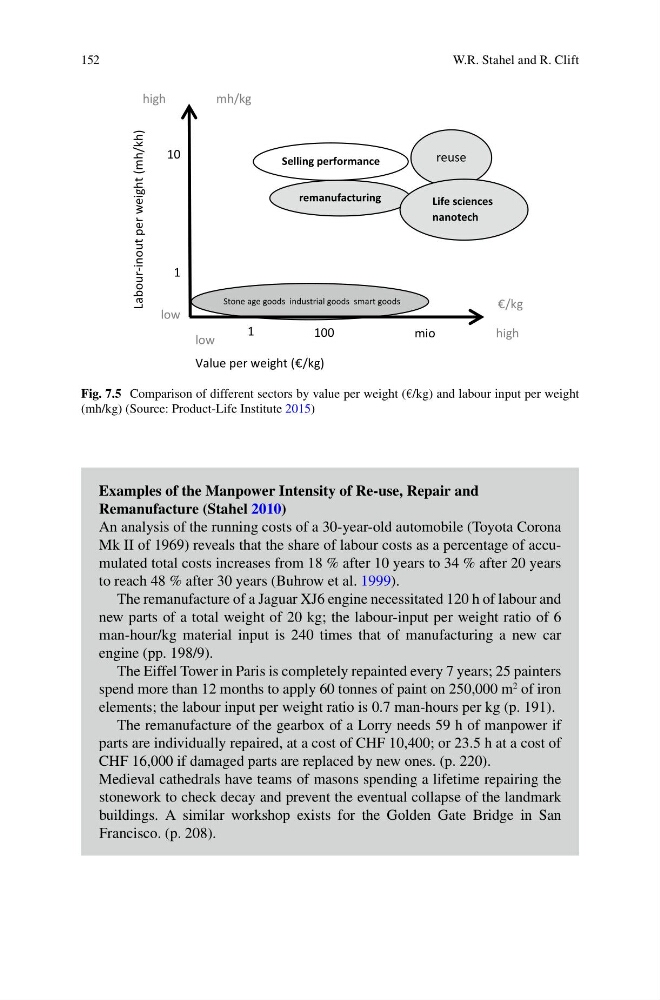
Fig. 7.5 Comparison of different sectors by value per weight (€/kg) and labour input per weight
(mh/kg) (Source: Product-Life Institute 2015)
Examples of the Manpower Intensity of Re-use, Repair and
Remanufacture (Stahel 2010)
An analysis of the running costs of a 30-year-old automobile (Toyota Corona
Mk II of 1969) reveals that the share of labour costs as a percentage of accumulated total costs increases from 18 % after 10 years to 34 % after 20 years
to reach 48 % after 30 years (Buhrow et al. 1999).
The remanufacture of a Jaguar XJ6 engine necessitated 120 h of labour and
new parts of a total weight of 20 kg; the labour-input per weight ratio of 6
man-hour/kg material input is 240 times that of manufacturing a new car
engine (pp. 198/9).
The Eiffel Tower in Paris is completely repainted every 7 years; 25 painters
spend more than 12 months to apply 60 tonnes of paint on 250,000 m
2
of iron
elements; the labour input per weight ratio is 0.7 man-hours per kg (p. 191).
The remanufacture of the gearbox of a Lorry needs 59 h of manpower if
parts are individually repaired, at a cost of CHF 10,400; or 23.5 h at a cost of
CHF 16,000 if damaged parts are replaced by new ones. (p. 220).
Medieval cathedrals have teams of masons spending a lifetime repairing the
stonework to check decay and prevent the eventual collapse of the landmark
buildings. A similar workshop exists for the Golden Gate Bridge in San
Francisco. (p. 208).
W.R. Stahel and R. Clift
Labour-inout per weight (mh/kh)
Value per weight (€/kg)
€/kg
1
100
mio
1
10
high
mh/kg
high
Stone age goods industrial goods smart goods
Life sciences
nanotech
reuse
Selling performance
remanufacturing
low
low
Fig. 7.5 Comparison of different sectors by value per weight (€/kg) and labour input per weight
(mh/kg) (Source: Product-Life Institute 2015)
Examples of the Manpower Intensity of Re-use, Repair and
Remanufacture (Stahel 2010)
An analysis of the running costs of a 30-year-old automobile (Toyota Corona
Mk II of 1969) reveals that the share of labour costs as a percentage of accumulated total costs increases from 18 % after 10 years to 34 % after 20 years
to reach 48 % after 30 years (Buhrow et al. 1999).
The remanufacture of a Jaguar XJ6 engine necessitated 120 h of labour and
new parts of a total weight of 20 kg; the labour-input per weight ratio of 6
man-hour/kg material input is 240 times that of manufacturing a new car
engine (pp. 198/9).
The Eiffel Tower in Paris is completely repainted every 7 years; 25 painters
spend more than 12 months to apply 60 tonnes of paint on 250,000 m
2
of iron
elements; the labour input per weight ratio is 0.7 man-hours per kg (p. 191).
The remanufacture of the gearbox of a Lorry needs 59 h of manpower if
parts are individually repaired, at a cost of CHF 10,400; or 23.5 h at a cost of
CHF 16,000 if damaged parts are replaced by new ones. (p. 220).
Medieval cathedrals have teams of masons spending a lifetime repairing the
stonework to check decay and prevent the eventual collapse of the landmark
buildings. A similar workshop exists for the Golden Gate Bridge in San
Francisco. (p. 208).
W.R. Stahel and R. Clift